
Why short-drama translation needs series context
A line can be grammatically correct and still be wrong for the character, scene, or next episode.
Read the page ->Weydub Insights / Articles
Practical articles on short-drama localization, subtitles, dubbing, Studio production, quality, and delivery.
A line can be grammatically correct and still be wrong for the character, scene, or next episode.
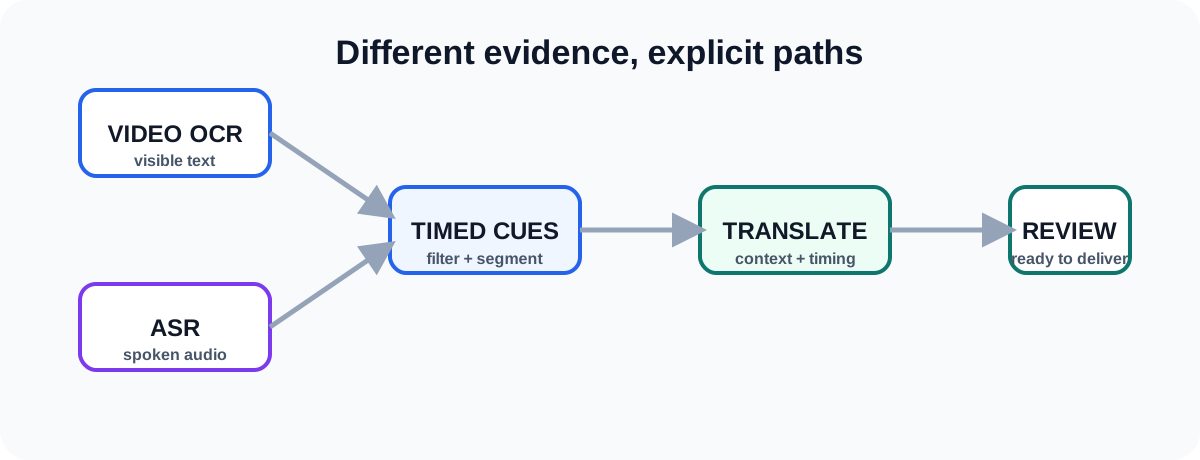
Read the page ->On-screen text and spoken dialogue require different evidence, correction, and timing paths.
Read the page ->Recurring series work needs shared assets, task state, review, and delivery relationships.
Read the page ->The answer depends on audience, channel, rights, budget, and the speed of learning you need.
Read the page ->Review effort should follow production risk: source, language, picture, audio, and delivery do not fail in the same way.
Read the page ->A playable file is only one part of a channel-ready localized release.
Read the page ->Short-drama globalization starts with a content decision: adapt an existing story, remake it for a market, or produce locally from the beginning.
Read the page ->Population alone is a weak market filter. Language fit, channel access, rights, audience behavior, and localization depth matter together.
Read the page ->Ad revenue, memberships, licensing, sponsorship, and channel economics should be evaluated as a system rather than a single platform percentage.
Read the page ->Subtitles and dubbing change audience access, production depth, review load, and release speed in different ways.
Read the page ->Lower generation cost does not make every language version a separate creative production decision.
Read the page ->As candidate content becomes faster and cheaper to produce, selection, rights, localization, review, and distribution become larger parts of the operating problem.
Read the page ->Models may automate more transformations, but series context, rights, review, channel delivery, and audience fit remain production responsibilities.
Read the page ->TikTok can support rapid content testing and discovery, while YouTube often favors channels, libraries, search, and longer viewing paths.
Read the page ->Meta surfaces can play different roles in discovery, community, sharing, and return visits; opening every account at once is not a strategy.
Read the page ->App stores, paid acquisition, creators, affiliates, and local partners buy different kinds of reach and control.
Read the page ->Short episodes lower the commitment to start watching, but the story still needs enough time for conflict, change, and a reason to continue.
Read the page ->A long series made of short episodes creates a different relationship between story structure, release cadence, and monetization.
Read the page ->Short-drama momentum comes from connected story decisions, not from adding a random twist every few seconds.
Read the page ->A useful estimate separates development, production, post, rights, localization, distribution, and contingency instead of using one per-episode number.
Read the page ->In-app purchases, advertising, subscriptions, licensing, and platform partnerships recover content through different user and rights relationships.
Read the page ->Downloads, viewing, revenue, production volume, and app activity are different measures and should not be blended into one headline.
Read the page ->The same short drama can be packaged for an owned app, a channel, or a licensing partner, but the control and economics differ.
Read the page ->A title can create value through different territories, languages, windows, channels, formats, and partner relationships when the rights permit it.
Read the page ->Where a series will be watched affects the rights scope, package, language depth, review bar, and investment the project can justify.
Read the page ->The useful unit is the path from acquisition to activation, viewing, payment or ad recovery, and retention.
Read the page ->The useful distinction is how the picture, performance, and reusable assets are produced, not whether a project used AI somewhere in the pipeline.
Read the page ->The first language should follow the intended audience, creative team, rights, and master-production plan rather than a default assumption about origin.
Read the page ->A series needs stable identity across faces, costumes, roles, scenes, text, and voice even when each frame can be generated independently.
Read the page ->Training, source materials, likeness, voice, generated outputs, adaptation, territories, and channel use can create different rights questions.
Read the page ->Stabilize the source story and assets before creating language versions, then track every derived output and exception.
Read the page ->A label describes a role in a project, not necessarily a permanent company identity.
Read the page ->The difference is usually in control, rights scope, operating responsibility, and how the partner is paid and reported.
Read the page ->Count the decisions and quality gates before counting job titles.
Read the page ->Operating an account, distributing a title, and owning the underlying rights are separate responsibilities that can be combined or split.
Read the page ->The right partner depends on the capability missing from the project, not only on a promise of reach.
Read the page ->Rights, source materials, and localization readiness are separate parts of a delivery, and a contract does not guarantee that every clean asset is in the folder.
Read the page ->Large episode batches, partner boundaries, and familiar sharing habits can make a cloud drive an intake point, but it should not become the production system.
Read the page ->The title, audience, rights, source condition, and channel determine whether localization effort can be recovered.
Read the page ->Start with the market and channel, then test story, source and rights, and finally decide how much to produce.
Read the page ->A short intake review can prevent a full batch from being built on the wrong master, missing audio, or incomplete episode set.
Read the page ->A file shows a piece of picture; a series model preserves the relationships that make language production repeatable.
Read the page ->High publishing speed increases the cost of repeating a terminology or role decision in every episode.
Read the page ->Clear names and version relationships reduce duplicate processing, missing episodes, and wrong-language delivery.
Read the page ->Batch scale needs representative tests, failure isolation, context reuse, and review gates before a full queue is released.
Read the page ->A useful cost record explains what was produced, for whom, with which source, and why it had to be repeated.
Read the page ->Hard subtitles, clean dialogue, and missing source text create different evidence paths, so OCR and ASR should not be treated as the same operation.
Read the page ->A release can fail in source, language, picture, audio, timing, version, or delivery even when one subtitle sample reads well.
Read the page ->The first problems usually appear when a shared master, language output, channel package, and later correction are recorded as unrelated files.
Read the page ->Review in layers so source, language, picture, audio, and delivery defects are visible and routed to the right owner.
Read the page ->Random samples can miss the scenes and languages most likely to fail; risk-based sampling puts review effort where it changes the release decision.
Read the page ->A shared identity or terminology decision can affect subtitles, scripts, voice direction, metadata, and downstream language versions.
Read the page ->Different on-screen text has different timing, position, and risk, so a region policy can protect the picture better than a default full-screen operation.
Read the page ->Fluent individual lines can still lose role, relationship, terminology, plot, or performance when the series context is missing.
Read the page ->Voice emotion, line length, pause placement, speech rate, timing, and sound mix are separate dimensions of audiovisual reconstruction.
Read the page ->Names, titles, organizations, world-building terms, and recurring phrases need an explicit policy before a series is translated at speed.
Read the page ->Music, effects, dialogue, territory, and platform matching create a rights and audio problem that localization alone cannot solve.
Read the page ->A compilation changes the viewing path, cumulative timeline, subtitle timing, metadata, and rights review of the series.
Read the page ->Titles, thumbnails, covers, descriptions, and the first scene connect discovery to the content promise on every channel.
Read the page ->A release package should make the target version usable without forcing the receiving team to reconstruct the project history.
Read the page ->A YouTube release needs content versions, rights, metadata, packaging, and a publishing sequence that matches the channel's job.
Read the page ->Tool pages answer isolated questions; a connected graph preserves the relationships between rights, markets, assets, language, quality, and delivery.
Read the page ->Lower model cost can reduce one line item while increasing the number of versions, candidates, reviews, and delivery paths a team must manage.
Read the page ->Automation is valuable for repeatable actions, but a release still needs context, rights, exception handling, review, and acceptance.
Read the page ->A library needs asset lineage, rights and window tracking, reusable language context, version control, and data that feeds the next content decision.
Read the page ->A convincing voice can amplify a strong line and a weak one, so role, meaning, timing, and performance intent must be settled before voice production.
Read the page ->A rights purchase should define territory, language, channel, term, permitted adaptations, source materials, and exit responsibilities before localization starts.
Read the page ->An API integration should model asynchronous work and review state instead of treating a request response as the final release.
Read the page ->Batch OCR needs representative region selection, temporal grouping, scene filtering, correction, and cross-episode review.
Read the page ->Speech recognition can restore a timed source track when the picture is clean but the original subtitle or script is missing.
Read the page ->Recognition quality depends on resolution, compression, font, contrast, region, motion, and whether the text is dialogue or scene text.
Read the page ->Noise, music, accents, overlapping speakers, low volume, segmentation, and missing terms can all produce different subtitle defects.
Read the page ->A subtitle can contain the right words and still fail because it arrives late, leaves too soon, breaks the wrong phrase, or is too dense to read.
Read the page ->Different text systems should be identified by region and behavior before a repair workflow is selected.
Read the page ->Foreground subjects and fine motion leave less visual evidence for restoration, so they need targeted regions and closer review.
Read the page ->If the story, character, and picture are correct, a targeted text or localization repair may be safer than regenerating a shot and introducing new visual changes.
Read the page ->Role labels support translation, dubbing, review, and version consistency when the same person appears under different names or forms of address.
Read the page ->Visual similarity is only one signal of identity; costume, role, action, dialogue, and episode context also matter.
Read the page ->A translated line must preserve meaning while fitting the audience's reading time, screen space, and channel expectations.
Read the page ->A dubbing line must be natural in the target language, fit the scene, and leave room for the intended voice performance.
Read the page ->A voice can be aligned to the scene while the mouth movement remains different; these are related but separate acceptance requirements.
Read the page ->The content video is only one part of an app release: store, interface, metadata, payment, support, and promotional assets also need a language plan.
Read the page ->A recap is an editorial version that combines story selection, script, narration, clips, subtitles, music, and rights.
Read the page ->One full episode can be useful, but a small set of deliberately chosen scenes often reveals more production risk before a batch decision.
Read the page ->Use AI for repeatable drafting and transformation while placing human judgment at context, risk, and acceptance decisions.
Read the page ->AI can prepare source, translation, timing, and candidate voice work while human performers and directors handle the parts that need interpretation and performance.
Read the page ->Source rights, retention, access, deletion, model-use policy, export, and account controls matter before a commercial asset enters a processing service.
Read the page ->Spanish localization needs an explicit audience and regional choice before translation, subtitles, metadata, and dubbing are reviewed.
Read the page ->Brazilian Portuguese localization requires locale-specific voice, forms of address, subtitle density, and platform packaging decisions.
Read the page ->Thai localization needs deliberate choices about politeness, address, gendered language, subtitle density, and spoken performance.
Read the page ->Indonesian localization depends on natural spoken language, forms of address, subtitle length, and a clear audience and channel brief.
Read the page ->Arabic localization requires a decision about Modern Standard Arabic or a regional variety, along with script, layout, voice, and audience context.
Read the page ->Japanese localization depends on relationship, honorific, register, subtitle compression, and character voice across the series.
Read the page ->Korean localization needs consistent speech levels, relationship context, names, subtitles, and voice direction across episodes.
Read the page ->Vietnamese localization makes forms of address and relationship context central to subtitle and dubbing quality.
Read the page ->French localization needs choices about spoken register, gendered language, names, subtitle compression, and the intended market.
Read the page ->German localization must balance sentence structure, register, terminology, subtitle space, and dubbing duration without flattening character voice.
Read the page ->Turkish localization needs attention to word order, forms of address, emotional register, subtitle length, and spoken performance.
Read the page ->