
Business models
How do short dramas make money?
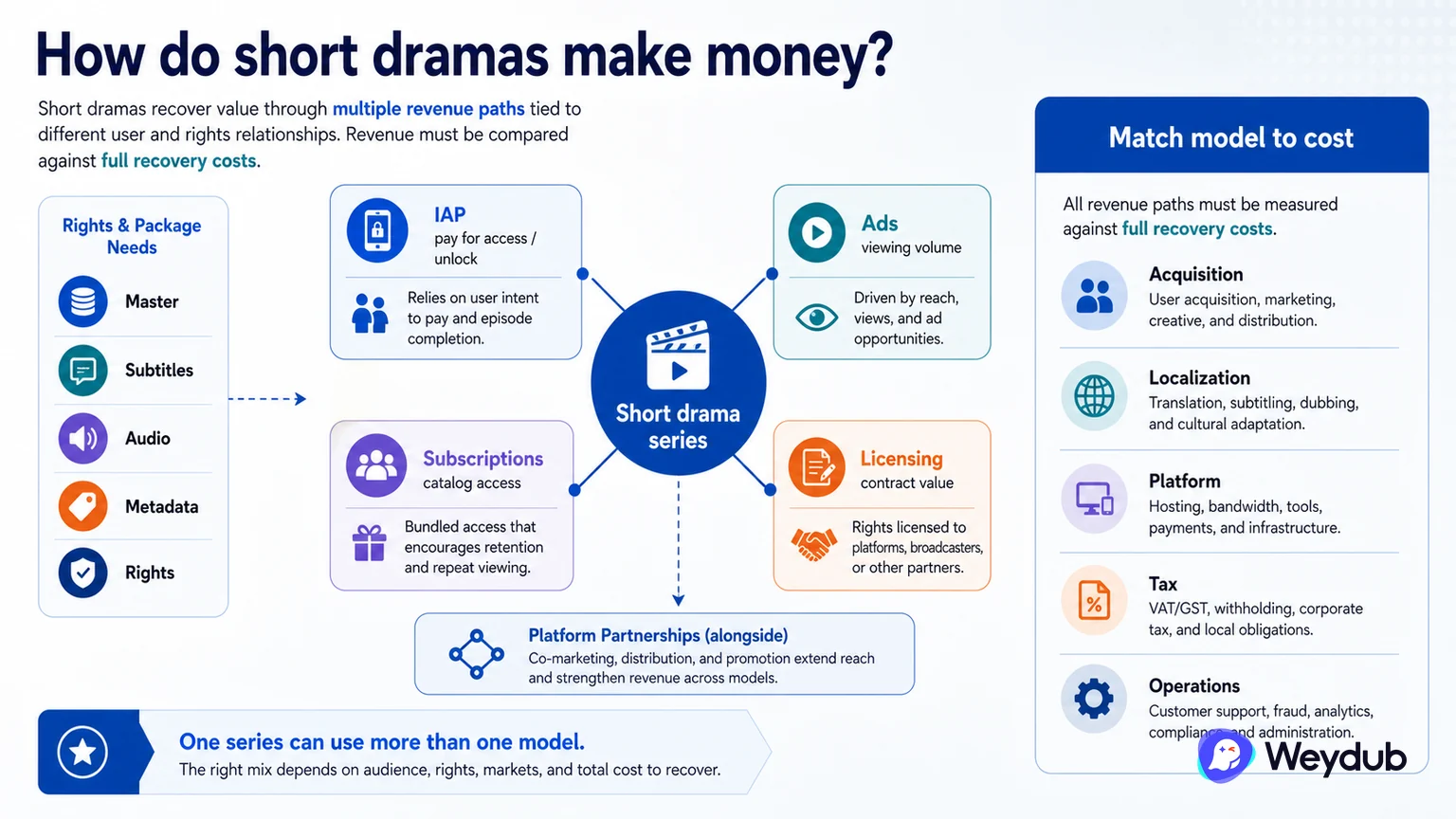
In-app purchases, advertising, subscriptions, licensing, and platform partnerships recover content through different user and rights relationships.
Key conclusions
- Separate content revenue, product revenue, advertising recovery, and rights income.
- Model acquisition, localization, platform, tax, and operating costs around the revenue path.
- The same series can use more than one model when rights and product logic allow it.
IAP asks a viewer to pay for access or progression. IAA recovers through advertising and depends on viewing volume, session behavior, and ad yield. Subscriptions bundle access across a catalog. Licensing and distribution settle value through contracts rather than only through an owned product funnel.
These models change the production choice. A paid app may prioritize a strong first episode and a clear unlock point. An ad-supported channel may prioritize repeat sessions and a large accessible library. A license buyer may require a specific master, subtitle, audio, metadata, and rights package.
Revenue should be compared with the full cost of recovery. A high top-line number does not show whether a version paid for acquisition, localization, support, platform fees, or future rework.
Ask who pays before asking where views come from
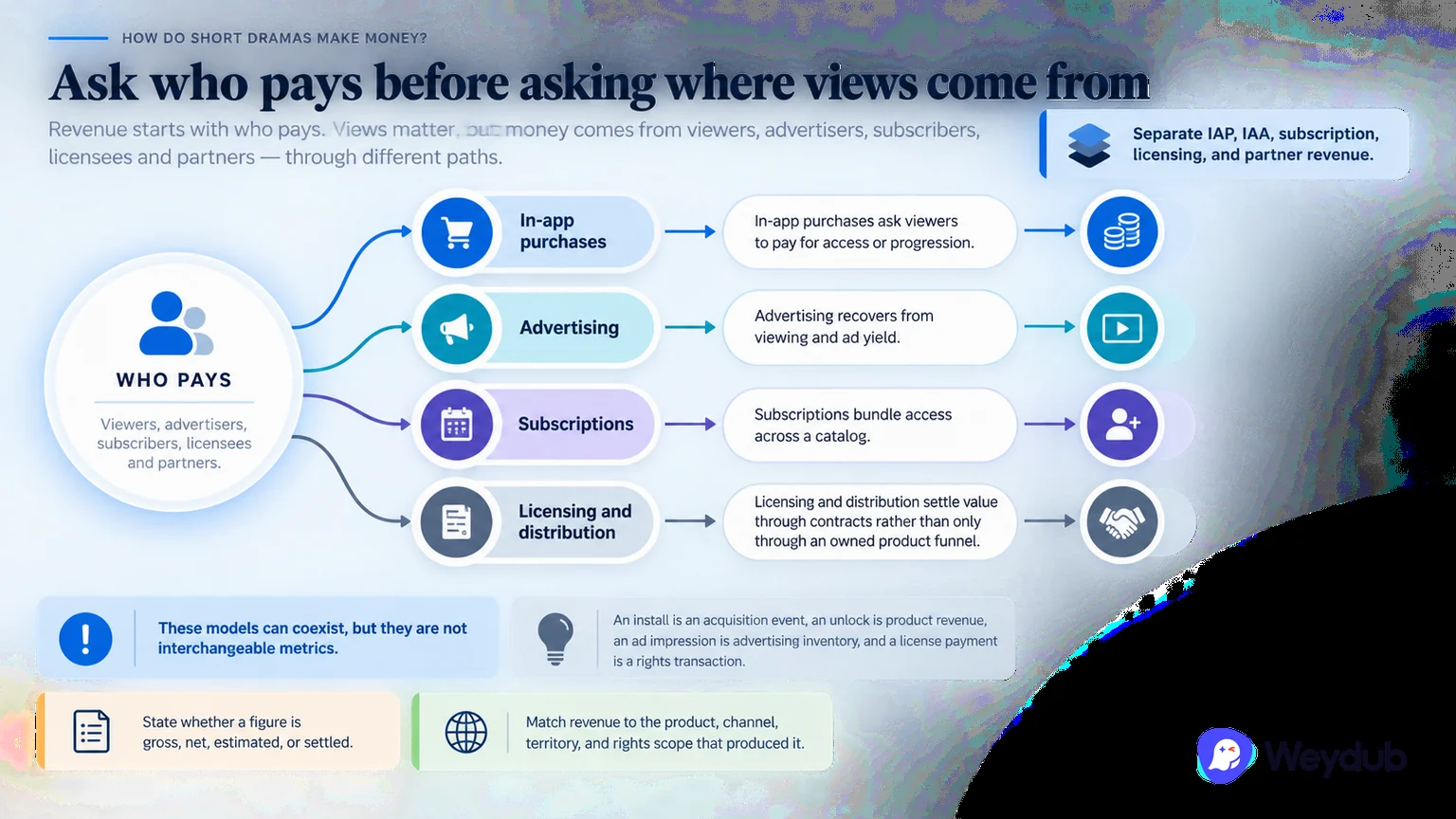
In-app purchases ask viewers to pay for access or progression. Advertising recovers from viewing and ad yield. Subscriptions bundle access across a catalog. Licensing and distribution settle value through contracts rather than only through an owned product funnel.
These models can coexist, but they are not interchangeable metrics. An install is an acquisition event, an unlock is product revenue, an ad impression is advertising inventory, and a license payment is a rights transaction.
- Separate IAP, IAA, subscription, licensing, and partner revenue.
- State whether a figure is gross, net, estimated, or settled.
- Match revenue to the product, channel, territory, and rights scope that produced it.
Revenue model changes production and localization
A paid app may prioritize a strong first episode and a clear unlock point. An ad-supported channel may prioritize repeat sessions and an accessible library. A licensing partner may require a clean master, subtitle files, audio tracks, metadata, artwork, and an acceptance package.
Compare each model with the full cost of recovery: acquisition, localization, support, platform fees, tax, rights, and future rework. A high top-line number does not explain whether a version is profitable.
| Model | Viewer or partner action | Production implication |
|---|---|---|
| IAP | Unlock or purchase access | Value moment, payment, and continuation |
| IAA | Watch and generate ad inventory | Session length, library, ad suitability |
| Subscription | Pay for recurring access | Catalog depth and retention |
| Licensing | Contracted use or distribution | Rights and delivery package |
Build a model around a defined release test
A useful forecast names the audience, channel, rights, localization version, cost period, and success signal. Keep product, platform, and rights reporting separate so a change in viewing does not get mistaken for a change in settled revenue.
- Define who pays and for what action.
- Map acquisition, localization, platform, support, and rights costs.
- Prepare the release package for the chosen model.
- Measure the full path from discovery to recovery.
- Reconcile estimates with settled results.
Frequently asked questions
Can one short drama use more than one revenue model?
Yes, when rights, product logic, audience path, and reporting remain explicit. Do not add figures from different models without defining the units.
Does a large audience prove a strong revenue model?
No. Audience size, monetized behavior, costs, fees, rights, and settlement are separate parts of recovery.
Related theme: Short-drama globalization
Weydub workflow
Take the next production step
Move from a market and source decision to a reviewable multi-episode localization workflow.