
Cost operations
How to attribute short-drama localization cost by series, language, and rework
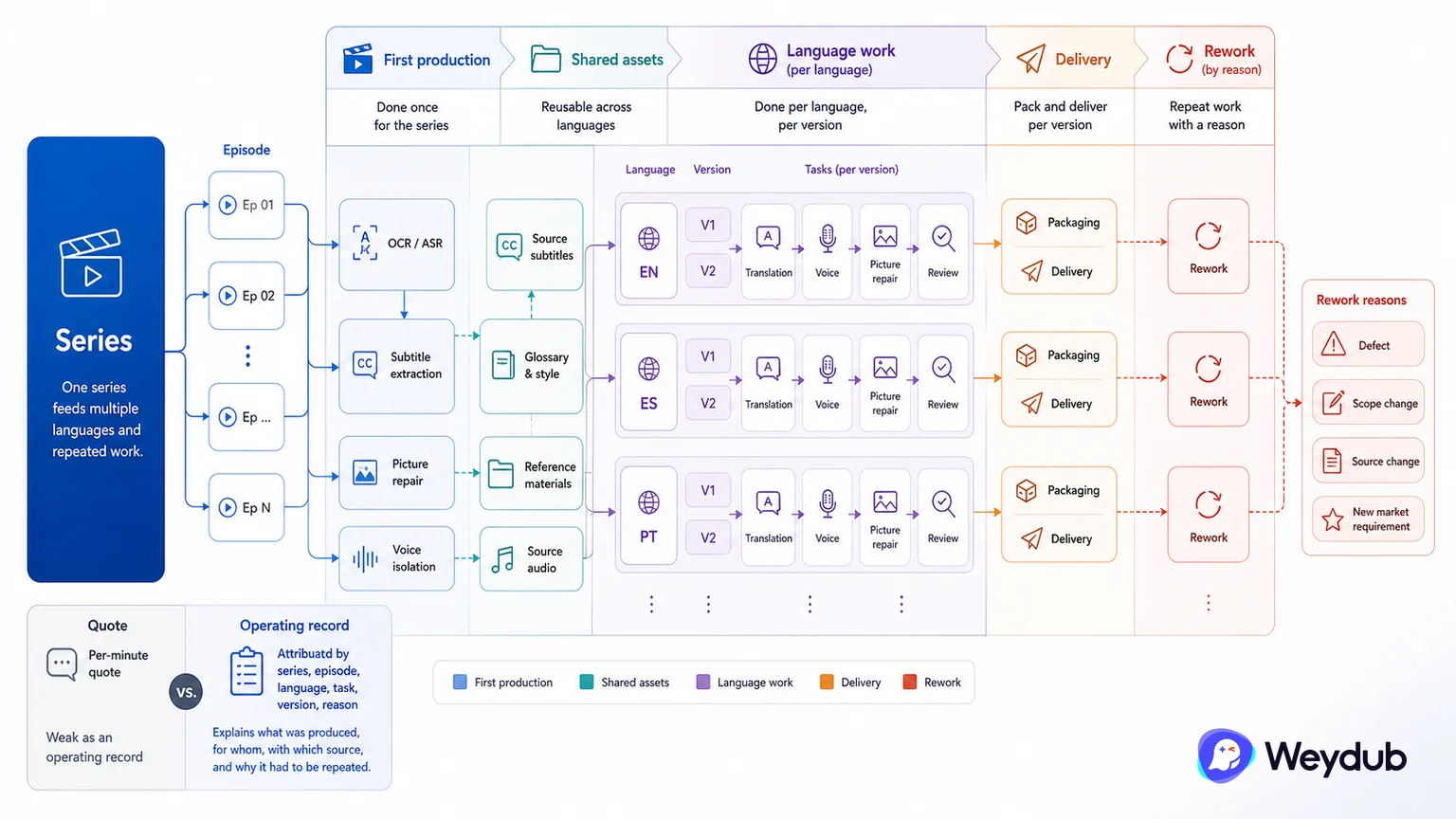
A useful cost record explains what was produced, for whom, with which source, and why it had to be repeated.
Key conclusions
- Separate first production, shared assets, language work, delivery, and rework.
- Record cost against the series and output version, not only a general project.
- Use defect categories to distinguish avoidable rework from an approved change in scope.
Per-minute pricing can be useful for a quote but is weak as an operating record. A series may share a master, glossary, character context, and delivery setup across languages, while a particular episode creates extra picture repair or audio work.
Track source preparation, subtitle extraction, translation, dubbing, picture, review, packaging, platform, and partner costs with a series and version reference. When a task is repeated, say whether the cause was a defect, a new market requirement, a source change, or a scope decision.
The result is not only better accounting. It shows where a workflow or asset can reduce future work and where a low initial quote is hiding a recurring operational burden.
Record cost against the unit that created it
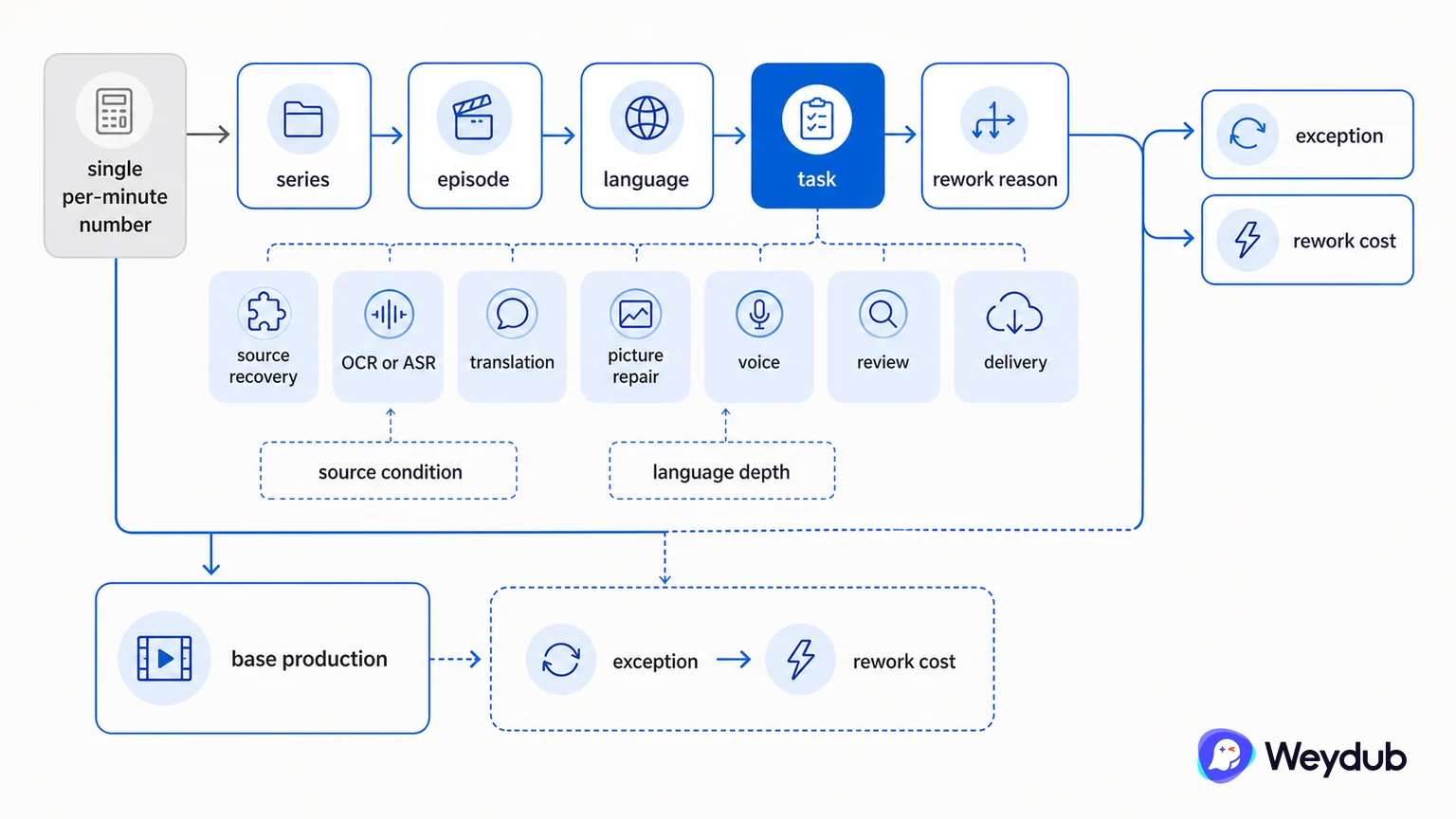
A single per-minute number hides whether budget went to source recovery, OCR or ASR, translation, picture repair, voice, review, delivery, or a specific language. Cost attribution should follow series, episode, language, task, and rework reason.
- Separate base production from exception and rework cost.
- Record source condition and language depth with each estimate.
- Do not treat an unpaid retry or a new business requirement as the same defect.
Use a cause-based cost table
The purpose is not accounting theater. A cause-based record tells the next project what can be reused, what should be sampled earlier, and whether a tool or workflow change actually moved the total cost.
| Cost area | Example cause | Useful decision |
|---|---|---|
| Source recovery | Hard subtitles, missing tracks | Request source or change tier |
| Language | Translation, terminology, review | Adjust locale or context |
| Media | Removal, restoration, mix | Sample difficult scenes |
| Rework | Wrong role, timing, output | Fix upstream policy |
| Delivery | Metadata, package, platform | Add channel gate |
Compare projects only with matching scope
A subtitle pilot, a dubbed flagship release, and a multi-channel library package are different products. Compare cost only after aligning episode count, source condition, language, review depth, rights, and deliverables.
- Define the production unit and scope.
- Log work and rework by cause.
- Separate fixed, variable, and exceptional cost.
- Compare against matching release packages.
- Use the result to change the next sample or tier.
Frequently asked questions
Is cost per minute useless?
No. It is useful for known work, but insufficient for selection and comparison when source condition, language depth, review, or delivery scope differs.
Should all rework be blamed on the localization tool?
No. Separate source, content, requirement, system, and delivery causes before judging the workflow.
Related theme: Localization production
Weydub workflow
Take the next production step
Connect episodes, language work, review, and delivery when a short drama needs more than a one-off file transformation.