
Industry observation
What changes when AI short-drama supply grows?
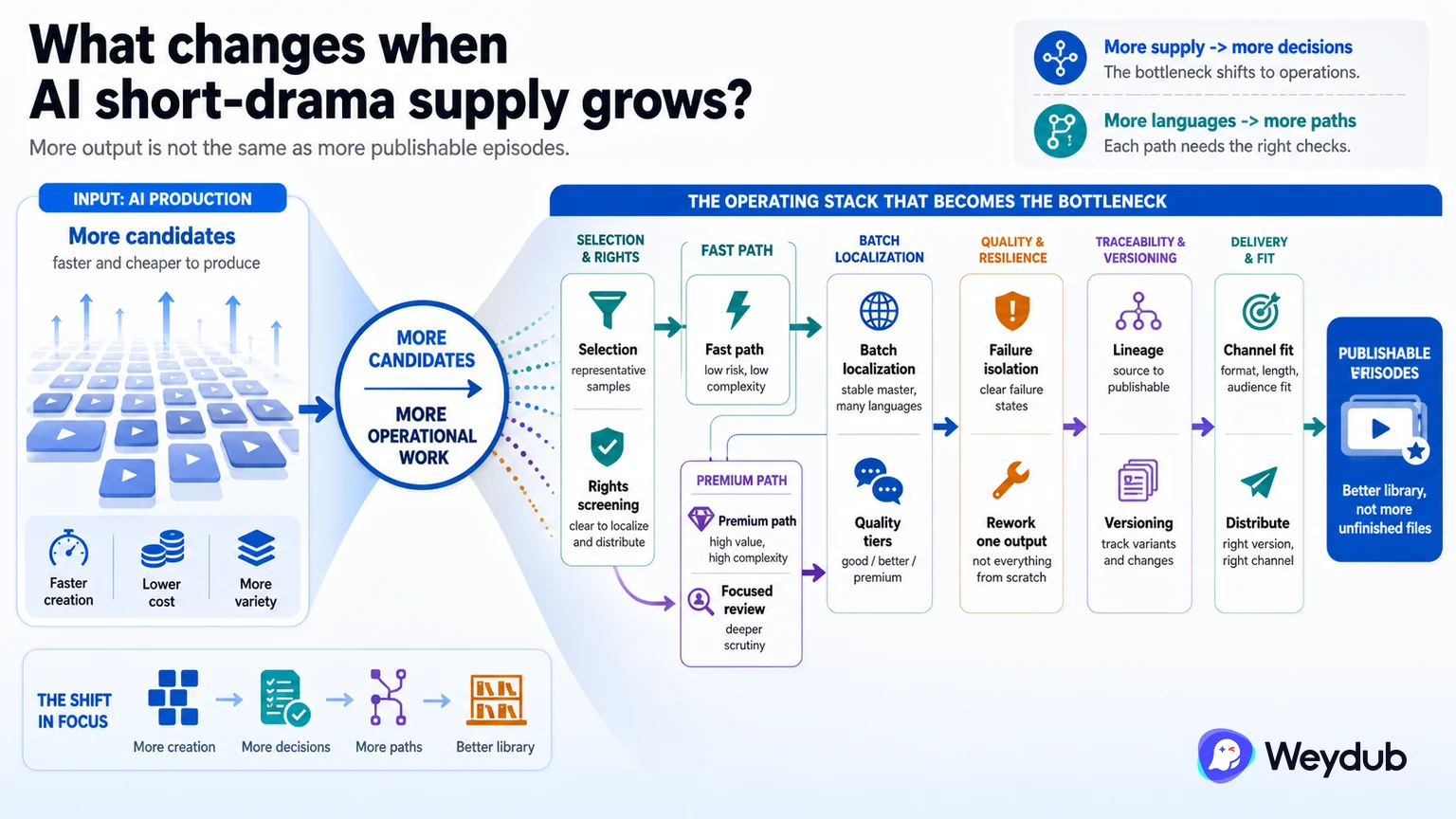
As candidate content becomes faster and cheaper to produce, selection, rights, localization, review, and distribution become larger parts of the operating problem.
Key conclusions
- More candidates increase the value of selection and rights screening.
- Batch localization needs quality tiers and failure isolation.
- A larger catalog makes lineage, versioning, and channel fit more important, not less.
A production bottleneck can move when generation speeds up. The team may receive more scripts, scenes, or series candidates, but still have limited attention for choosing what to finish, checking rights, maintaining character consistency, and validating release packages.
Localization capacity also changes shape. A stable master can support more languages, but more language versions create more review, delivery, and update paths. Teams need representative samples, clear failure states, and a way to rework one dependent output without losing the rest of the batch.
The practical response is not to assign the same depth to every candidate. Define a fast path, a focused review path, and a premium path, then record what each tier promises. Higher supply should produce better decisions and a better library, not merely more unfinished files.
More candidates move the bottleneck downstream
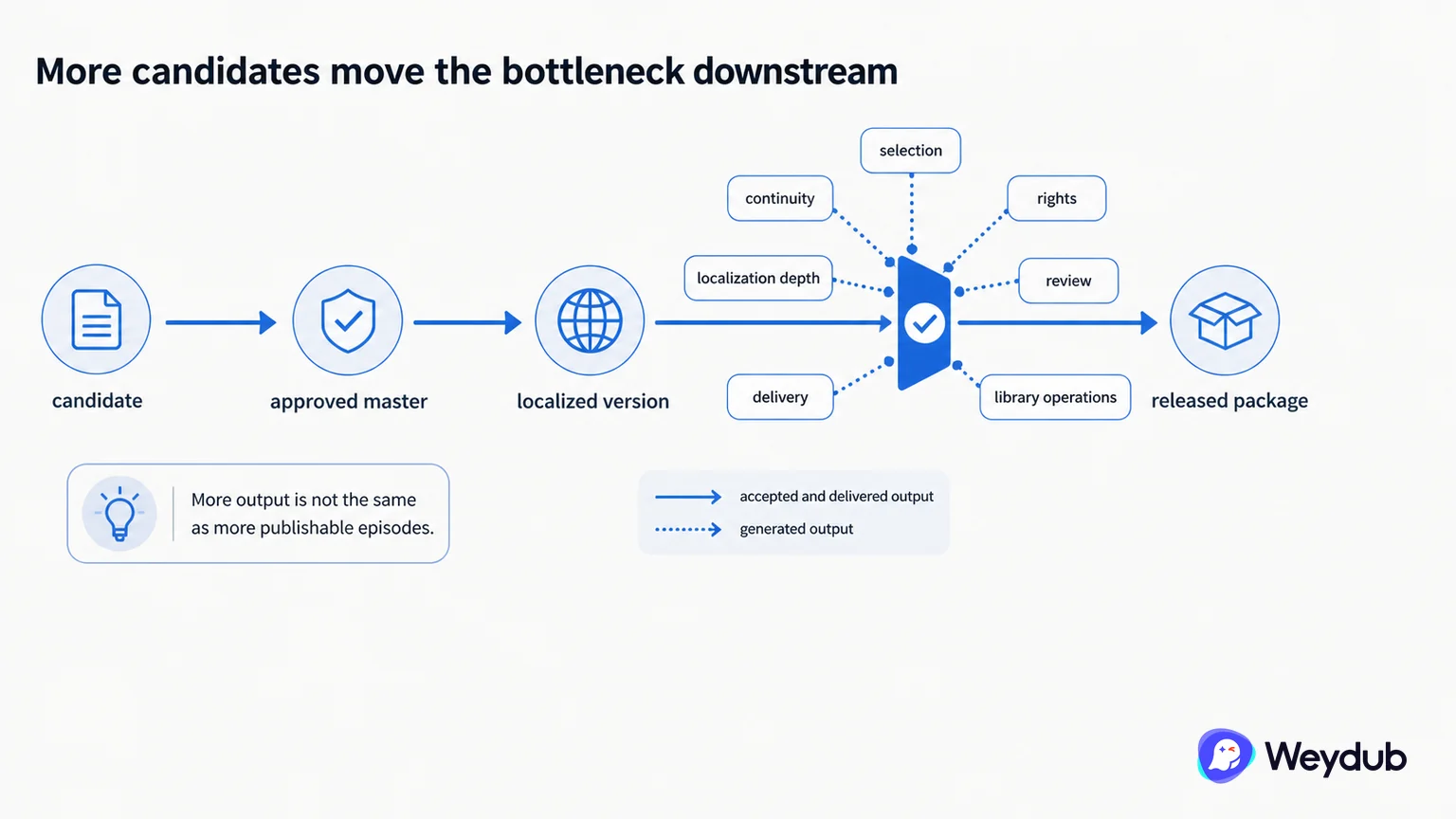
When AI increases the number of scenes or series a team can generate, the limiting questions become selection, continuity, rights, localization depth, review, delivery, and library operations. More output is not the same as more publishable episodes.
The team needs to distinguish candidate, approved master, localized version, and released package. Otherwise production speed creates a larger pile of ambiguous assets.
- Define selection and approval gates before scaling generation.
- Keep rights and reference assets with the candidate and approved version.
- Measure accepted and delivered output, not only generated output.
Production growth changes the work mix
A larger candidate pool increases the value of story and market selection, while repeated language production increases the value of shared context, batch status, and local rework. Teams may need more review and operations even when fewer people touch each individual frame.
Automation is most useful when it exposes decisions and preserves their relationships. A fast system that loses source, role, or delivery context simply moves the cost into later rework.
| Growth signal | Bottleneck | Operational response |
|---|---|---|
| More generated scenes | Selection and continuity | Review gates and asset lineage |
| More episodes | Episode order and package tracking | Series status and reconciliation |
| More languages | Terminology, roles, and review | Shared context and language briefs |
| More channels | Metadata, rights, and variants | Channel-specific delivery records |
Scale acceptance with the content
Before increasing volume, define what makes an output usable for the intended audience and channel. Sample difficult scenes, preserve exceptions, and let a correction point to the smallest affected unit. This keeps growth from turning every defect into a full-project restart.
- Set acceptance definitions for the release.
- Select representative candidates and test source conditions.
- Build an approved master and reusable context.
- Localize with batch and review state.
- Measure delivered outcomes and feed defects back into production.
Frequently asked questions
Does higher AI throughput guarantee higher output?
No. It may move the constraint to selection, continuity, rights, localization, review, and delivery.
What should a team measure instead of generation count?
Track approved, reviewed, delivered, and accepted outputs, along with defect causes, rework scope, and release conditions.
Related theme: Industry observations
Weydub workflow
Take the next production step
Apply the decision framework to a repeatable localization workflow with visible assets, tasks, and handoffs.