
Language systems
Why short-drama translation needs series context
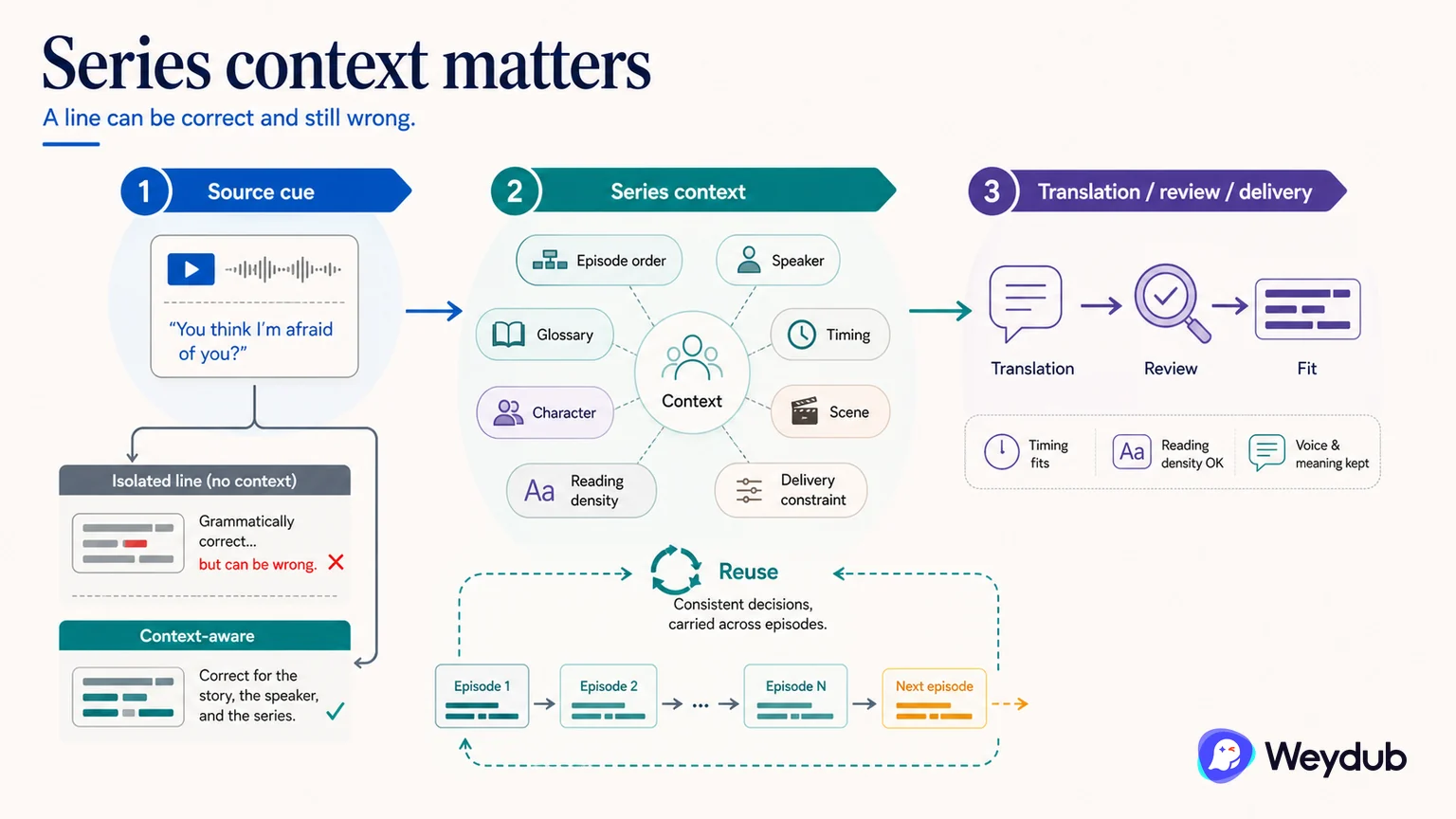
A line can be grammatically correct and still be wrong for the character, scene, or next episode.
Key conclusions
- Freeze a usable source subtitle before translating.
- Keep names, roles, terminology, and episode order available to the translator or review step.
- Treat timing and reading density as delivery constraints, not cosmetic cleanup.
Short dramas compress plot, relationships, and emotional turns into a small number of lines. A translation workflow that sees only one cue at a time can produce fluent sentences while losing who is speaking, what a term means, or why a repeated phrase changes later.
Series context does not mean every line needs a long literary brief. It means the workflow can carry the useful context: episode order, character identity, glossary decisions, source timing, and review state. That context lets a team correct a decision once and reuse it across the remaining episodes.
The same principle matters when subtitles feed dubbing. A target line must remain understandable on screen and fit the intended performance. Translation, segmentation, timing, and voice work should therefore be reviewed as connected outputs.
Start with the context that changes the line
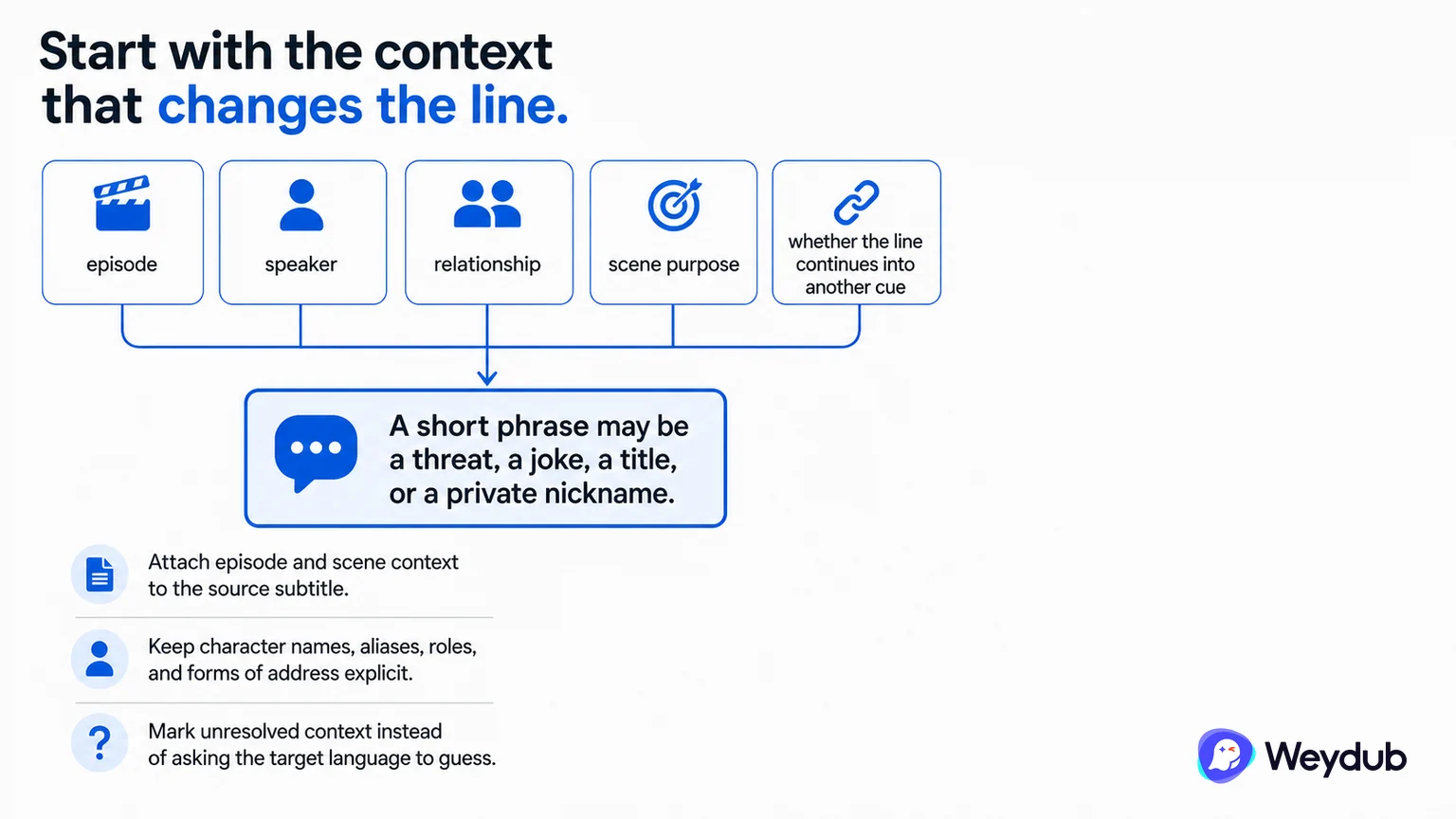
Before translating a cue, identify the episode, speaker, relationship, scene purpose, and whether the line continues into another cue. A short phrase may be a threat, a joke, a title, or a private nickname depending on that context.
- Attach episode and scene context to the source subtitle.
- Keep character names, aliases, roles, and forms of address explicit.
- Mark unresolved context instead of asking the target language to guess.
Build a reusable language record
Keep a compact series record of approved names, glossary terms, relationship notes, style choices, and decisions that apply only to one episode or market.
| Context item | Why it matters | Where it remains visible |
|---|---|---|
| Character and role | Controls address, pronouns, and voice intent | Character record and subtitle review |
| Terminology | Prevents repeated names or concepts from drifting | Glossary and language batch |
| Episode and scene | Explains references and continuity | Source subtitle and review note |
| Timing and density | Keeps the line readable and performable | Cue timeline and delivery check |
Review translation and dubbing as connected outputs
A subtitle can be semantically correct and still be too long for a natural performance. Review text, timing, role, voice choice, and the downstream composite against the same approved context.
- Freeze the source evidence and version.
- Resolve names, roles, and terminology.
- Translate and segment for the target language.
- Check reading speed and performance length.
- Record the approved decision for later episodes.
Do not confuse reuse with copying
Shared story facts should be reused; target-language phrasing still needs its own judgment. An English nickname is not automatically the right Spanish or Brazilian Portuguese form.
Frequently asked questions
Does every subtitle need a long context note?
No. Keep a compact series record and attach only the scene, role, terminology, and timing context that can change the cue.
Can an approved English translation be copied into every language?
No. Shared facts can travel across languages, but address, register, idiom, timing, and voice decisions need language-specific review.
Should context be added only when dubbing is planned?
No. Context improves subtitle consistency on its own and becomes even more important when the same text feeds voice and delivery versions.
Related theme: Subtitle and language systems
Weydub workflow
Take the next production step
Turn source video into reviewable subtitle material, then carry approved context into translation and delivery.