
Language market guide
Localizing a Chinese short drama into Turkish
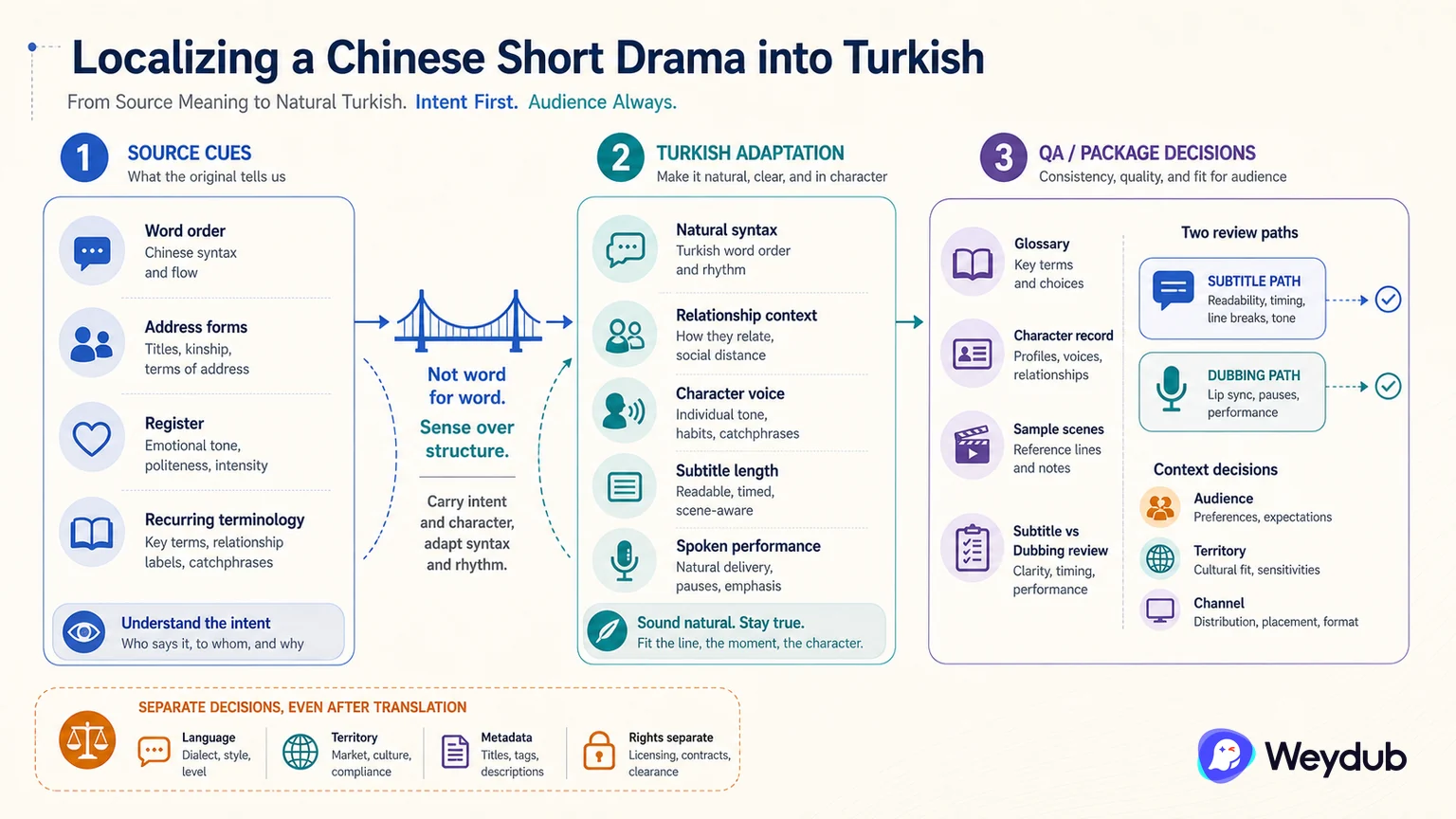
Turkish localization needs attention to word order, forms of address, emotional register, subtitle length, and spoken performance.
Key conclusions
- Carry character and relationship context into Turkish translation.
- Review sentence order, names, register, and recurring terminology across episodes.
- Check subtitle density and dubbing pauses with target-language review.
A literal source order may not produce natural Turkish dialogue. The target line should preserve intent and character while allowing the syntax, register, and rhythm that an audience expects.
Build a compact glossary and character record, then sample family, workplace, conflict, humor, and romance. Subtitle and dubbing versions should be evaluated separately for space and time.
Keep the selected Turkish audience and channel in the package. Language, territory, metadata, and rights remain separate decisions even when the translation is complete.
Set the locale before translating
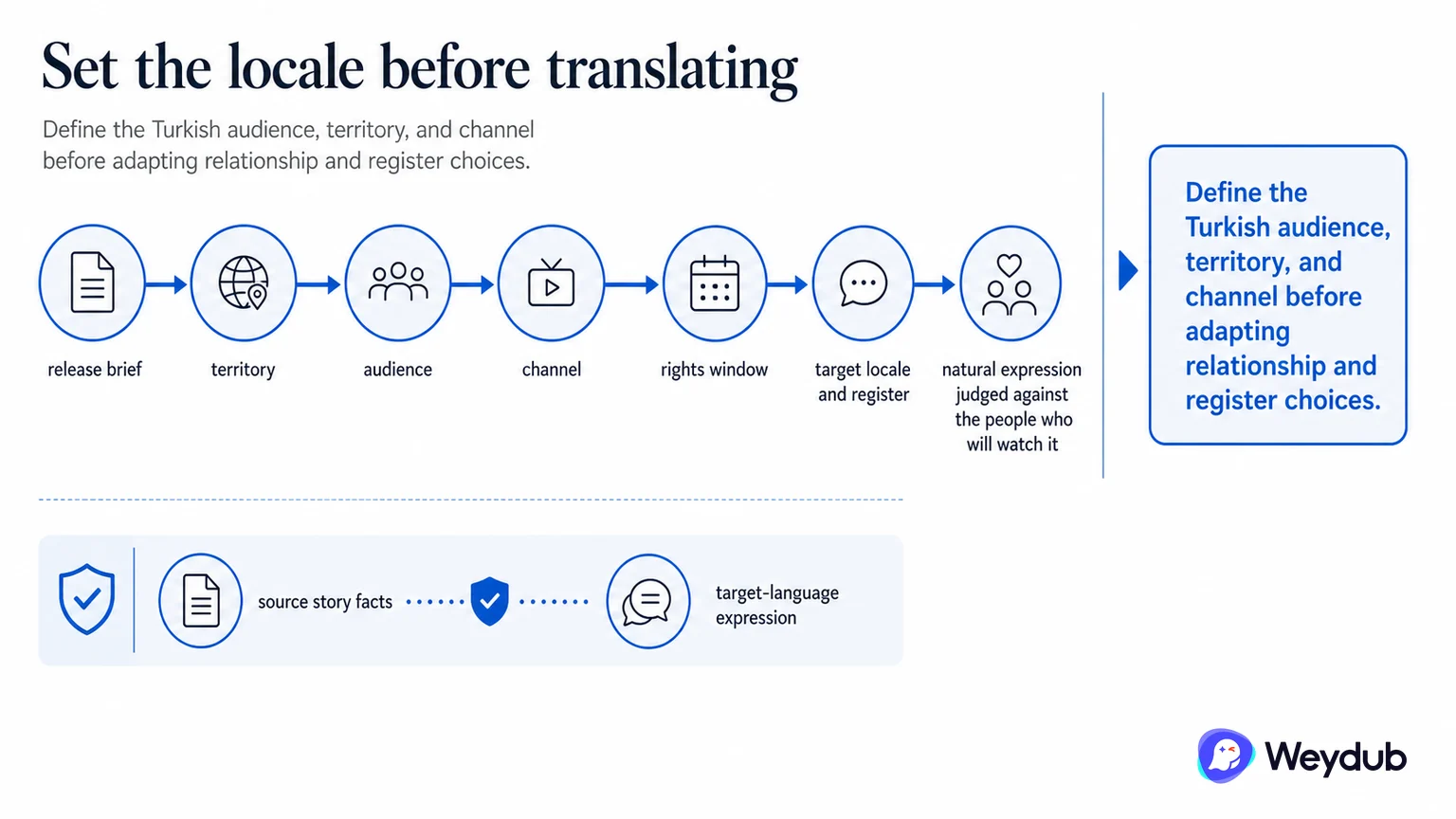
Define the Turkish audience, territory, and channel before adapting relationship and register choices.
Language labels do not define territory, audience, platform, rights, or payment expectations by themselves. Write the release brief first so a natural expression is judged against the people who will watch it.
- Name territory, audience, channel, and rights window.
- Choose the target locale and register before translating the batch.
- Keep source story facts separate from target-language expression.
Carry relationship and terminology through the series
Word order, forms of address, suffixes, emotional register, subtitle length, and spoken delivery need consistent series review.
Short drama repeats names, titles, family terms, threats, jokes, and relationship changes quickly. Keep a character and glossary record, then let the target language make its own natural choices within that shared story context.
| Localization layer | What to decide | Review evidence |
|---|---|---|
| Locale | Territory, audience, channel | Release brief and rights |
| Story context | Names, roles, relationships, terms | Character and glossary record |
| Subtitles | Density, breaks, timing, layout | Representative high-risk cues |
| Voice | Register, pronunciation, performance | Scene playback and native review |
Test the language in real scenes
Do not validate a market with isolated sentences. Sample opening scenes, relationship changes, emotional peaks, fast dialogue, names, jokes, and moments that will be dubbed. Compare the result with the intended channel package and revise the language policy before scaling.
- Freeze the source and locale brief.
- Build names, roles, and terminology context.
- Translate representative scenes.
- Review subtitle density and spoken performance.
- Run a small batch before the full series.
Frequently asked questions
Is translating into a language enough to cover every country that uses it?
No. Territory, locale, rights, audience, platform, and cultural register should be named separately.
Can one machine translation setting serve the whole series?
It can provide a draft, but names, relationships, recurring terms, timing, and performance need series-level review.
Should the same subtitle be used for dubbing?
It can be a source, but dubbing may need different line length, pauses, register, and performance decisions.
Related theme: Subtitle and language systems
Weydub workflow
Take the next production step
Turn source video into reviewable subtitle material, then carry approved context into translation and delivery.