
Human-AI workflow
How should human translators and AI translation work together?
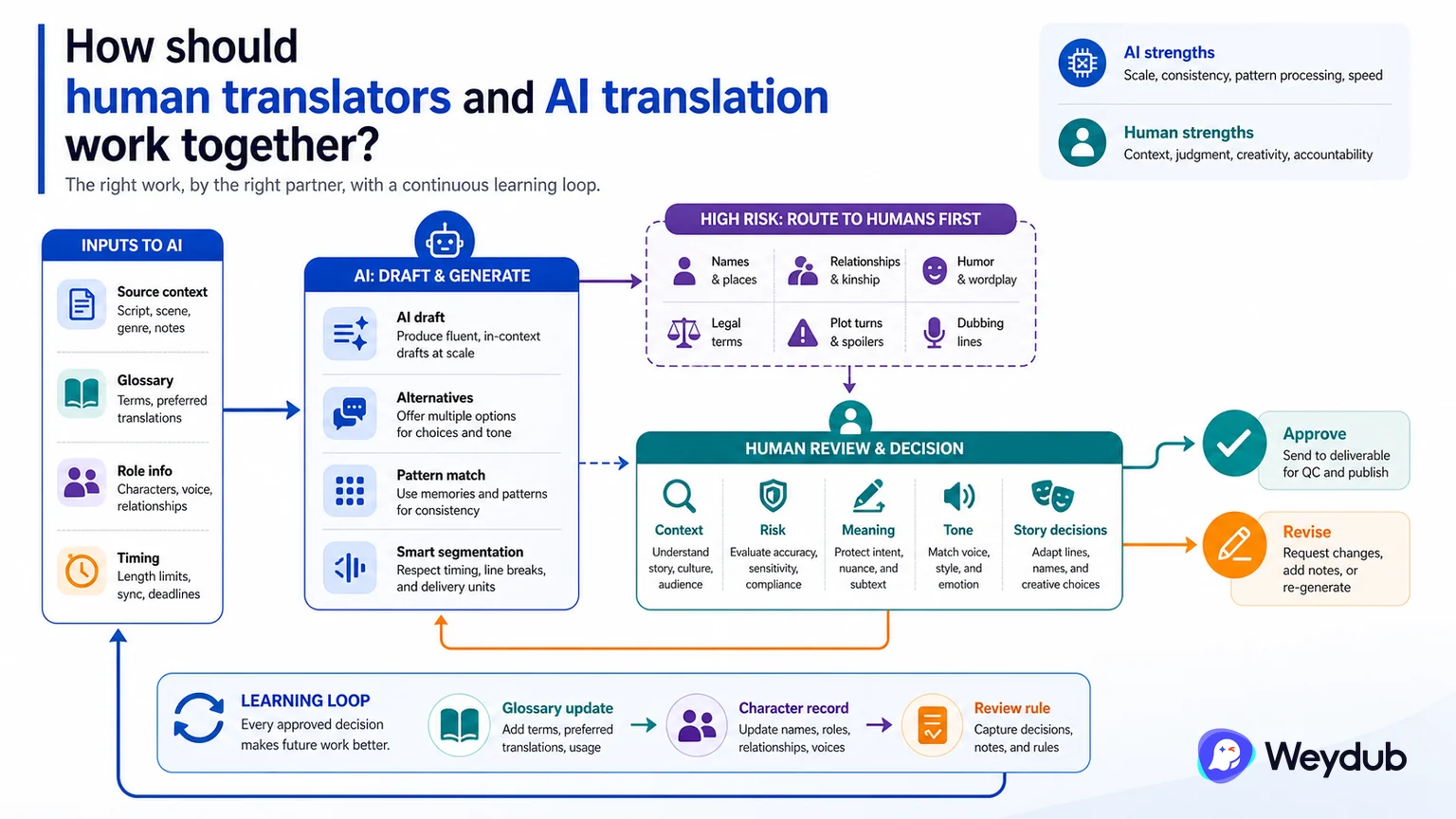
Use AI for repeatable drafting and transformation while placing human judgment at context, risk, and acceptance decisions.
Key conclusions
- Give the model source context, glossary, role information, and timing constraints.
- Let people review high-risk meaning, tone, terminology, and story decisions.
- Record edits and approved terms so later work benefits from them.
Human-AI collaboration works when each side has a defined job. AI can draft, segment, propose alternatives, and process repeated patterns. A translator or reviewer decides whether the line fits the character, scene, market, and release promise.
Do not leave the human with an unbounded correction task. Provide the context needed to decide and route high-risk cues first: names, relationships, humor, legal terms, plot turns, and lines that feed dubbing.
The approved result should improve the next batch through a glossary, character record, or review rule. Human review creates durable production context when the decision is captured rather than lost in an export.
Put people where context and consequence are highest
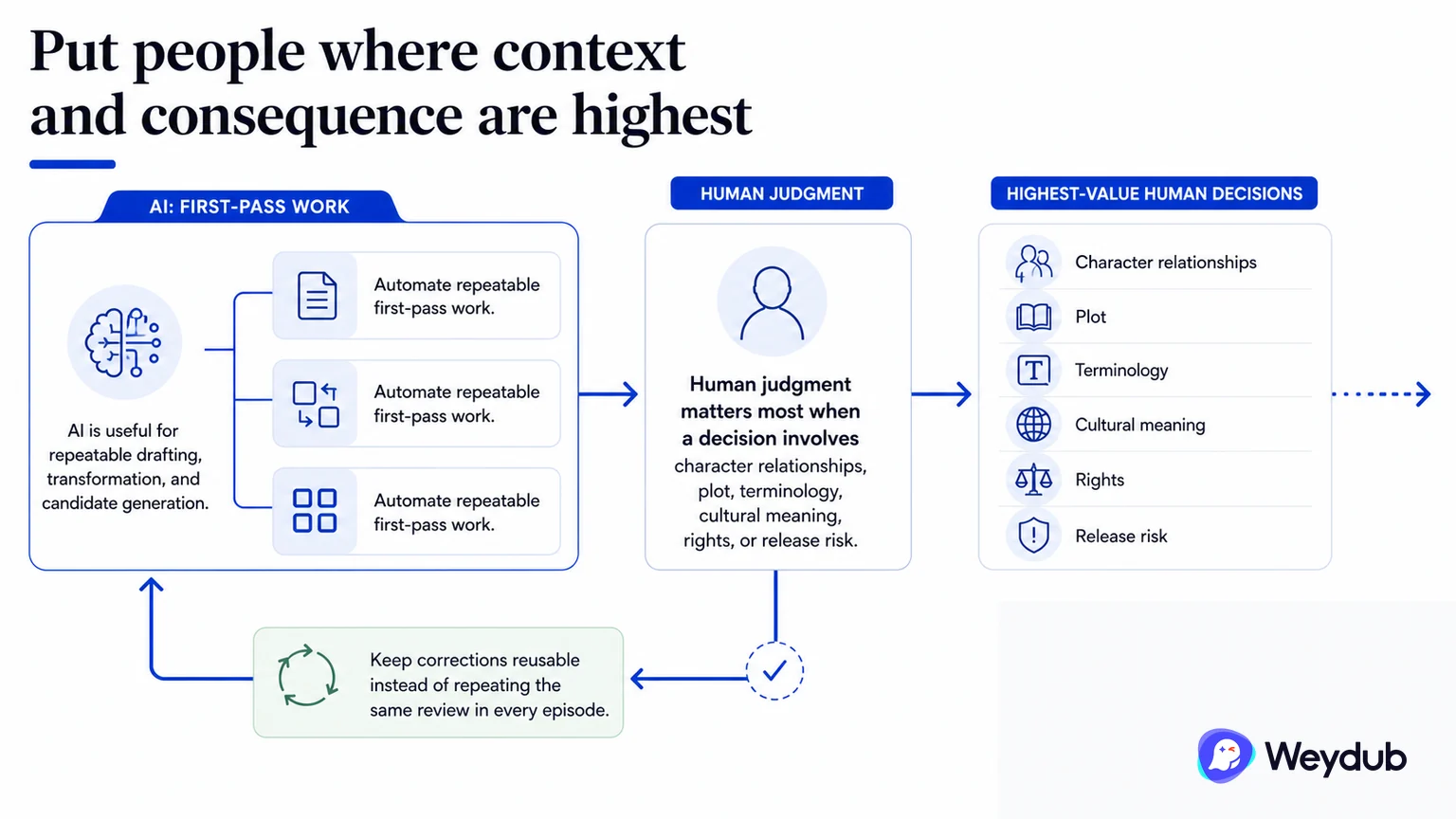
AI is useful for repeatable drafting, transformation, and candidate generation. Human judgment matters most when a decision involves character relationships, plot, terminology, cultural meaning, rights, or release risk.
- Automate repeatable first-pass work.
- Use humans for source ambiguity, role, story, and acceptance decisions.
- Keep corrections reusable instead of repeating the same review in every episode.
Design the handoff between draft and decision
A human should receive enough evidence to judge the output: source cue, scene, speaker, glossary, timing, and prior approved decisions. A vague request to proofread everything hides the decisions that need the most attention.
| Stage | AI contribution | Human contribution |
|---|---|---|
| Source | Extract or draft | Confirm evidence and version |
| Language | Translate candidates | Resolve context, role, and register |
| Timing | Segment and suggest duration | Accept reading and performance fit |
| Release | Prepare variants | Approve rights, quality, and package |
Measure the workflow, not only the draft
Track the defect categories, review time, accepted reuse, rework, and downstream failures. A faster draft is useful when it shortens the route to an approved version, not when it shifts the same work to the end.
- Define what can be automated safely.
- Attach source and context to the draft.
- Route high-risk decisions to a person.
- Record corrections and reusable rules.
- Measure approved output and rework.
Frequently asked questions
Does human review remove the value of AI?
No. AI can reduce repetitive effort while human review protects context, risk, and acceptance decisions.
Should humans review every line equally?
Use mandatory gates plus risk-based attention; high-impact or uncertain lines deserve more review than stable repetitions.
Related theme: Subtitle and language systems
Weydub workflow
Take the next production step
Turn source video into reviewable subtitle material, then carry approved context into translation and delivery.