
Pilot design
How should a short-drama localization sample be designed?
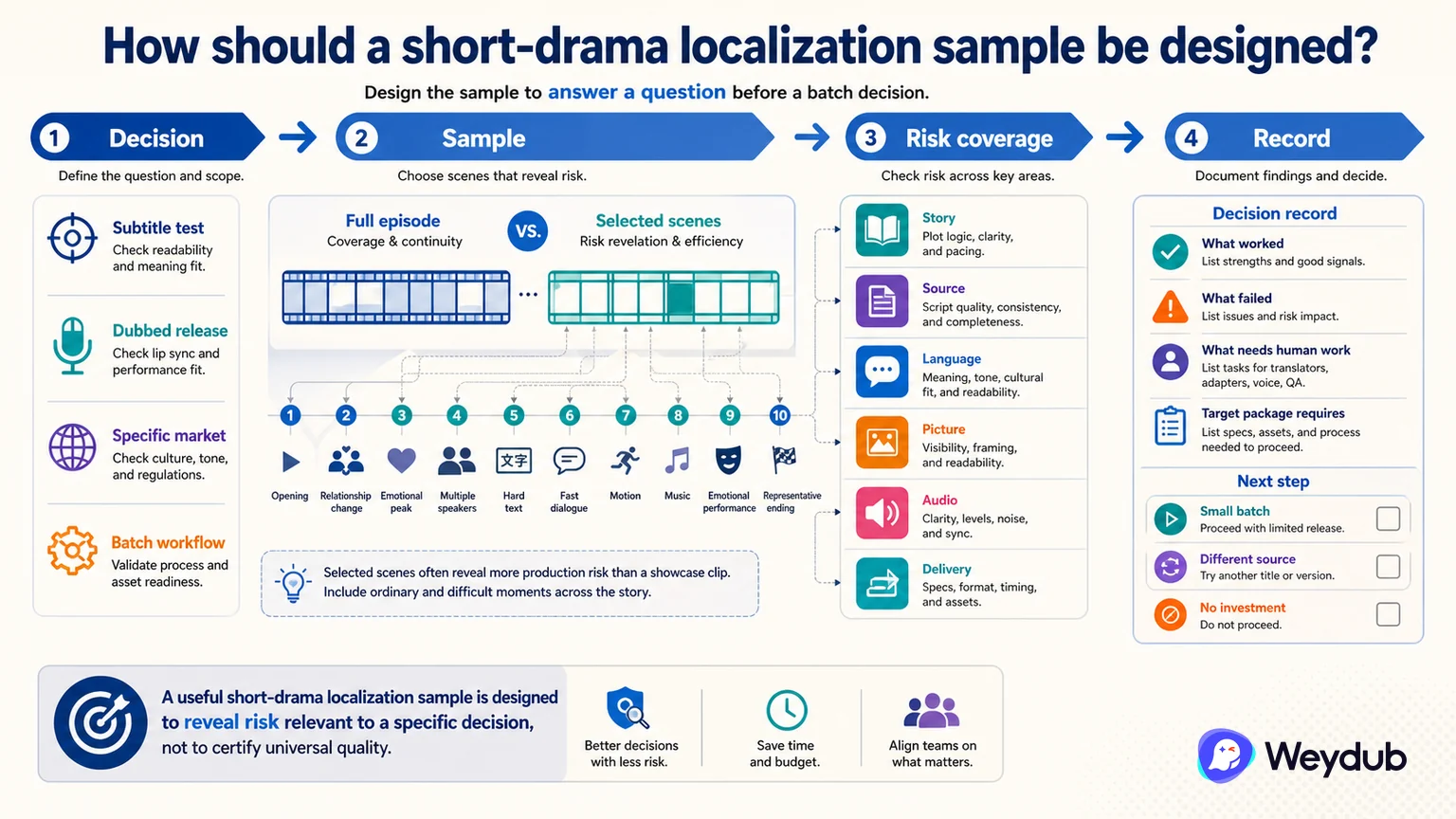
One full episode can be useful, but a small set of deliberately chosen scenes often reveals more production risk before a batch decision.
Key conclusions
- Sample story, source, language, picture, audio, and delivery risks.
- Include ordinary and difficult scenes instead of only a showcase clip.
- Define the decision the sample will support before running it.
A sample should answer a question: can this title support a subtitle test, a dubbed release, a specific market, or a batch workflow? The scenes should therefore cover the conditions that could change that decision, such as hard text, fast dialogue, role ambiguity, music, motion, and emotional performance.
A full episode provides continuity, while selected fragments can increase coverage across risk types. The method should be recorded so the result is not presented as a universal quality benchmark.
Finish with a decision record: what worked, what failed, what needs human work, what the target package requires, and whether the next step is a small batch, a different source, or no investment.
Choose a sample that reveals risk
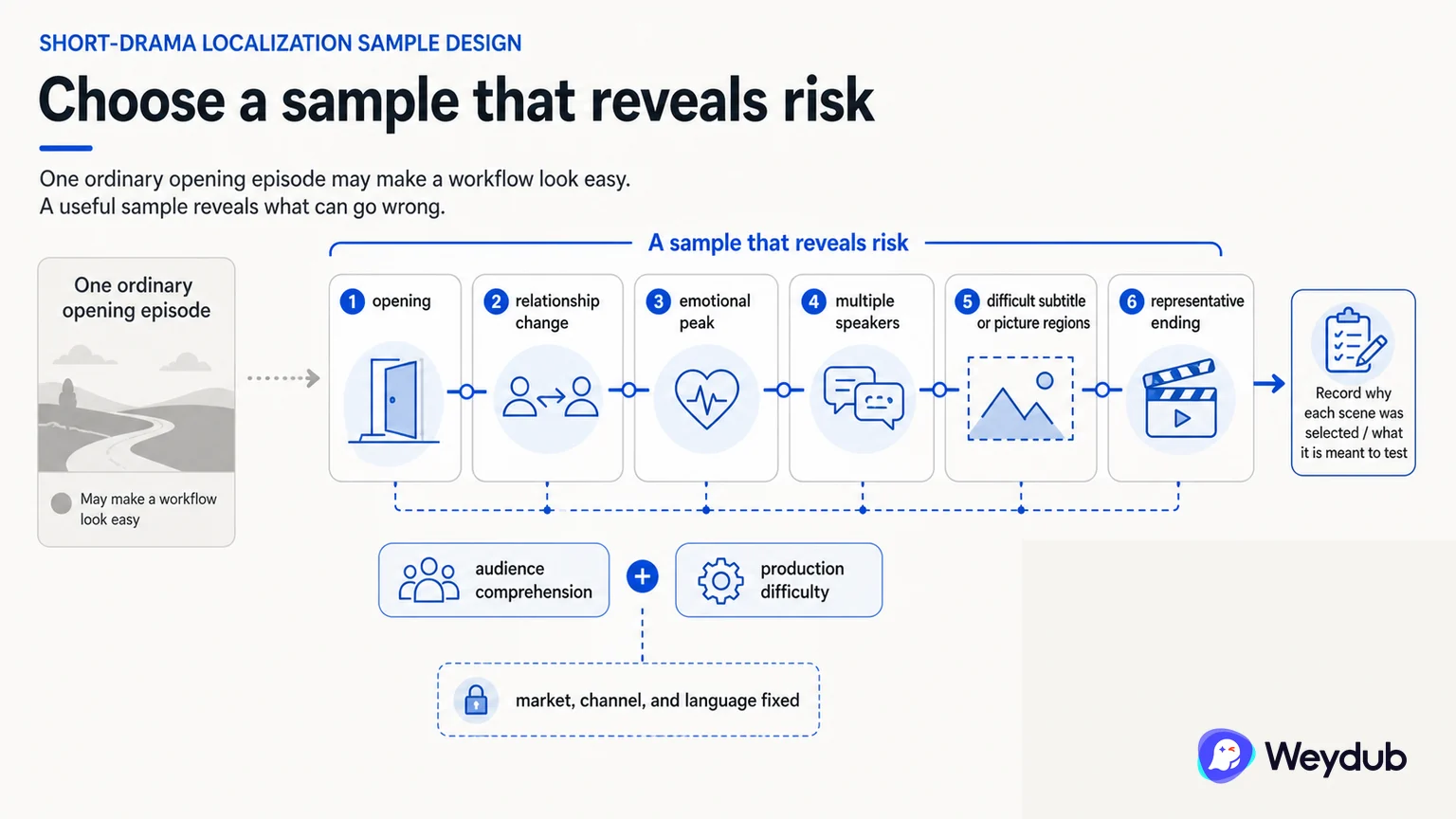
One ordinary opening episode may make a workflow look easy. A useful sample includes the opening, relationship change, emotional peak, multiple speakers, difficult subtitle or picture regions, and a representative ending.
- Sample both audience comprehension and production difficulty.
- Keep market, channel, and language fixed when comparing production options.
- Record why each scene was selected and what it is meant to test.
One episode or several fragments?
One full episode shows continuity and handoff. Several deliberately chosen fragments can expose more risk per unit of effort. The right design depends on the decision: validate story, compare subtitles and dubbing, or estimate batch recovery.
| Sample design | Strength | Limitation |
|---|---|---|
| One full episode | Continuity and delivery | May miss rare hard cases |
| Risk fragments | Efficient coverage of defects | Less evidence about full flow |
| Small batch | Early scaling signal | Costs more before decision |
| Hybrid | Continuity plus risk coverage | Needs clear acceptance scope |
End with a decision record
A sample that works proves only the tested conditions. Record the version, scenes, language, settings, review time, failures, and next investment. If the sample changes too many variables, it cannot tell the team what to change next.
- State the hypothesis and acceptance bar.
- Select representative full-episode and risk scenes.
- Run the intended localization path.
- Log quality, cost, and review burden.
- Continue, adjust, or stop with evidence.
Frequently asked questions
Is one full episode always the best sample?
No. It is strong for continuity, while selected fragments can reveal difficult OCR, translation, picture, or dubbing conditions more efficiently.
Can a successful sample guarantee the full batch?
No. It reduces uncertainty under tested conditions; a small batch is still useful before full scaling.
Related theme: Short-drama globalization
Weydub workflow
Take the next production step
Move from a market and source decision to a reviewable multi-episode localization workflow.