
Why short-drama translation needs series context
A line can be grammatically correct and still be wrong for the character, scene, or next episode.
Read the page ->Weydub Insights
Research and practical guidance for short-drama globalization, AI media workflows, production quality, and channel-ready delivery.
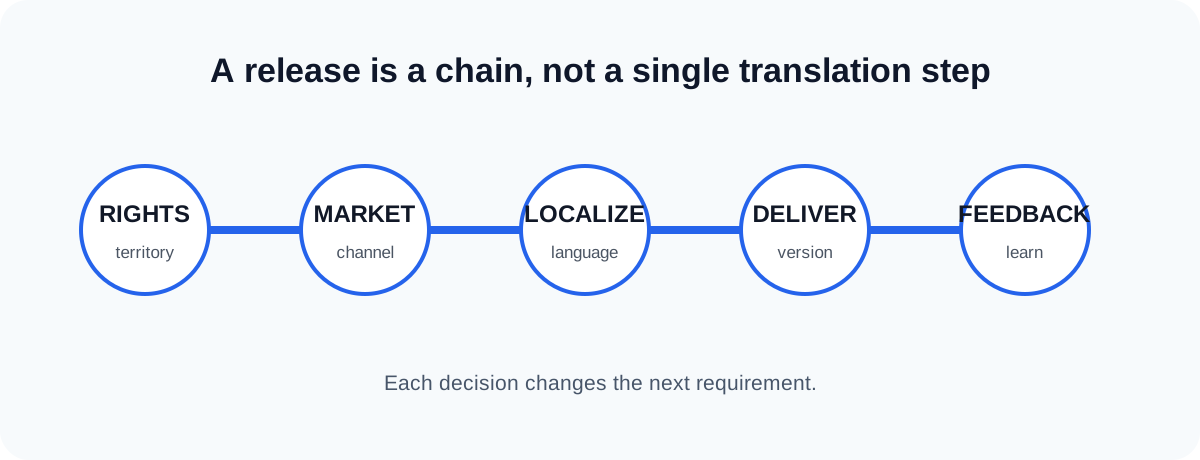
Start with the map
Insights connects market decisions to the media, language, review, and delivery choices that follow.
The decisions that connect a short drama to a new audience, market, and channel.
02A series is a production context, not a folder of unrelated video files.
03Subtitle extraction, translation, timing, and dubbing are connected by constraints, not by a single magic button.
04Production quality comes from targeted review and local rework, not from hiding uncertainty behind a single score.
05The final output is a channel package with specifications, rights, metadata, and version state.
06AI is most useful when it makes a production decision visible, reviewable, and reusable.
07Short drama is a serialized viewing format shaped by episode length, story rhythm, release design, and monetization.
08A localization project becomes easier to operate when rights, source materials, decisions, and deliverables have named owners.
09Subtitle extraction, picture cleanup, translation, dubbing, and synchronization are separate capabilities that depend on one another.
10The practical questions behind AI media localization are about cost movement, scale, consistency, and where judgment still matters.
Useful next reads
Read a practical explanation, then follow its related topic or comparison.
A line can be grammatically correct and still be wrong for the character, scene, or next episode.
Read the page ->On-screen text and spoken dialogue require different evidence, correction, and timing paths.
Read the page ->Recurring series work needs shared assets, task state, review, and delivery relationships.
Read the page ->Compare speed, audience access, production depth, and rework before choosing a first version.
View comparison ->Editorial boundary: Weydub Insights separates public product documentation, industry context, and operational guidance. Claims carry a source note and checked date; a visual summarizes a conclusion but does not replace the underlying evidence.