
Dubbing dependency
Why does better AI dubbing make the translation upstream more important?
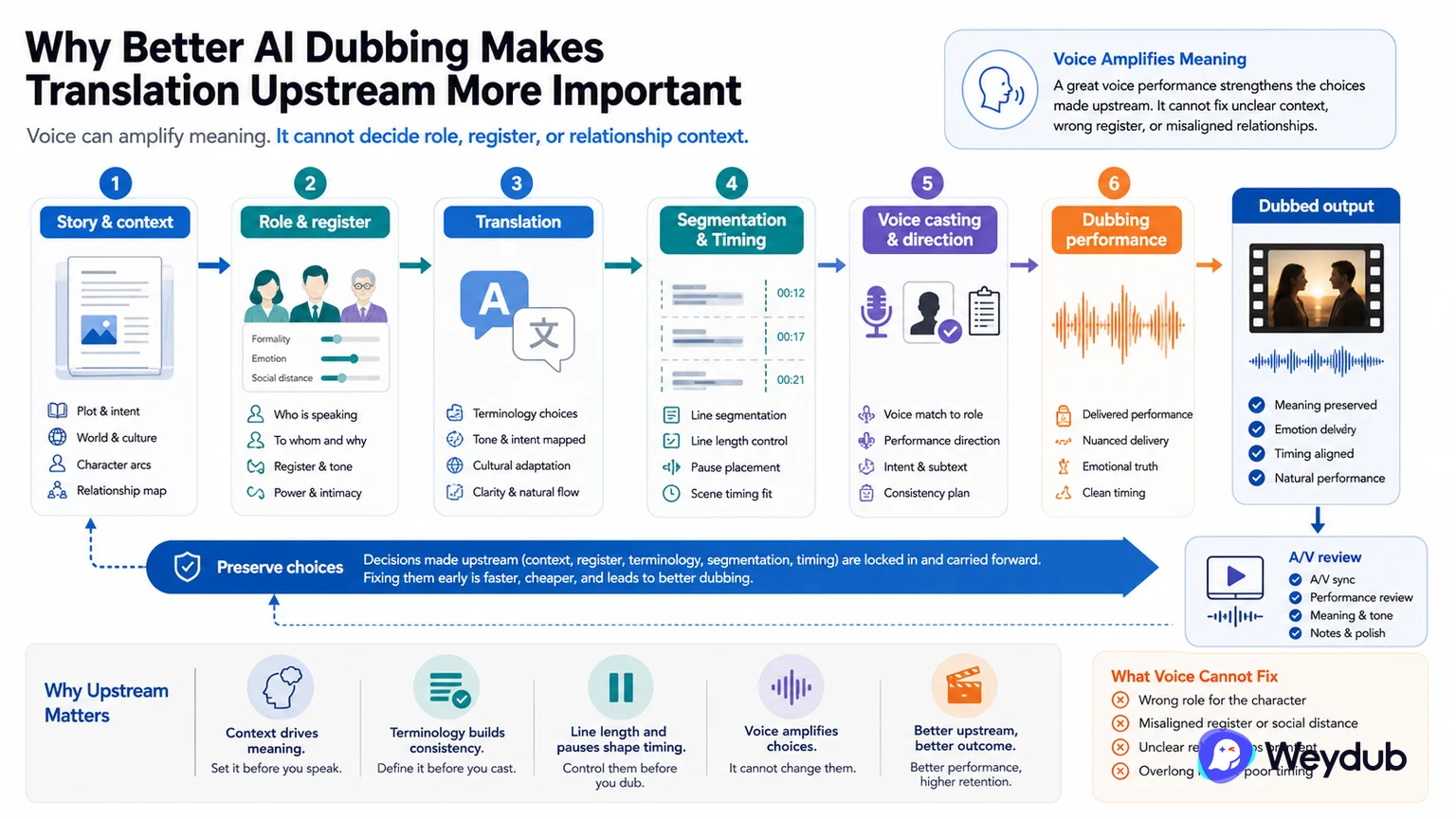
A convincing voice can amplify a strong line and a weak one, so role, meaning, timing, and performance intent must be settled before voice production.
Key conclusions
- Resolve character, relationship, and terminology context before casting a voice.
- Control line length, pauses, CPS/SPS, and scene timing before final dubbing.
- Review translation, voice, picture, and mix as one audiovisual output.
A voice model can make a sentence sound fluent and emotional, but it cannot decide whether the character should use a title, a nickname, a threat, or a formal register. Those choices belong to the story and relationship context.
Dubbing also exposes translation length. A line that is acceptable as a subtitle may be too long for a natural performance or may force a pause that breaks the scene. Translation, segmentation, voice direction, and timing therefore form a dependency chain.
Fix the upstream language and role decisions before tuning the voice. Then preserve approved choices so later episodes can inherit the intended performance rather than recreating it from isolated lines.
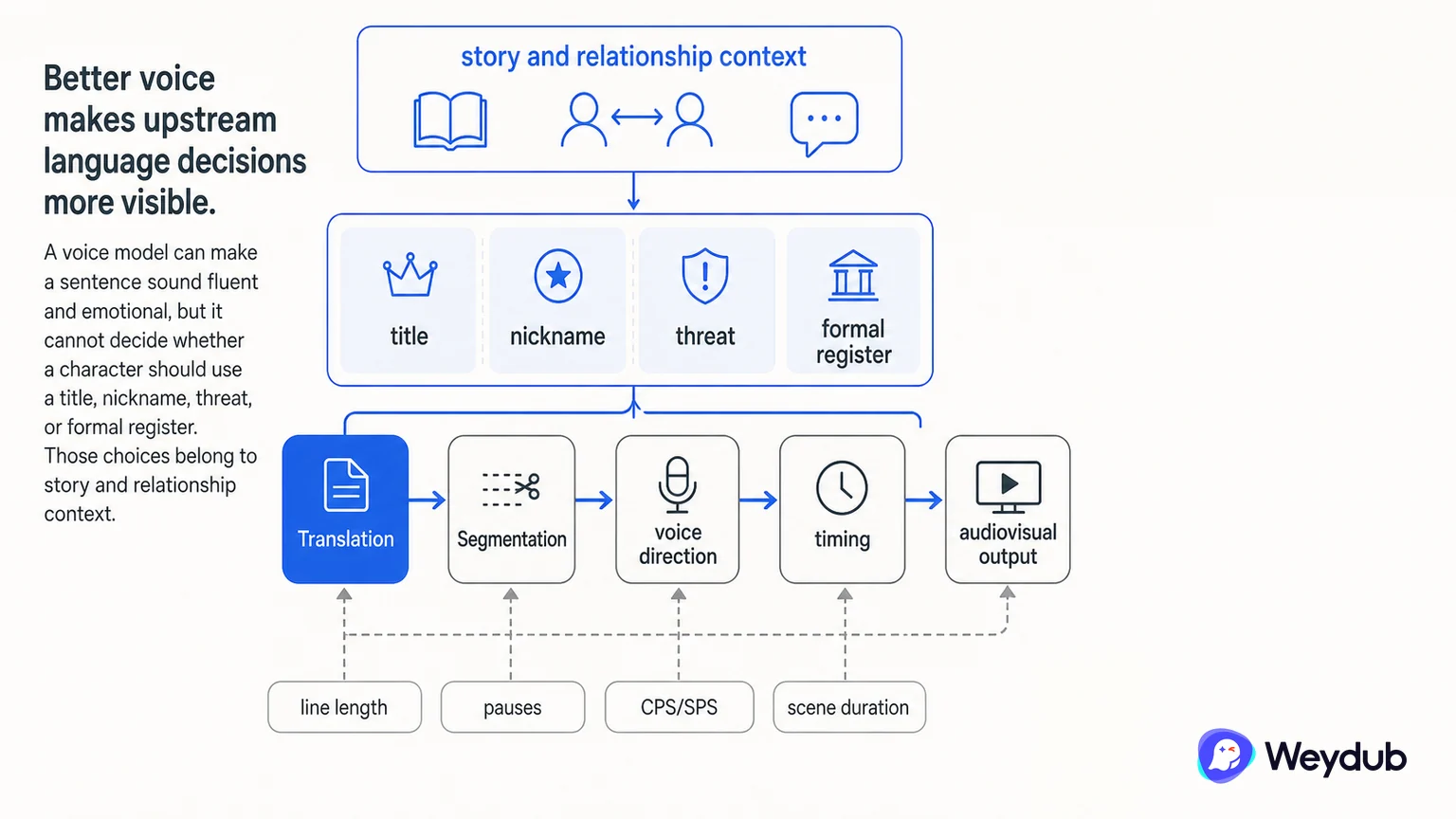
A better voice makes upstream language decisions more visible
A voice model can make a sentence sound fluent and emotional, but it cannot decide whether a character should use a title, nickname, threat, or formal register. Those choices belong to story and relationship context.
Dubbing also exposes translation length. A line acceptable as a subtitle may be too long for a natural performance or force a pause that breaks the scene. Translation, segmentation, voice direction, and timing form a dependency chain.
- Resolve character, relationship, and terminology context before casting.
- Control line length, pauses, CPS/SPS, and scene duration.
- Review translation, voice, picture, and mix as one audiovisual output.
Fix upstream problems before tuning the voice
If the target line is too long or assigned to the wrong role, changing voice style will not solve the rhythm. Correct the language or role decision first, then preserve the approved choice so later episodes inherit the intended performance rather than recreating it from isolated lines.
| Upstream issue | Visible dubbing symptom | Correct repair |
|---|---|---|
| Wrong role or relationship | Wrong tone or address | Update context and translation |
| Overlong line | Rushed delivery or forced pause | Rewrite for speech and timing |
| Wrong segmentation | Awkward entry or exit | Retiming and cue revision |
| Weak source context | Inconsistent performance | Add role and terminology record |
Accept the complete audiovisual version
Dubbing review should listen and watch at the same time. Check emotion, character continuity, speech rate, pause, scene action, subtitle relationship, music, effects, and mix. A good isolated sentence is not proof of good episode performance.
- Confirm role, scene, and language context.
- Approve the target line for speech.
- Generate or record the voice candidate.
- Review against picture, subtitles, music, effects, and mix.
- Store the accepted decision for later episodes.
Frequently asked questions
Can a stronger voice model fix a weak translation?
No. It can make a line sound more polished, but it cannot decide context, role, meaning, or whether the line fits the scene.
Why review voice with picture and subtitles?
Timing, performance, role, and mix are audiovisual decisions. An isolated voice clip cannot prove episode quality.
Related theme: Distribution and delivery
Weydub workflow
Take the next production step
Prepare a localized version with subtitles, voice, timing, and a delivery path that matches the destination.