
Production checklist
A master-first checklist for multilingual AI drama production
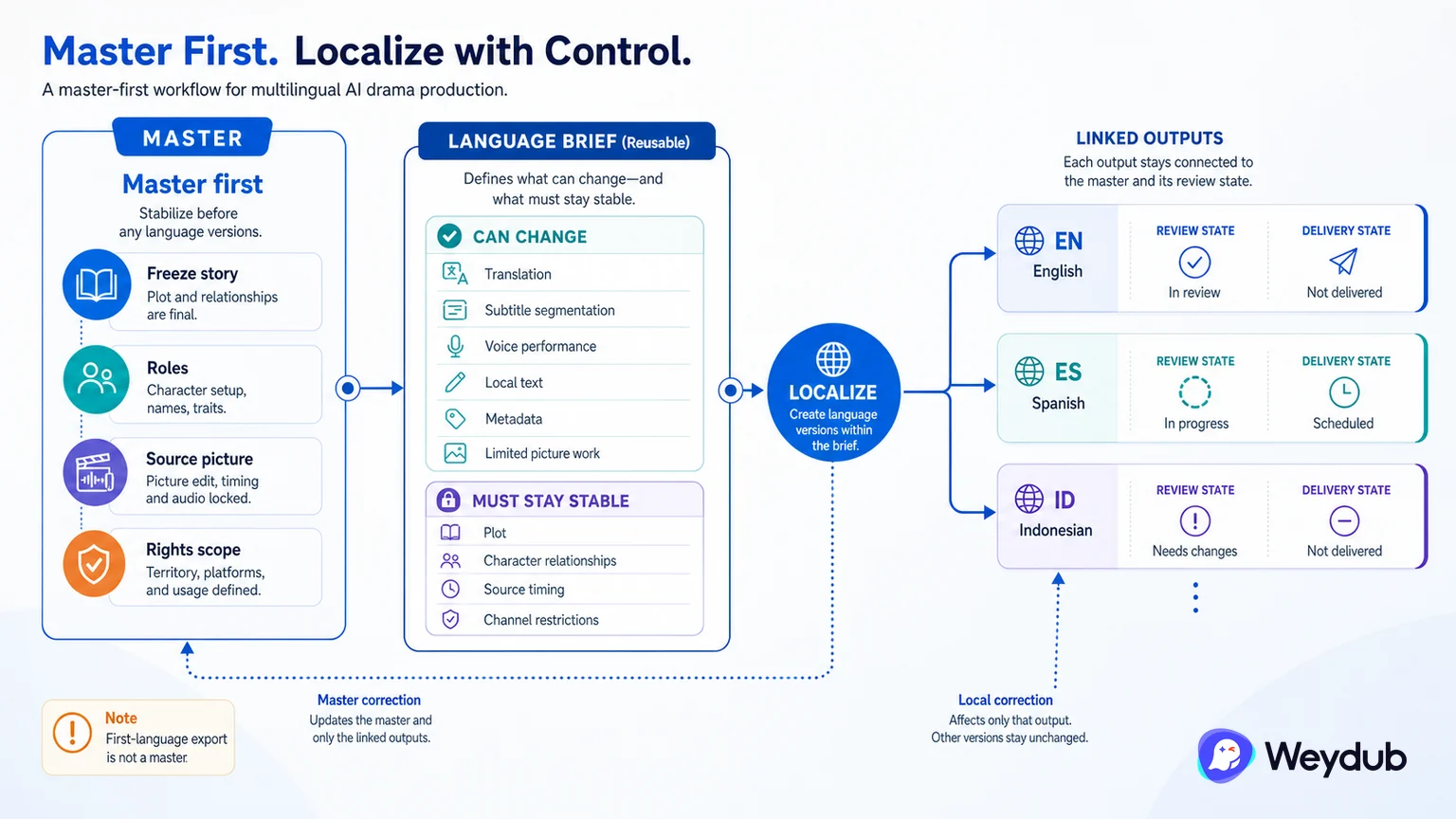
Stabilize the source story and assets before creating language versions, then track every derived output and exception.
Key conclusions
- Freeze story, roles, source picture, and rights before batch localization.
- Create a reusable language brief with glossary, voice, timing, and channel requirements.
- Keep each output connected to the master and its review state.
A multilingual project becomes easier to operate when the first-language master is a real decision rather than an unfinished candidate. It should have an episode order, character references, approved terms, usable picture and audio, and a rights scope that covers the intended derivations.
The language brief should say what can change: translation, subtitle segmentation, voice performance, local text, metadata, or limited picture work. It should also say what must remain stable, such as plot, character relationships, source timing, or channel restrictions.
After production, store the review and delivery state with the language version. A correction to the master should show which localized outputs are affected; a correction to one language should not silently change every other version.
Define the master before creating language versions
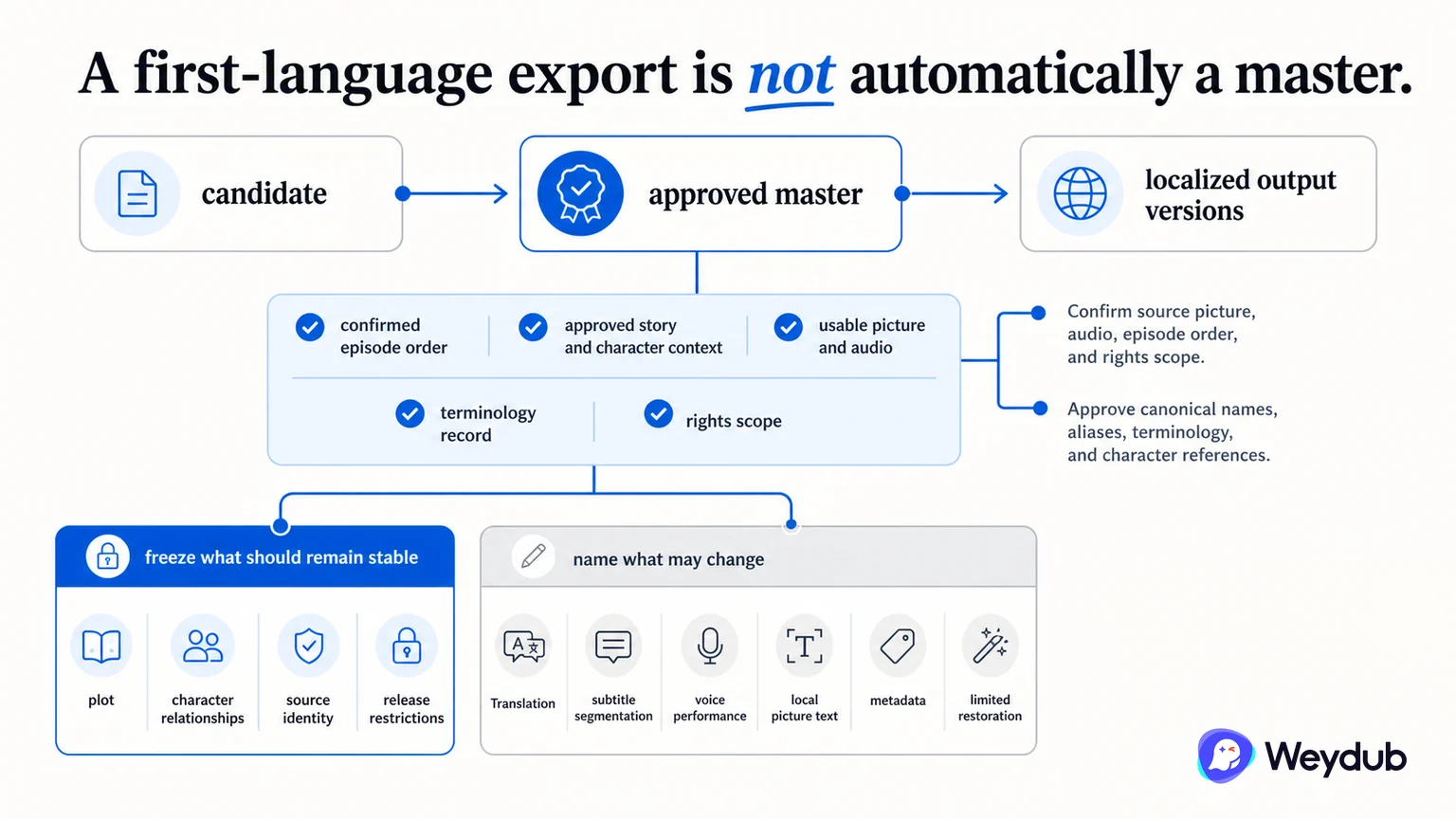
A first-language export is not automatically a master. The master should have a confirmed episode order, approved story and character context, usable picture and audio, a terminology record, and a rights scope that covers the intended language and channel derivatives.
Freeze what should remain stable and name what may change. Translation, subtitle segmentation, voice performance, local picture text, metadata, and limited restoration may vary by market; plot, character relationships, source identity, and release restrictions may not.
- Confirm source picture, audio, episode order, and rights scope.
- Approve canonical names, aliases, terminology, and character references.
- Separate candidate, approved master, and localized output versions.
Build a reusable language brief
A language brief turns one approved decision into repeatable production context. It should identify the target locale, audience, channel, subtitle policy, dubbing direction, reading or speech constraints, metadata requirements, and the items that require native-language review.
Keep subtitles and dubbing related but separate. A readable subtitle line may not be a natural spoken line, and a voice performance may need a different duration or pause pattern. Both should inherit the same character and terminology context.
- Name the locale, territory, channel, and release purpose.
- Record subtitle density, line-break, speech-rate, and voice-direction rules.
- State which decisions require human or qualified language review.
Track derived outputs and exceptions
Every localized output should point back to the master and forward to its delivery package. If the master changes, the team needs to know which languages and episodes require revalidation. If one language changes, the correction should not silently overwrite unrelated versions.
Preserve review state with the output: draft, corrected, approved, replaced, or released. This prevents a technically complete file from being mistaken for an approved delivery.
- Create the language and episode scope.
- Generate or import subtitles, picture, audio, and metadata as separate assets.
- Review high-risk scenes and record exceptions.
- Approve the language package and link it to its delivery target.
- Propagate only source changes that affect dependent outputs.
Frequently asked questions
Should every language be regenerated when the master changes?
Only when the changed source decision affects that language or its dependent output. The point of lineage is to identify the real propagation scope.
Is an MP4 enough to call something a master?
Usually no. A usable master includes source context, approved assets, rights scope, version state, and the information needed to create and review later derivatives.
Related theme: Localization production
Weydub workflow
Take the next production step
Connect episodes, language work, review, and delivery when a short drama needs more than a one-off file transformation.