
Subtitle translation
How should subtitle translation control CPS and reading speed?
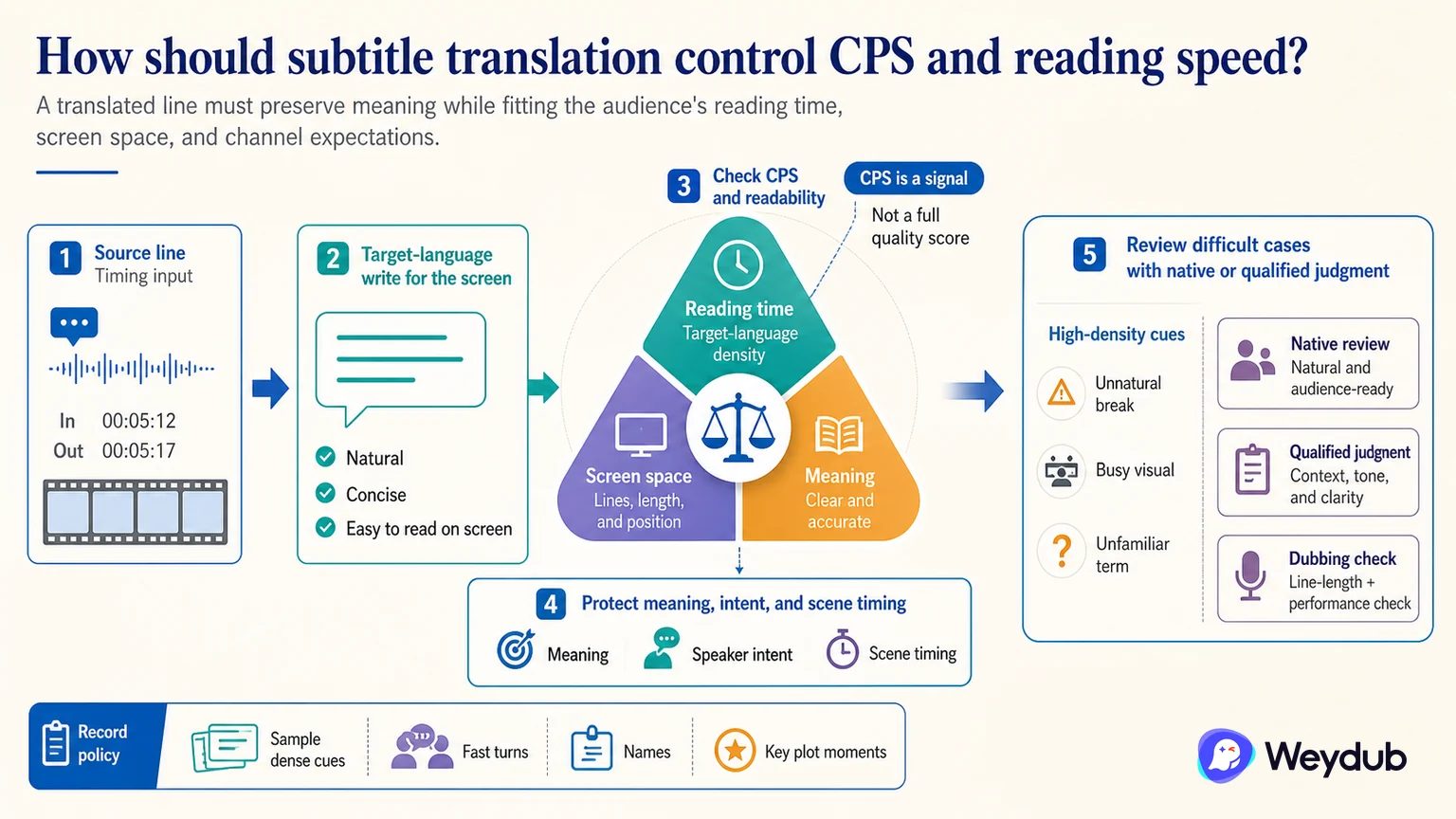
A translated line must preserve meaning while fitting the audience's reading time, screen space, and channel expectations.
Key conclusions
- Measure target-language density rather than copying source line breaks.
- Protect meaning, speaker intent, and scene timing together.
- Review difficult languages and formats with native or qualified language judgment.
Characters-per-second is a useful signal, not a complete quality score. A line can meet a numeric limit and still be hard to understand if the break is unnatural, the visual is busy, or the audience needs more time for an unfamiliar term.
Translation should be written for the target screen and timing. Compressing every line can remove role, emotion, or plot information; preserving every source word can make the cue unreadable. The right decision depends on the scene and the channel.
Record the timing and reading policy for the release, then sample high-density cues, fast turns, names, and key plot moments. Subtitles that will feed dubbing need an additional line-length and performance check.
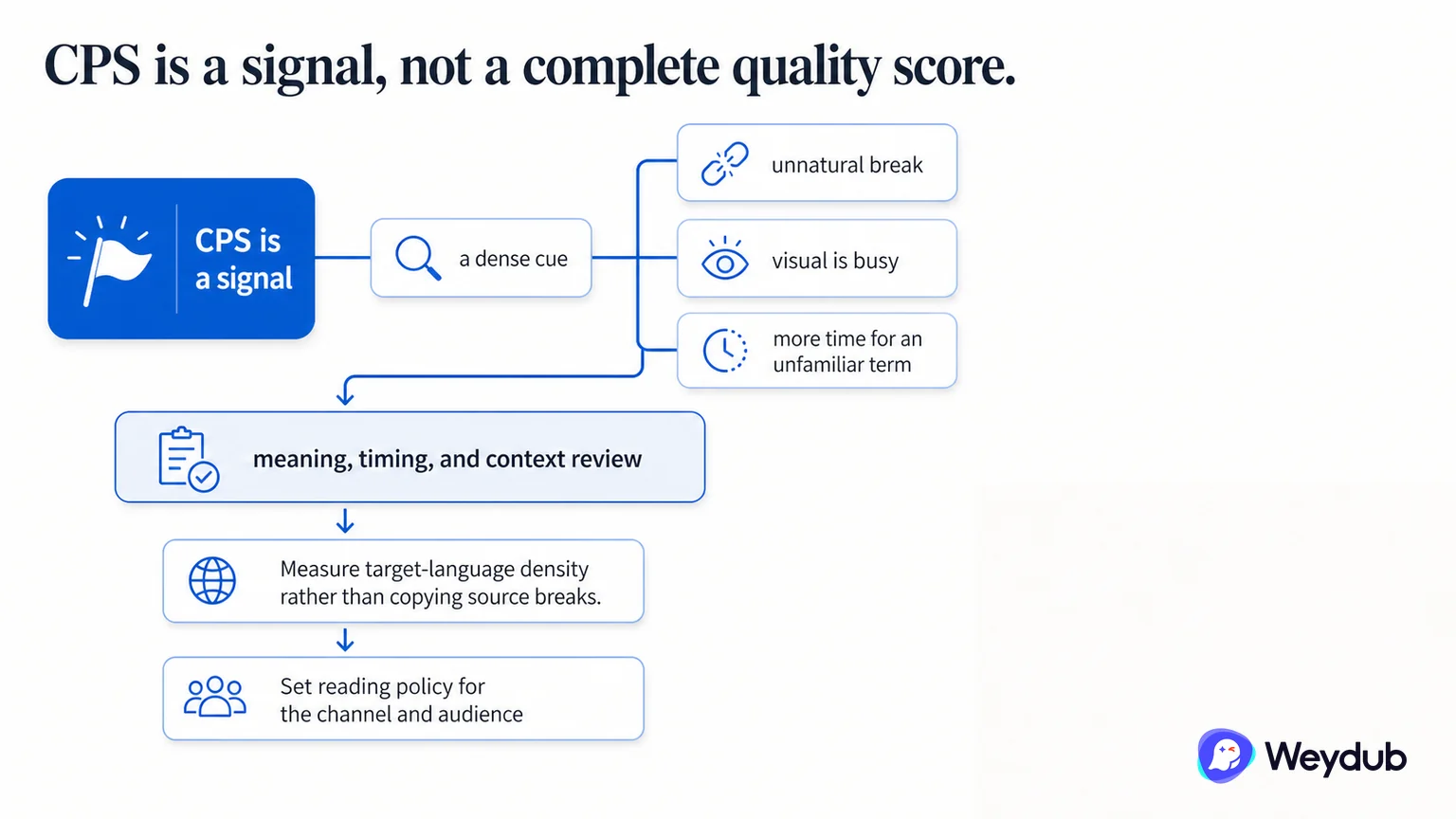
CPS is a signal, not a complete quality score
Characters per second can flag a dense cue, but a line may still be difficult when the break is unnatural, the visual is busy, or the audience needs more time for an unfamiliar term. A numeric limit does not replace meaning, timing, and context review.
Target languages expand and contract differently. Copying source line breaks or compressing every line can remove role, emotion, or plot information.
- Measure target-language density rather than copying source breaks.
- Protect meaning, speaker intent, and scene timing together.
- Set reading policy for the channel and audience, not only a generic number.
Write the line for the screen and release
Translation should be edited for the target screen, timing, and channel. Review fast dialogue, names, high-density cues, emotional turns, and plot-critical moments with native or qualified language judgment.
Subtitles that feed dubbing need additional line-length, pause, and performance checks. A readable subtitle and a natural spoken line may require different wording while sharing the same context.
| Check | Question | Evidence |
|---|---|---|
| Density | Can the audience read it in time? | CPS, duration, scene complexity |
| Breaks | Does the line break by meaning? | Phrase, speaker, shot transition |
| Context | Is role and intent preserved? | Character, relationship, plot |
| Dubbing use | Can it become a spoken line? | Duration, pauses, performance |
Record the policy and sample the risk
The release record should state timing and reading policy, language, channel, and exceptions. Use a representative sample rather than treating one average score as proof of the entire batch.
- Define audience, channel, and reading policy.
- Translate with series context and target-language review.
- Measure dense and difficult cues.
- Review key plot and performance moments.
- Freeze the approved subtitle version and exceptions.
Frequently asked questions
Is a subtitle acceptable when it meets the CPS limit?
Not automatically. Meaning, line breaks, scene context, timing, and audience reading conditions still need review.
Should subtitles and dubbing use identical lines?
They should share story and terminology context, but screen reading and spoken performance may require different wording and timing.
Related theme: Subtitle and language systems
Weydub workflow
Take the next production step
Turn source video into reviewable subtitle material, then carry approved context into translation and delivery.