
Production model
Why manage a short drama as a series instead of a folder of files?
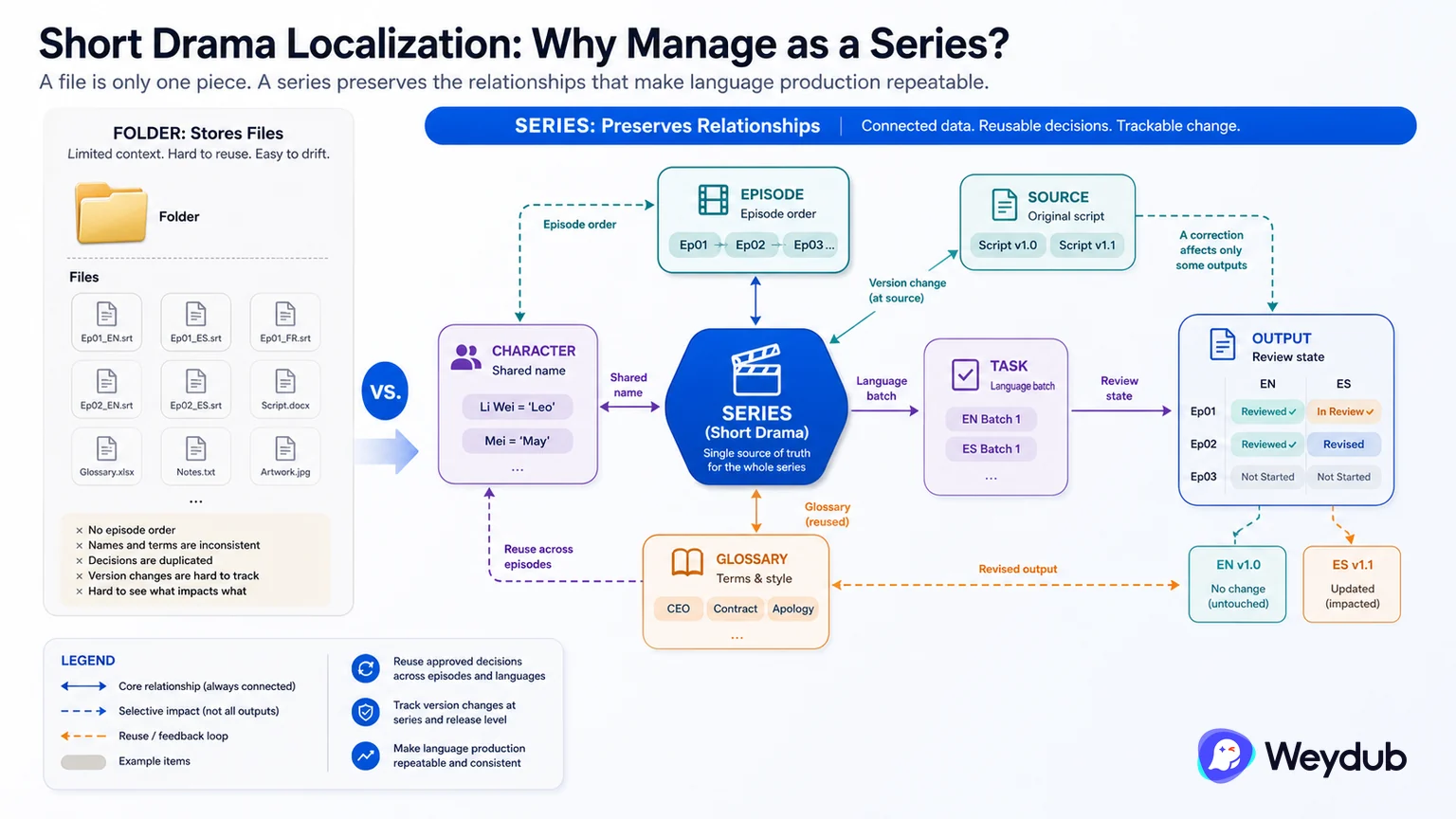
A file shows a piece of picture; a series model preserves the relationships that make language production repeatable.
Key conclusions
- Keep episode, character, glossary, source, task, and output relationships visible.
- Reuse approved decisions across episodes and languages.
- Track version changes at the series and release level.
A single video file cannot explain its place in the story, the approved name of a character, the language batch it belongs to, or which delivery package already contains it. Those relationships become essential as soon as an episode is revised or a second language is added.
Series management lets a team reuse context without pretending that every output is identical. A character label can be shared, while a subtitle cue remains episode-specific. A source correction can identify affected outputs, while an unrelated language version remains untouched.
Focused file tasks still have a place. The operating model should simply grow with repetition: from one transformation to a series asset, from a download to a tracked output, and from a note to a reviewable decision.
Files are outputs; the series is the production context
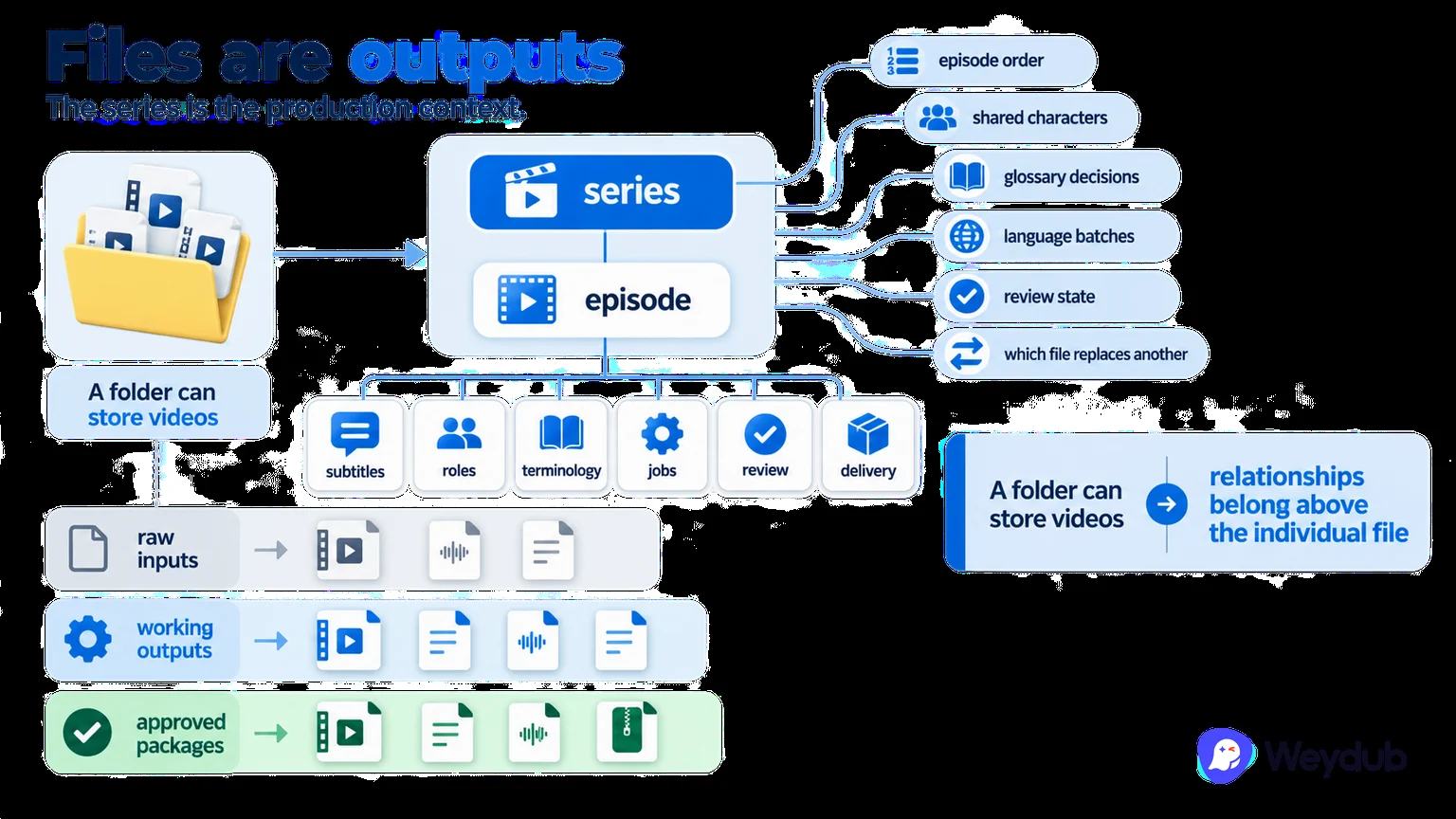
A folder can store videos, but it does not reliably express episode order, shared characters, glossary decisions, language batches, review state, or which file replaces another. Those relationships belong above the individual file.
- Use series and episode as stable production objects.
- Attach subtitles, roles, terminology, jobs, review, and delivery to the correct object.
- Keep raw inputs, working outputs, and approved packages distinguishable.
Make version relationships visible
When a source name changes, the team needs to find the affected languages, voices, composites, metadata, and delivery packages. Overwriting a file named final hides the dependency boundary and encourages either missed updates or unnecessary full regeneration.
| Level | Shared context | Typical question |
|---|---|---|
| Series | Characters, glossary, rights, release plan | What applies across episodes? |
| Episode | Source, cues, scenes, exceptions | Which unit needs review? |
| Language batch | Translation, voice, approval | Which target version is current? |
| Delivery | Channel package and rights window | What can ship now? |
Use Studio when repetition creates coordination cost
A single clip may remain a focused job. Repeated episodes and languages need shared context, status, review, handoff, and API or export boundaries. The system should make local rework possible without losing the approved series context.
- Create the series and episode structure.
- Attach approved source and shared language context.
- Run tasks by language or media operation.
- Review and record exceptions at the smallest unit.
- Export a versioned delivery package.
Frequently asked questions
Does managing by series mean every episode must share one output?
No. It means shared context and dependencies are visible while each episode and language version retains its own state.
When is a folder still enough?
For a small one-off handoff it may be adequate, but recurring episodes, languages, and revisions quickly require structured state.
Related theme: Localization production
Weydub workflow
Take the next production step
Connect episodes, language work, review, and delivery when a short drama needs more than a one-off file transformation.