
Knowledge systems
Why build a short-drama globalization knowledge graph instead of a tool list?
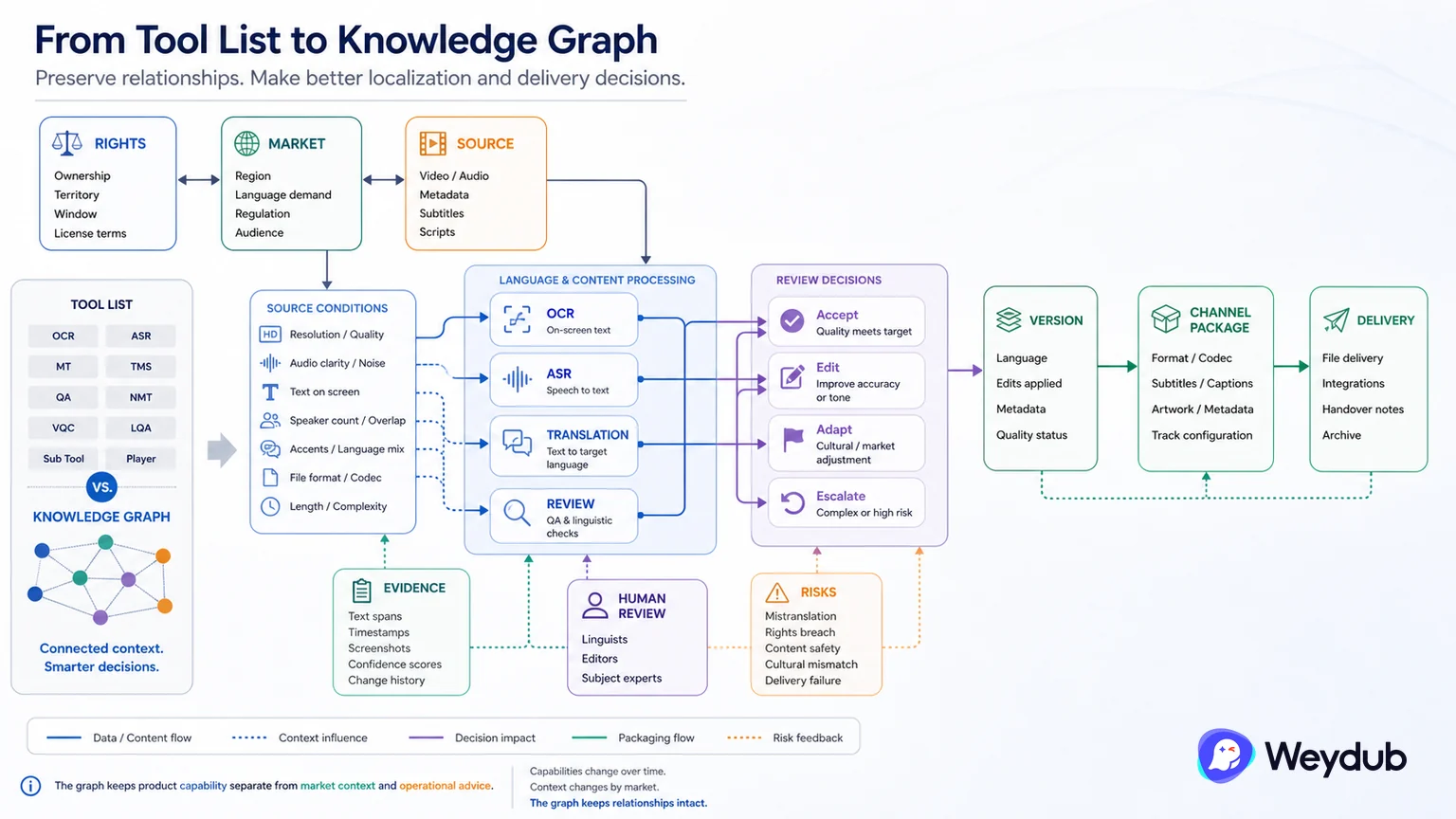
Tool pages answer isolated questions; a connected graph preserves the relationships between rights, markets, assets, language, quality, and delivery.
Key conclusions
- Connect concepts, entities, workflows, and evidence.
- Keep product capability separate from market context and operational advice.
- Use relationships to explain what changes when a source, channel, or language changes.
A tool list can tell a reader that an OCR, translation, or dubbing capability exists. It does not explain when it should start, which source it depends on, what the next handoff is, or which risks travel into delivery.
A knowledge graph organizes those relationships. Market and rights choices affect source intake; source conditions affect OCR, ASR, picture, and language paths; review decisions affect versions and channel packages. The graph can remain useful even as individual tools and platform rules change.
Public pages should expose the concepts and evidence that help a reader make a decision. Internal operational records, credentials, private analytics, and unverified claims should remain outside the public graph.
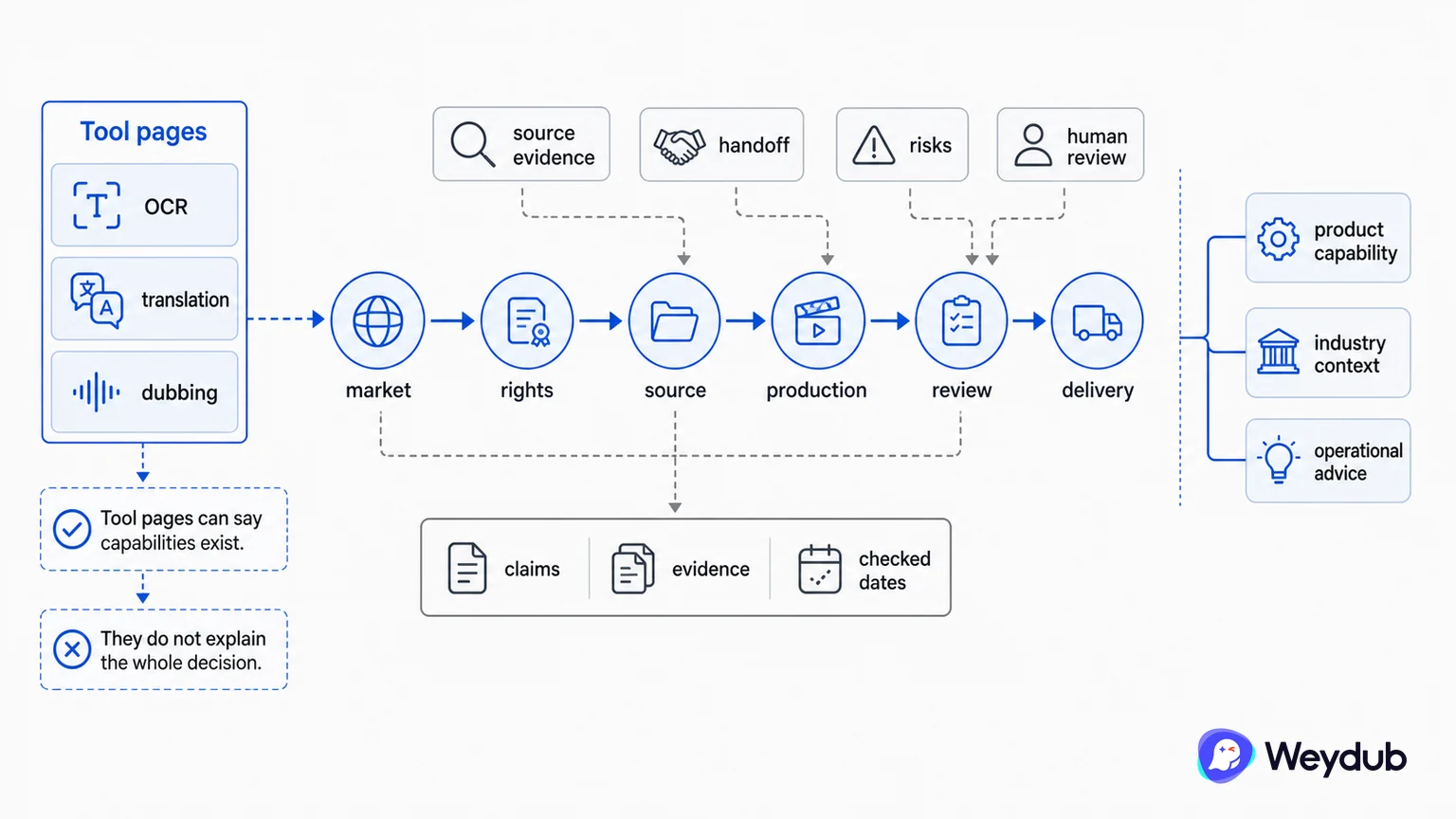
Tool pages do not explain the whole decision
A tool list can say that OCR, translation, or dubbing exists. It does not show which source evidence the capability needs, what handoff follows, which risks travel into delivery, or when human review should intervene.
- Connect market, rights, source, production, review, and delivery concepts.
- Keep product capability separate from industry context and operational advice.
- Attach claims to evidence and checked dates.
Model the relationships that change the work
A rights or market decision changes the source and channel brief. Source condition changes OCR, ASR, picture, and language paths. Review decisions change versions and packages. A graph keeps those dependencies visible while individual tools and platform rules change.
| Graph layer | Connected concepts | Question |
|---|---|---|
| Context | Market, language, territory, rights | Where can this version be used? |
| Production | Source, OCR/ASR, translation, picture, voice | How is it made and reviewed? |
| Objects | Series, episode, asset, job, output | What depends on what? |
| Delivery | Channel, metadata, package, feedback | What can ship and what did it teach? |
Expose the public map, protect private operations
Public pages can explain concepts, product boundaries, evidence, and decision logic. Credentials, private analytics, submission records, internal experiments, and unverified claims remain outside the public graph. The graph should help a reader reason, not pretend that every node is a universal fact.
- Define entities and evidence levels.
- Connect concepts to workflows and documents.
- Keep public claims scoped and dated.
- Separate private operational records.
- Review links and graph edges as the product evolves.
Frequently asked questions
Is a knowledge graph just a navigation page?
No. Navigation is one output. The important part is preserving relationships between decisions, assets, workflows, evidence, and delivery.
Should internal metrics and credentials be added to the public graph?
No. Public pages should expose supported concepts and evidence while private operations remain controlled.
Related theme: Industry observations
Weydub workflow
Take the next production step
Apply the decision framework to a repeatable localization workflow with visible assets, tasks, and handoffs.