
Market selection
Which overseas market should a short drama enter first?
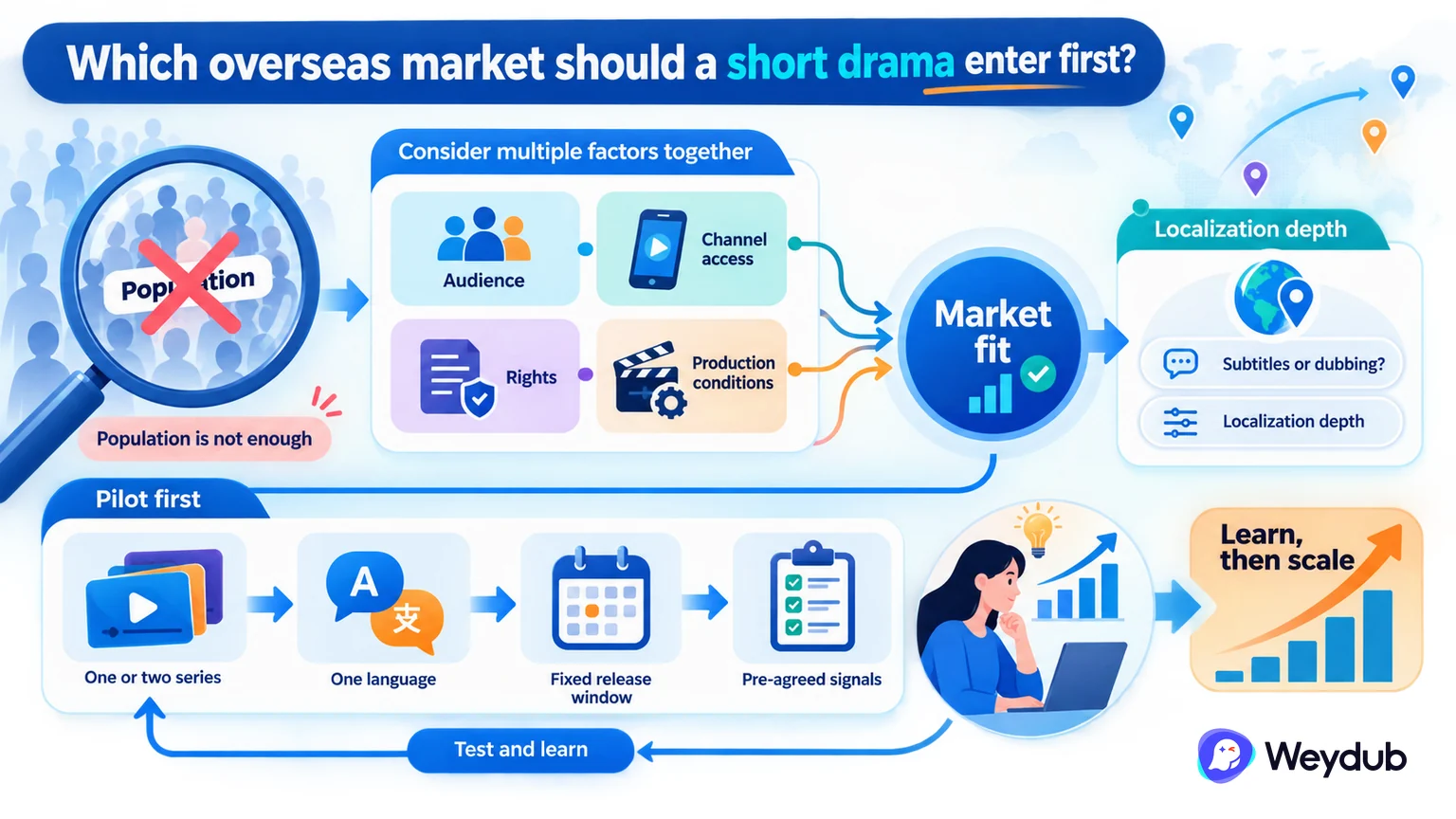
Population alone is a weak market filter. Language fit, channel access, rights, audience behavior, and localization depth matter together.
Key conclusions
- Score market fit across audience, channel, rights, and production conditions.
- Use a small release test before committing a full library or many languages.
- Do not treat a large addressable audience as proof of profitable acquisition.
A first market is a learning decision as much as a revenue decision. The team needs to know whether the story premise travels, whether the chosen channel can reach the audience, whether the rights cover the intended use, and whether subtitles or dubbing are sufficient for the test.
Language is only one part of the localization cost. Titles, descriptions, payment expectations, content rules, voice style, thumbnail promises, and customer support can all change the operating model. A market that looks close in a spreadsheet may require more adaptation than a smaller but better-supported test market.
A practical pilot limits the variables: one or two series, one language or locale, a clear channel, a fixed release window, and pre-agreed signals for continuation. The result should inform the next investment rather than be presented as a universal market ranking.
Population is an upper bound, not a route to viewers
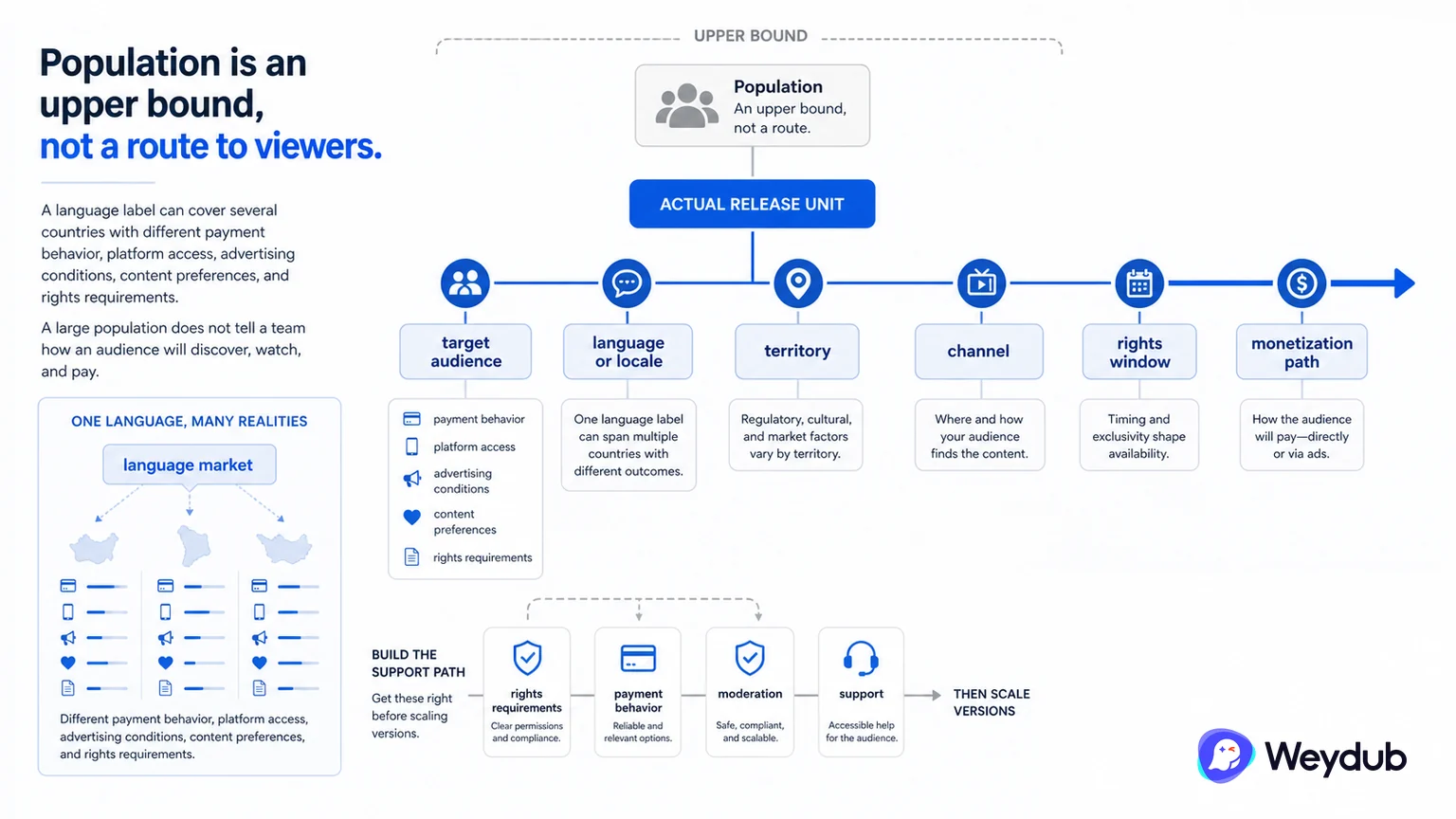
A language label can cover several countries with different payment behavior, platform access, advertising conditions, content preferences, and rights requirements. A large population does not tell a team how an audience will discover, watch, and pay for a specific series.
Start with the actual release unit: target audience, language or locale, territory, channel, rights window, and monetization path.
- Separate language market from territory.
- Name the first channel and the audience behavior it needs.
- Check rights, payment, moderation, and support constraints before scaling versions.
Use a market scorecard with evidence
Compare audience fit, content and platform access, acquisition path, payment or advertising model, rights availability, localization cost, competition, and the team's operating ability. A market with a reachable audience, clear rights, and a manageable test may teach more than a larger market that cannot be distributed or measured cleanly.
| Dimension | Question | Evidence |
|---|---|---|
| Audience fit | Does the story promise make sense? | Sample review and audience response |
| Reach | Can the audience be acquired? | Channel and creative test |
| Monetization | How does value become revenue? | Payment, ads, subscription, or rights model |
| Operations | Can the team support it? | Rights, language review, support, delivery |
Treat the first release as a controlled test
Define a sample, channel, language policy, budget, and success signal. Keep localized assets, campaign promise, and version state connected so a weak result can be assigned to story, language, packaging, acquisition, or payment rather than being blamed on the market as a whole.
- Define the audience and release scope.
- Choose a representative story and localization depth.
- Prepare the channel and acquisition promise.
- Measure viewing, continuation, conversion, and operational defects.
- Use the result to choose the next territory or language.
Frequently asked questions
Should English always be the first overseas language?
Not automatically. The right first target depends on audience fit, channel access, rights, localization effort, monetization, and the team's ability to learn.
Can one language version represent several countries?
It can be reused in some cases, but territory, rights, payment, culture, platform, and support decisions still need separate review.
Related theme: Short-drama globalization
Weydub workflow
Take the next production step
Move from a market and source decision to a reviewable multi-episode localization workflow.