
Format fundamentals
Why are short-drama episodes often one to three minutes long?
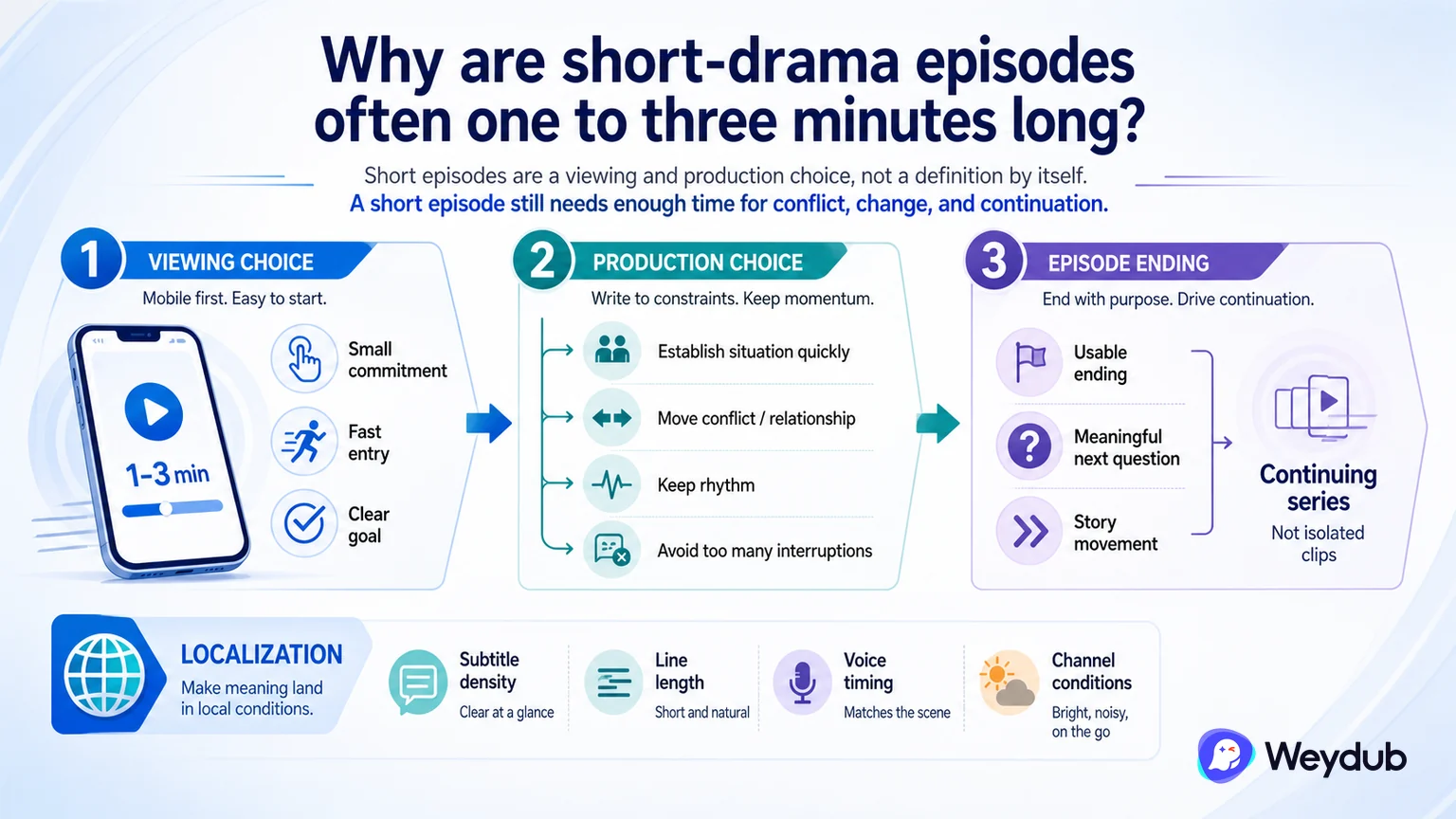
Short episodes lower the commitment to start watching, but the story still needs enough time for conflict, change, and a reason to continue.
Key conclusions
- Episode length is a viewing and production choice, not a definition by itself.
- Fast entry requires clear character goals and efficient scene movement.
- A short episode still needs a usable ending, not an arbitrary cut.
One to three minutes fits mobile sessions and makes the first viewing decision feel small. It also creates a strict writing and editing constraint: the episode has to establish a situation, move the relationship or conflict, and leave the audience with a meaningful next question.
Short does not mean every second should contain a twist. Characters still need enough space to be understood, and emotional beats need a rhythm that is more than a sequence of interruptions. A series can be fast without becoming impossible to follow.
For localization, the format affects subtitle density, line length, voice timing, and delivery. The target version should preserve the episode's story movement while meeting the reading and listening conditions of its channel.
Short is a format constraint, not the whole definition
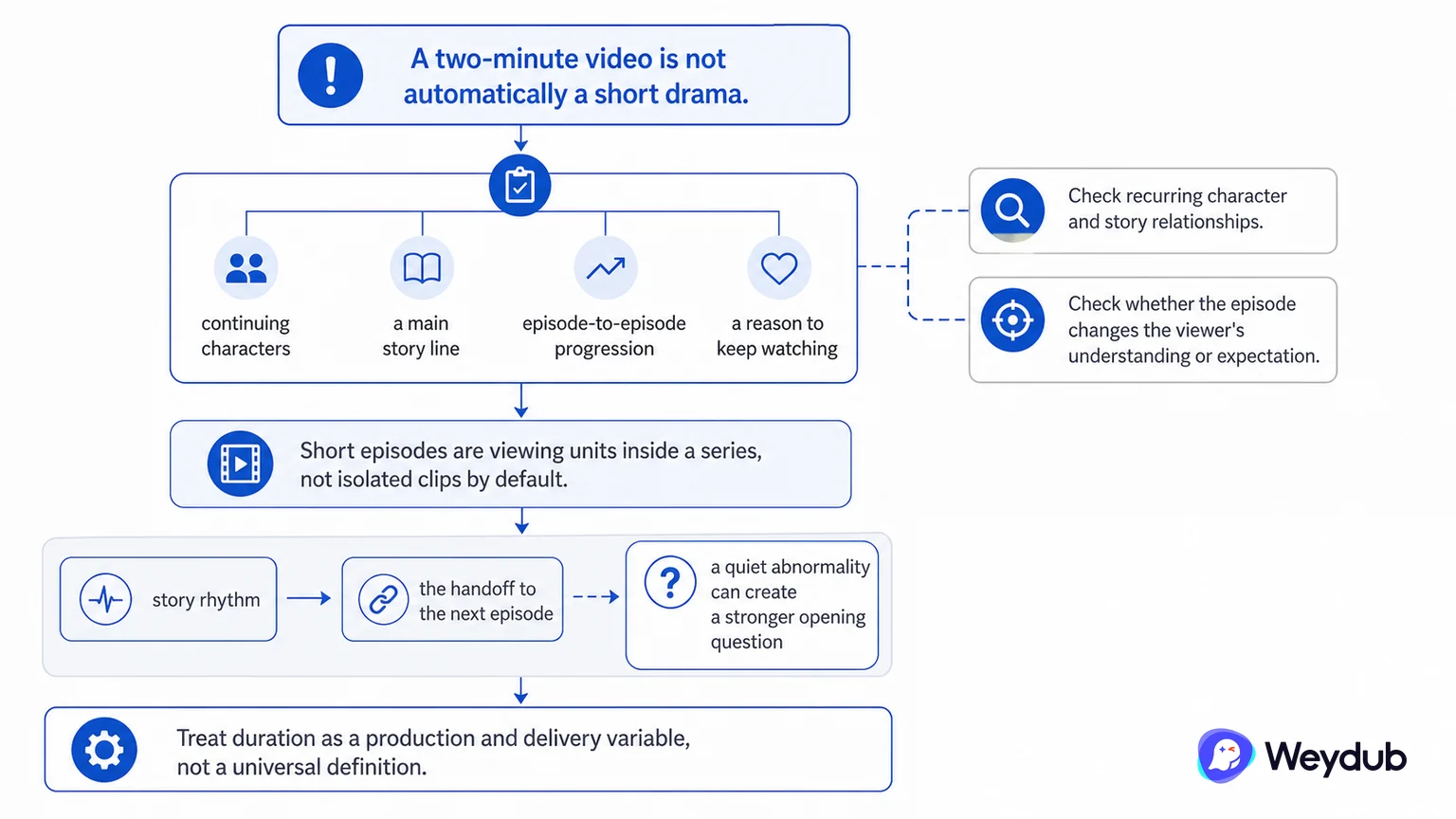
A two-minute video is not automatically a short drama. The format depends on continuing characters, a main story line, episode-to-episode progression, and a reason to keep watching. Short episodes are viewing units inside a series, not isolated clips by default.
Length changes how much a scene can establish, but story rhythm and the handoff to the next episode matter just as much. A quiet abnormality can create a stronger opening question than a loud event with no context.
- Check recurring character and story relationships.
- Check whether the episode changes the viewer's understanding or expectation.
- Treat duration as a production and delivery variable, not a universal definition.
Episode length changes the production and channel package
Short episodes require deliberate entrances, exits, captions, thumbnails, playlists, and continuation paths. The localization workflow must preserve the story unit while adapting subtitle density, dubbing duration, picture text, and metadata for the target channel.
Do not compare an episode by length alone. Two episodes of the same duration may have very different dialogue density, visual complexity, and review risk.
| Question | Why it matters | What to review |
|---|---|---|
| Story unit | Does the episode move the series? | Conflict, relationship, change, next question |
| Language | Can the audience read or hear it? | Cue density, pauses, names, timing |
| Picture | Can the localized frame survive? | Text regions, faces, hands, motion |
| Delivery | Can viewers continue? | Episode order, title, thumbnail, playlist |
Use the format to design a test
A representative sample should include an opening hook, a relationship or plot turn, a difficult subtitle or audio moment, and the transition to the next episode. This tests whether localization protects the format rather than only whether one file exports correctly.
- Define the series and audience promise.
- Select representative short episodes.
- Review story rhythm, language density, picture, and sound.
- Check the channel handoff and continuation path.
- Use audience and production evidence to refine episode design.
Frequently asked questions
Does a short episode have to be one to three minutes?
No. That is a common range in some short-drama products, not a universal definition. Series continuity and viewing design matter more than a single duration threshold.
Can a short-drama episode be treated like a social clip?
Sometimes it can be repurposed, but a series episode carries story, character, localization, and continuation context that a standalone clip may not.
Related theme: Short-drama format and economics
Weydub workflow
Take the next production step
Connect episodes, language work, review, and delivery when a short drama needs more than a one-off file transformation.