
Review operations
A practical review checklist for short-drama localization
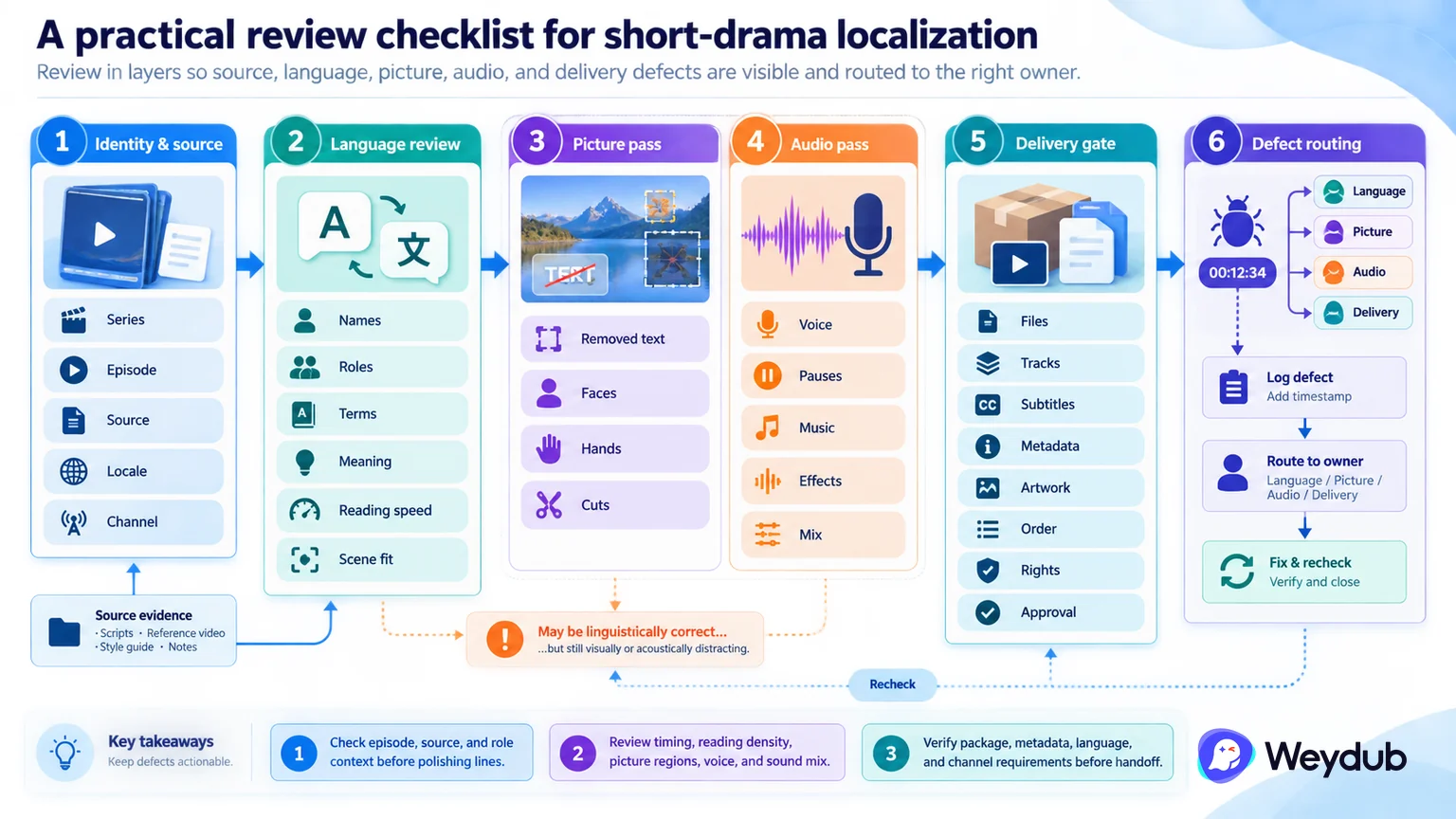
Review in layers so source, language, picture, audio, and delivery defects are visible and routed to the right owner.
Key conclusions
- Check episode, source, and role context before polishing lines.
- Review timing, reading density, picture regions, voice, and sound mix.
- Verify package, metadata, language, and channel requirements before handoff.
Start with identity: series, episode, source version, target locale, and intended channel. Then check the language layer: names, roles, terminology, meaning, segmentation, reading speed, and whether the target line fits the scene.
The picture and sound layers need their own pass. Inspect removed text, scene text, faces and hands, cuts, voice continuity, pauses, music, effects, and overall mix. A localization can be linguistically correct while still being visually or acoustically distracting.
Finish with delivery: file names, tracks, subtitle format, metadata, artwork, episode order, rights window, and approval state. Record defects with timestamps and a defined recheck path.
Review in five passes
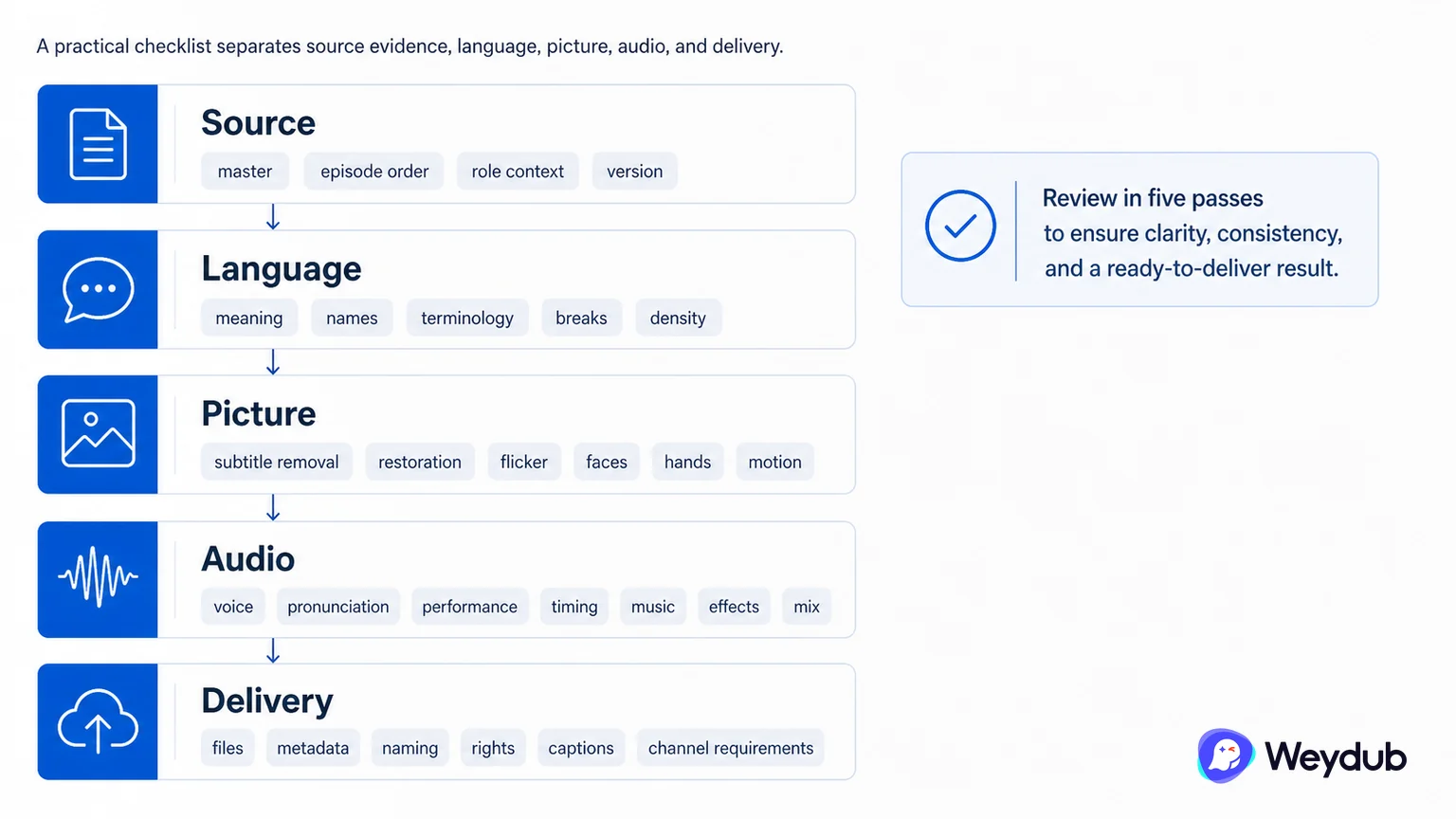
A practical checklist separates source evidence, language, picture, audio, and delivery. This makes an observed defect actionable and prevents a clean-looking video from hiding a missing track or wrong version.
- Source: master, episode order, role context, and version.
- Language: meaning, names, terminology, breaks, and density.
- Picture: subtitle removal, restoration, flicker, faces, hands, and motion.
- Audio: voice, pronunciation, performance, timing, music, effects, and mix.
- Delivery: files, metadata, naming, rights, captions, and channel requirements.
Sample the moments most likely to fail
Include the opening and ending, fast dialogue, scene changes, recurring names, emotional peaks, songs, overlapping speakers, text over faces or hands, and the first and last episodes of a batch. Record the risk reason beside every sample.
| Risk moment | What to watch | Possible follow-up |
|---|---|---|
| Fast dialogue | Timing, density, speaker changes | Cue or voice rework |
| Scene change | Entry, exit, continuity | Retiming or segmentation |
| Foreground text | Restoration and flicker | Narrow region or manual repair |
| Music or effects | Voice clarity and claims | Mix or rights review |
| Release edge | Metadata and package | Delivery hold |
Log the smallest repair unit
A useful issue record names episode, time range, language, asset, defect class, evidence, owner, and proposed repair. After correction, review dependent outputs rather than rerunning the whole series by habit.
- Select risk-based samples.
- Classify and record the defect.
- Repair cue, region, role, voice, episode, or field.
- Check neighboring and dependent outputs.
- Approve the corrected version with exceptions.
Frequently asked questions
Should every episode receive the same review coverage?
Use mandatory gates for every release and increase coverage around risk hotspots, new source conditions, and high-visibility episodes.
Can a checklist replace an experienced reviewer?
No. It makes judgment traceable and repeatable; difficult or ambiguous cases still need qualified review.
Related theme: Quality and review
Weydub workflow
Take the next production step
Organize source, language, picture, audio, and delivery checks around the version that is actually going to ship.