
Content forms
AI drama, AI comics, and live-action short drama: what actually differs?
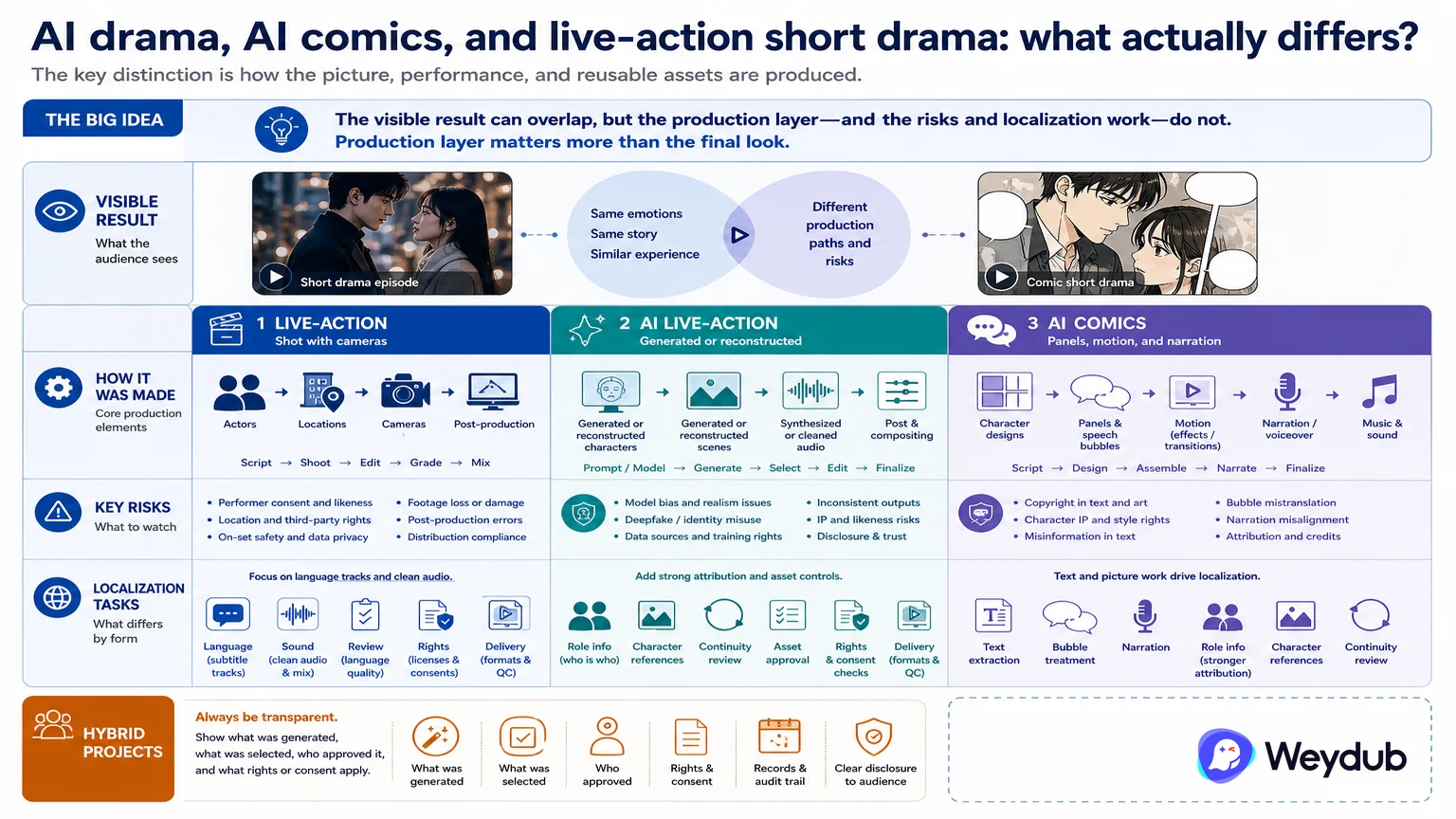
The useful distinction is how the picture, performance, and reusable assets are produced, not whether a project used AI somewhere in the pipeline.
Key conclusions
- Identify which production layer uses AI and which assets remain human-controlled.
- Expect different continuity and source-material risks across forms.
- All three forms still need language, sound, review, rights, and delivery management.
Live-action drama relies on actors, locations, cameras, and post-production. AI live-action projects may generate or reconstruct realistic characters and scenes. AI comics may combine character designs, panels, motion, speech, bubbles, and narration. The visible result can overlap, while the production risks do not.
The distinction matters when a team localizes the series. A live-action source may need subtitle tracks, clean audio, and role information. An AI live-action source may need character references and continuity review. An AI comic may require picture-text extraction, bubble treatment, narration, and stronger character attribution.
A hybrid project should describe which asset was generated, which was selected, who approved it, and what rights or consent apply. Saying that a project is simply an AI drama hides the information needed to plan localization and rework.
Identify which production layer uses AI
Live-action drama relies on actors, locations, cameras, and post-production. AI live-action projects may generate or reconstruct realistic characters and scenes. AI comics may combine character designs, panels, motion, speech, bubbles, and narration. The visible result can overlap while the production risks do not.
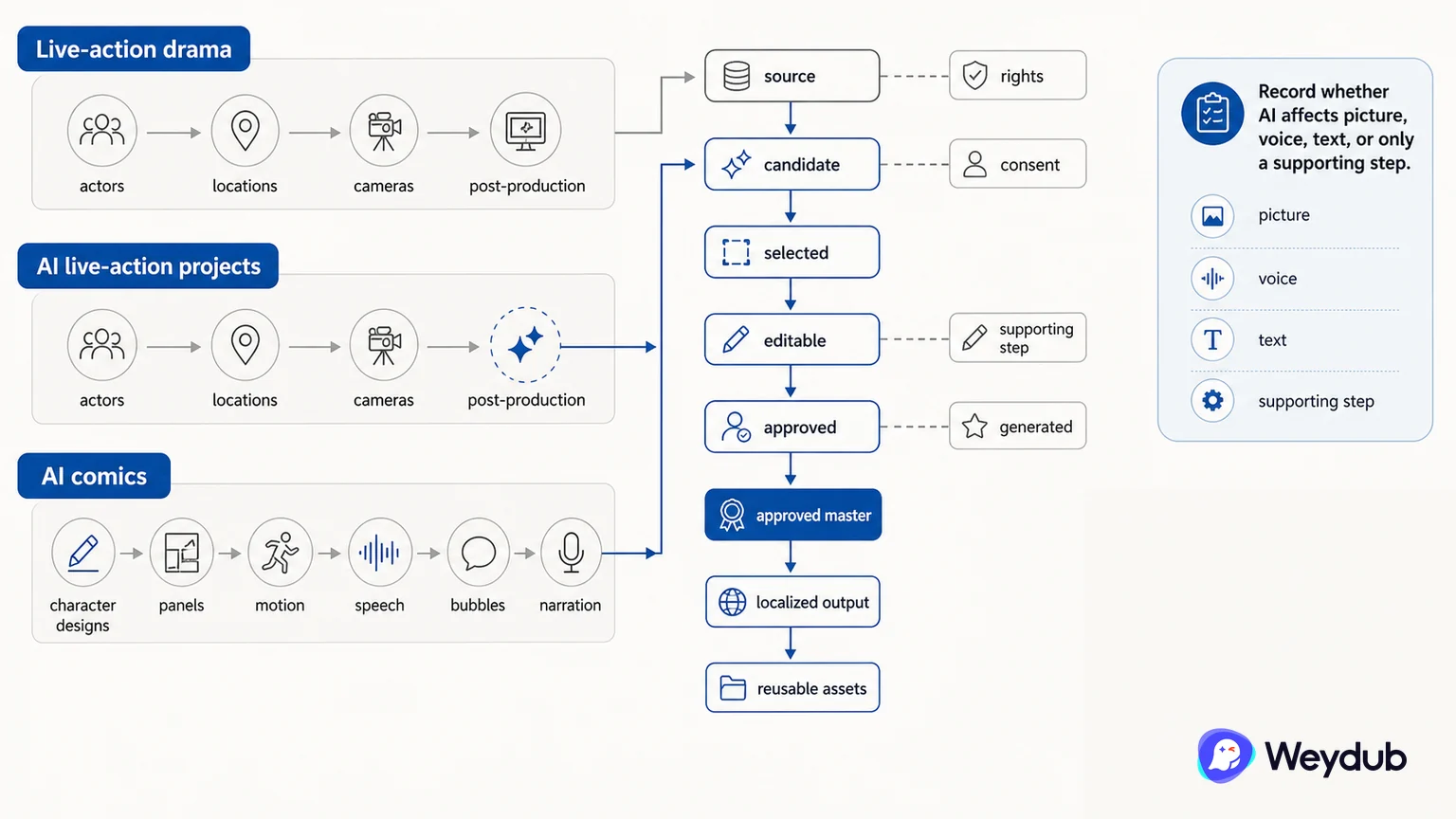
The useful distinction is the asset lineage: what was generated, what was selected, what remains editable, who approved it, and which rights or consent apply.
- Describe source, candidate, approved master, and localized output separately.
- Record whether AI affects picture, voice, text, or only a supporting step.
- Keep rights and references attached to the relevant asset.
The localization input changes with the content form
A live-action source may need subtitle tracks, clean audio, and role information. An AI live-action source may need character references and continuity review. An AI comic may need picture-text extraction, bubble treatment, narration, and stronger character attribution.
All three still need language, sound, review, rights, and delivery management. The label alone does not tell a team which files or checks are required.
| Content form | Distinct source risk | Localization focus |
|---|---|---|
| Live action | Recorded performance and picture continuity | Clean master, audio, subtitles, roles |
| AI live action | Candidate selection and identity drift | References, continuity, voice, rights |
| AI comic | Panel identity, text, and narration | Character attribution, bubbles, voice, layout |
Plan hybrid projects by asset and decision
A hybrid project should state which layer is generated, which is human-controlled, who approved it, and what may change during localization. This turns a broad AI label into a usable production brief and makes later rework local when possible.
- Inventory visual, text, audio, and reference assets.
- Record source, candidate, approved, and derived lineage.
- Assign rights, consent, and acceptance owners.
- Test localization on representative difficult scenes.
- Deliver the version with its scope and evidence.
Frequently asked questions
Is an AI comic localized like a live-action series?
Some language and delivery principles are shared, but picture text, panel layout, character attribution, narration, and visual continuity may require different handling.
Does using AI in one step make the whole production an AI drama?
The label is less useful than describing which assets and decisions use AI and which remain human-controlled.
Related theme: AI media workflows
Weydub workflow
Take the next production step
Keep automation, review, and delivery connected when AI-generated media needs to become a usable release.