
High-risk picture repair
How to reduce subtitle-removal damage over faces and hands
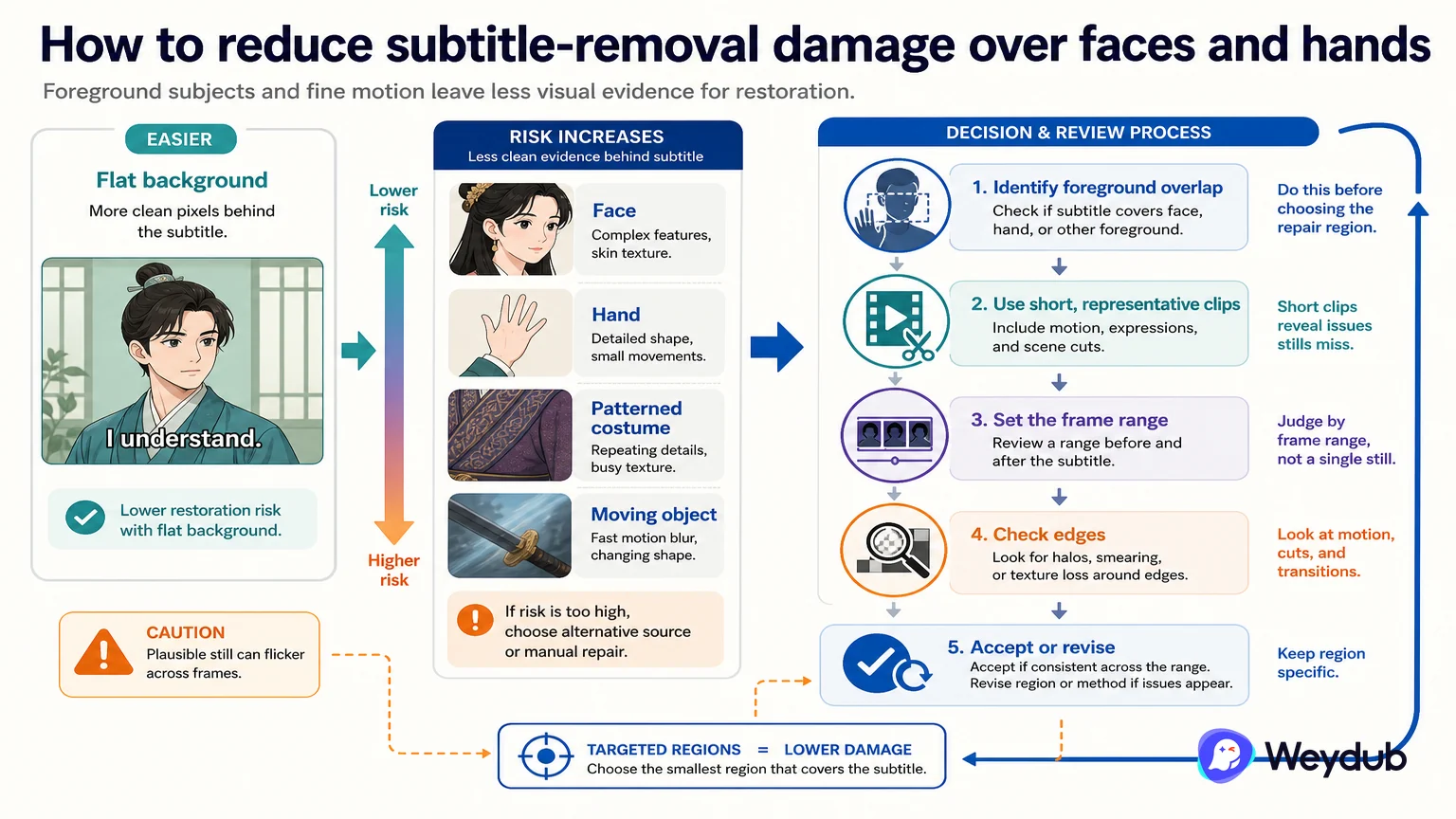
Foreground subjects and fine motion leave less visual evidence for restoration, so they need targeted regions and closer review.
Key conclusions
- Identify foreground overlap before choosing the repair region.
- Use short representative clips with motion, expressions, and scene cuts.
- Accept or revise by frame range rather than trusting a single still image.
Text over a flat background is often easier to repair than text over a face, hand, patterned costume, or moving object. The system may have to infer both the background and a foreground boundary, and a plausible still frame can still flicker during motion.
Protect the subject where possible and keep the region as specific as the source allows. Review frame sequences, not only before-and-after screenshots. Pay attention to edges, expressions, hand movement, and the moment a subtitle appears or disappears.
If the risk is too high, consider a different source, a crop, an editorial alternative, or a manual repair for the critical shot. A localized release is better served by an explicit limitation than by an unreviewed clean-looking frame.
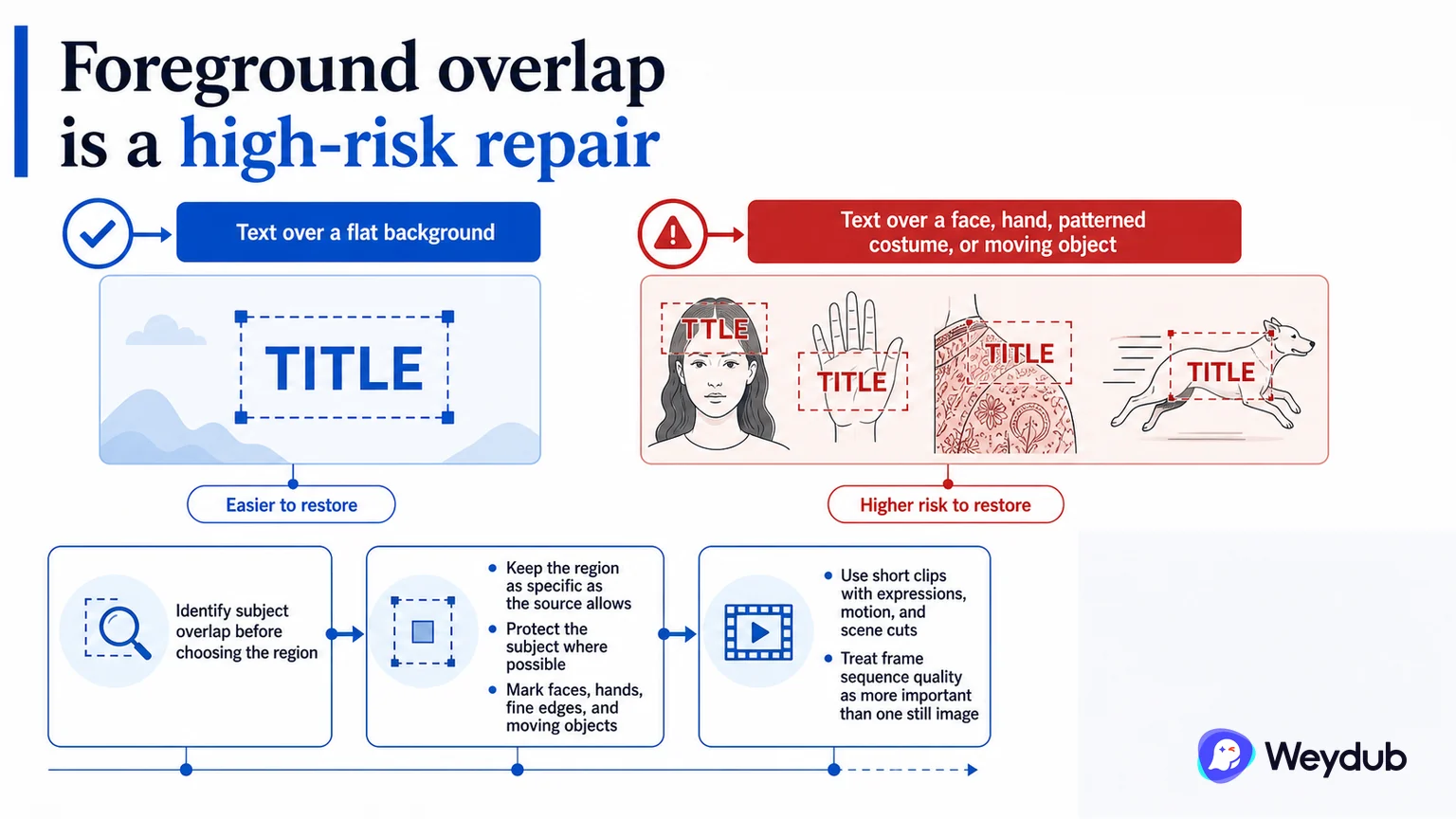
Foreground overlap is a high-risk repair
Text over a flat background is often easier to restore than text over a face, hand, patterned costume, or moving object. The system may need to infer both background and foreground boundaries, and a plausible still frame can still flicker during motion.
Identify subject overlap before choosing the region. Keep the region as specific as the source allows and protect the subject where possible.
- Mark faces, hands, fine edges, and moving objects.
- Use short clips with expressions, motion, and scene cuts.
- Treat frame sequence quality as more important than one still image.
Review the entire transition around the repair
A before-and-after screenshot can hide edge movement, texture changes, or a flicker when the subtitle appears and disappears. Watch the frame range with the original sound and picture, then compare the repair against the target subtitle or dubbed output.
| Risk | What can fail | Acceptance check |
|---|---|---|
| Face overlap | Expression or facial boundary changes | Continuous close-up playback |
| Hand or fine edge | Fingers and motion become unstable | Frame sequence and action |
| Moving background | Texture or geometry flickers | Camera or object movement |
| Text transition | Repair appears late or leaves residue | Entry, exit, and adjacent frames |
Use an explicit fallback when risk is too high
A different source, crop, editorial alternative, or manual repair may be safer for a critical shot. A localized release is better served by a stated limitation than by an unreviewed clean-looking frame.
- Classify foreground and motion risk.
- Create a short representative sample.
- Review continuous frames rather than screenshots.
- Choose AI, manual, crop, source replacement, or keep-text path.
- Record the limitation and approve the usable version.
Frequently asked questions
Why can a still image pass while the video fails?
Restoration may look plausible in one frame but flicker or distort edges across motion. Continuous playback is required for acceptance.
Should high-risk shots always be rejected?
No. They should receive targeted review and an explicit fallback decision when the source evidence cannot support a reliable repair.
Related theme: Localization capabilities
Weydub workflow
Take the next production step
Start with the source condition and choose a focused workflow for subtitle extraction, picture cleanup, or language production.