
Format fundamentals
Why do short dramas often run for dozens of episodes?
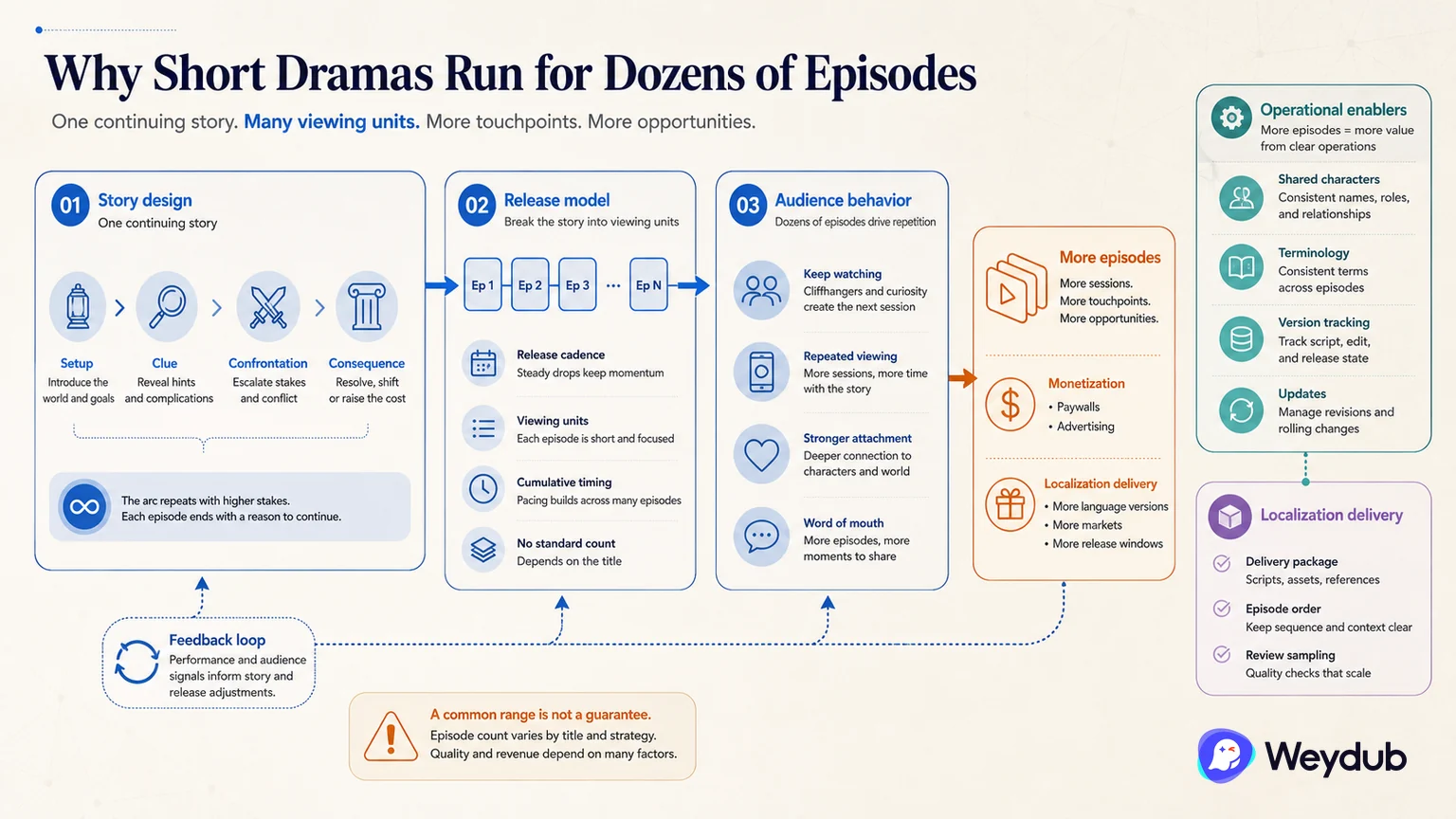
A long series made of short episodes creates a different relationship between story structure, release cadence, and monetization.
Key conclusions
- Episode count is shaped by story design, release model, and audience behavior.
- More episodes increase the value of shared characters, terminology, and version tracking.
- Do not use a common range as a quality or revenue guarantee.
A short drama can divide a continuous story into many small viewing units. This lets a viewer begin with a low time commitment while allowing the full story to build over repeated sessions. The number of episodes also affects updates, paywalls, advertising opportunities, and the size of the delivery package.
From a production perspective, more episodes increase the value of series context. Names, relationships, subtitles, voice decisions, and source versions need to remain consistent across the run. A folder of files is not enough to explain which episode belongs to which language and release state.
The right episode count depends on the story and channel. Localization teams should plan for episode order, cumulative timing, shared assets, and review sampling rather than assuming that a standard count will fit every title.
Episode count is a story and release decision
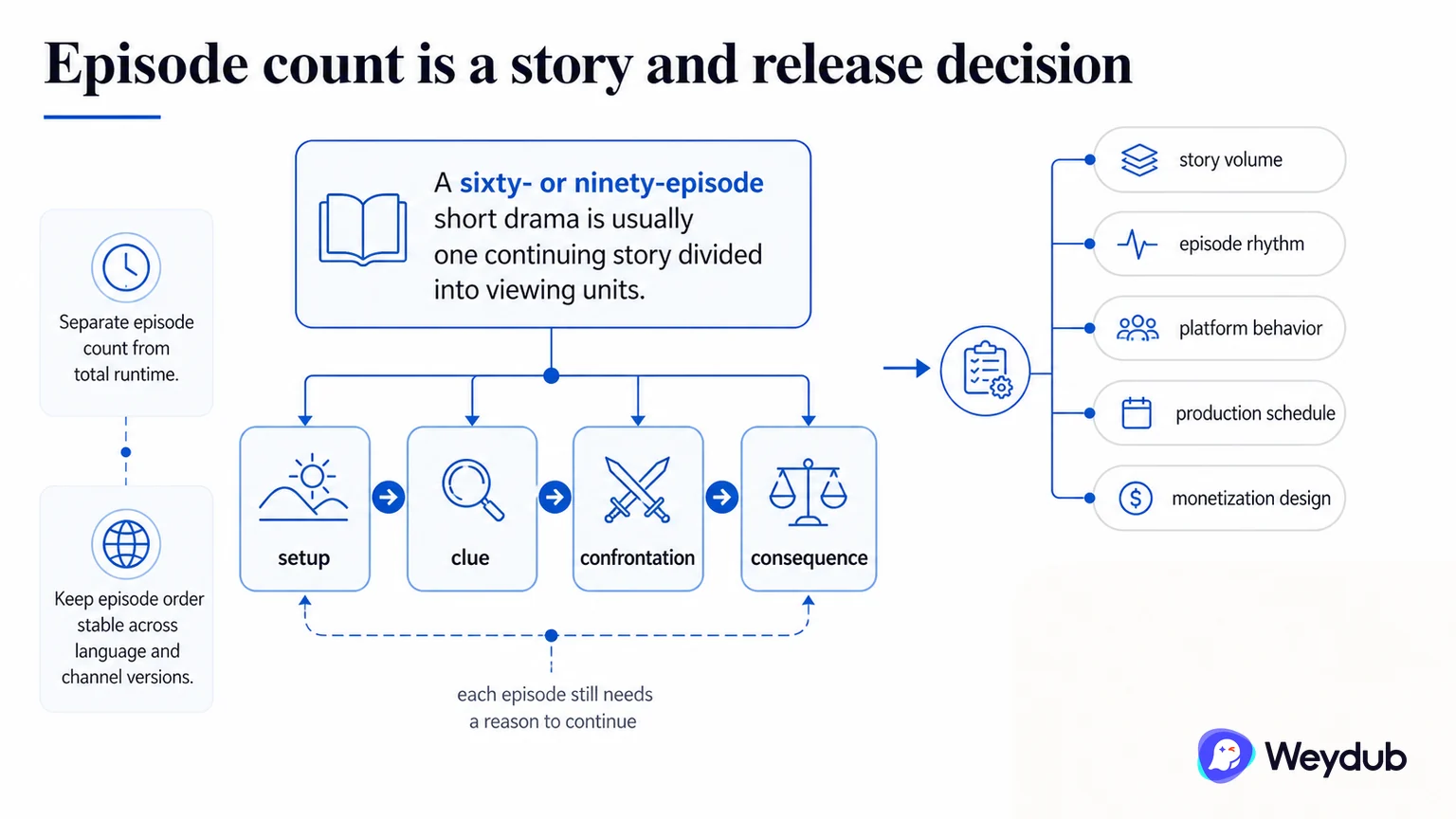
A sixty- or ninety-episode short drama is usually one continuing story divided into viewing units, not dozens of unrelated shorts. A reveal may be split across setup, clue, confrontation, and consequence, while each episode still needs a reason to continue.
The final count depends on story volume, episode rhythm, platform behavior, production schedule, and monetization design. It should not be treated as a fixed industry rule.
- Separate episode count from total runtime.
- Map turning points and cliffhangers across the series.
- Keep episode order stable across language and channel versions.
More episodes increase localization state
A larger series creates more subtitle files, clean masters, voices, metadata, and review decisions. The team needs series context, episode identifiers, glossary and character records, and package reconciliation so one missing or outdated asset does not hide inside a large folder.
Longer series also multiply the effect of a source decision. A changed name, role, or subtitle style may affect many episodes and languages, while a local picture defect may affect only one time range.
| Scale question | Risk | Control |
|---|---|---|
| Episode order | Wrong sequence or missing unit | Manifest and count reconciliation |
| Recurring context | Names, roles, terms drift | Series glossary and character record |
| Language versions | Old and new outputs mix | Version and replacement links |
| Delivery | One incomplete package blocks release | Channel-specific acceptance checklist |
Plan a series as reusable context
The right workflow shares the decisions that should remain stable while keeping episode status and review local. A correction to one cue should not force a full series regeneration, but a source change that affects recurring context should show its downstream scope.
- Create the episode and series manifest.
- Approve shared roles, terminology, and source rules.
- Process and review episodes with explicit status.
- Reconcile all language and channel packages.
- Record source changes and affected versions.
Frequently asked questions
Does a ninety-episode series need ninety separate localization projects?
Not necessarily. Episodes need local status, but shared series context, terminology, and delivery rules should be reusable.
Does more episodes always mean more value?
No. Count affects story, production, release, and monetization design. The useful measure is whether the series sustains viewing and can be delivered consistently.
Related theme: Short-drama format and economics
Weydub workflow
Take the next production step
Connect episodes, language work, review, and delivery when a short drama needs more than a one-off file transformation.