
YouTube format
Why do YouTube short dramas often become one long compilation?
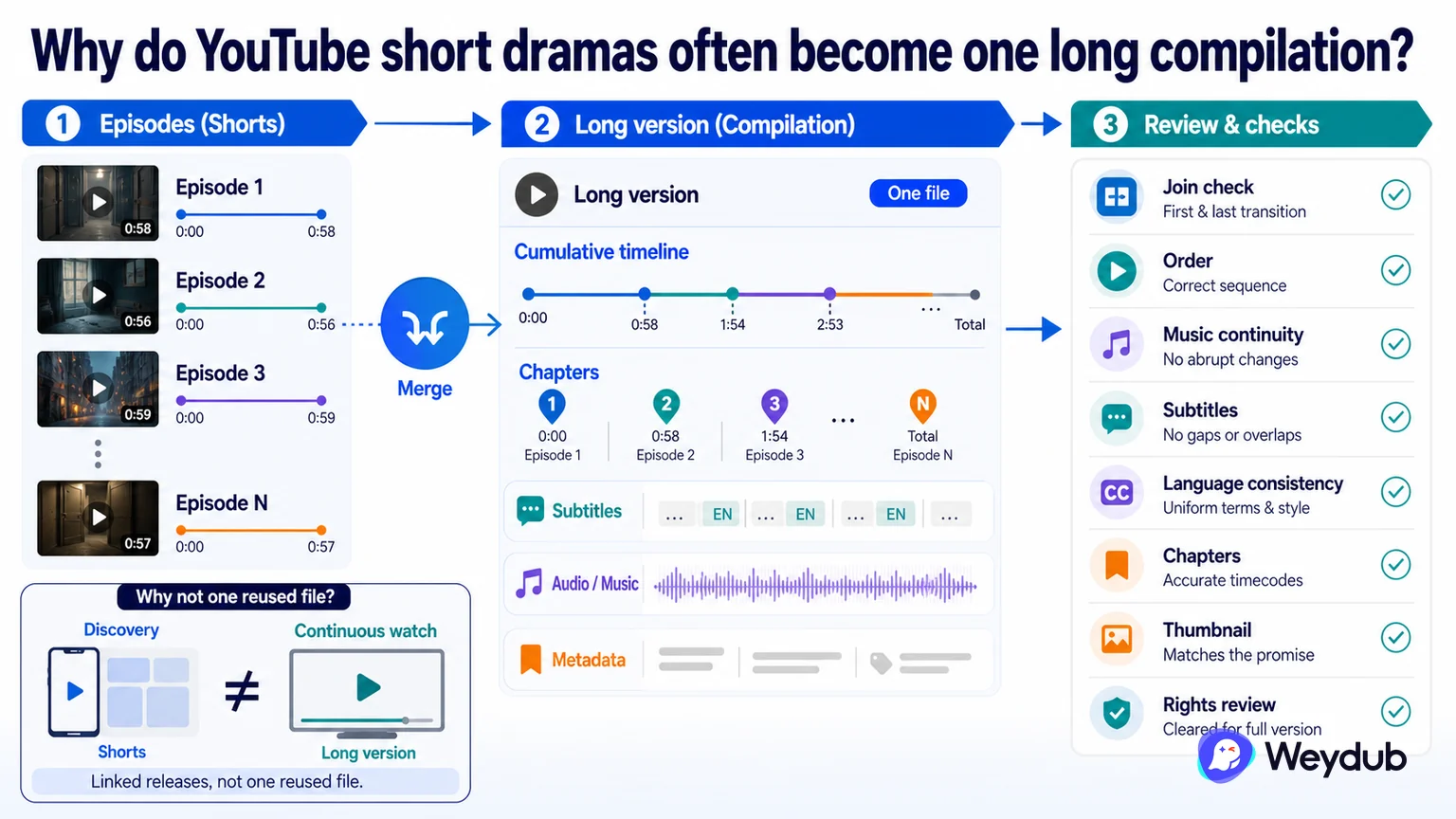
A compilation changes the viewing path, cumulative timeline, subtitle timing, metadata, and rights review of the series.
Key conclusions
- Keep episode order and cumulative timecodes correct.
- Prepare chapters, title, thumbnail, description, and language metadata for the long version.
- Review joins, repeated intros, music, and subtitle continuity across the full run.
A compilation can make a series easier to find and watch as a library. It also turns separate episode timelines into one cumulative timeline. Subtitles, audio, chapter marks, metadata, and rights checks must follow the combined version rather than being concatenated without review.
The long version should have a clear reason to exist. It may support viewers who prefer continuous watching, while individual episodes or Shorts support discovery and sequence. Treat those as linked releases with different packaging, not as a single file reused everywhere.
Before publishing, check the first and last transition, chapter timecodes, language consistency, music and effects, thumbnail promise, and whether the combined runtime changes the channel's delivery or rights requirements.
A compilation creates a new timeline
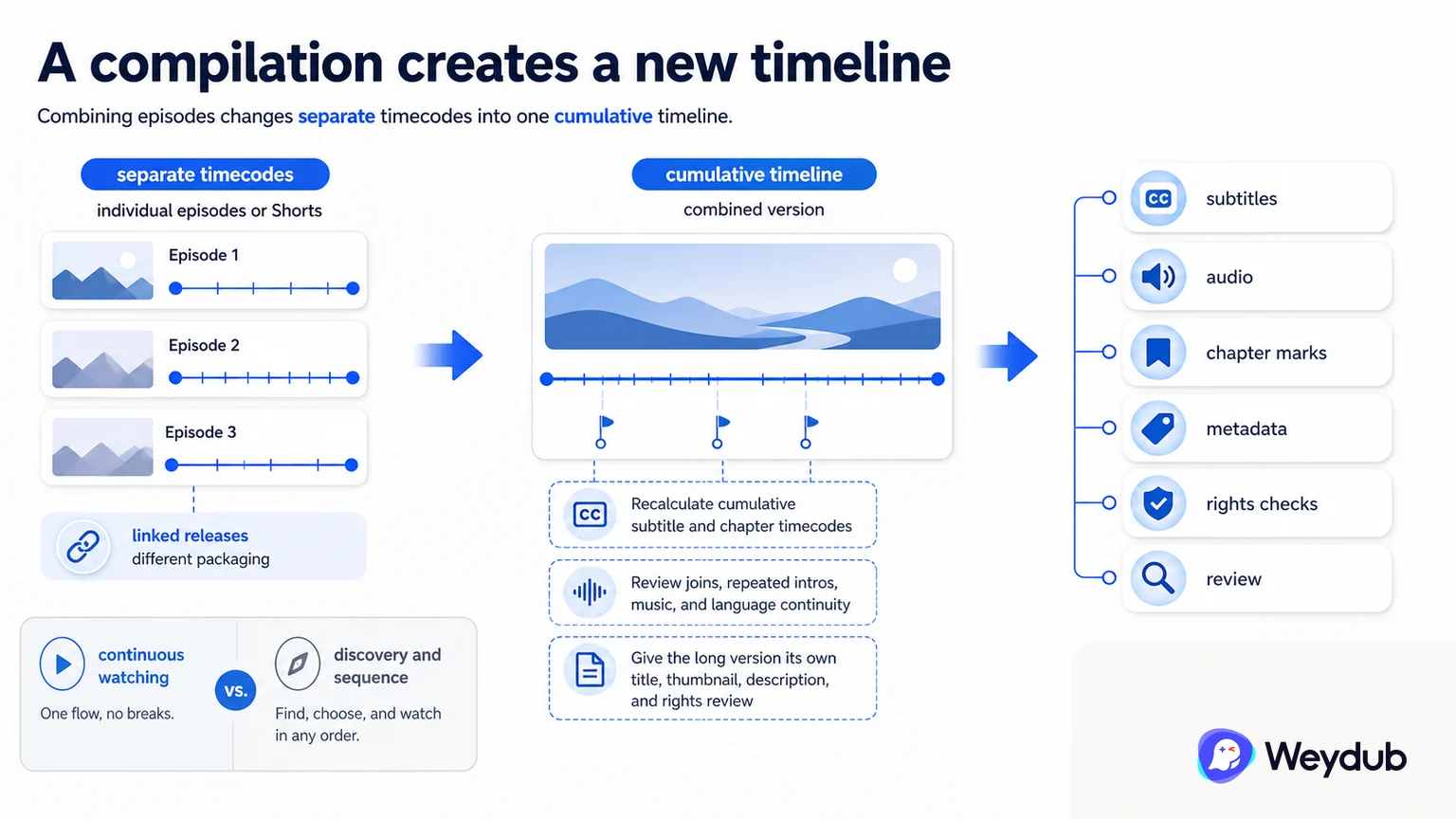
Combining episodes changes separate timecodes into one cumulative timeline. Subtitles, audio, chapter marks, metadata, rights checks, and review must follow the combined version rather than being concatenated without inspection.
A compilation can serve viewers who prefer continuous watching, while individual episodes or Shorts support discovery and sequence. Treat them as linked releases with different packaging.
- Recalculate cumulative subtitle and chapter timecodes.
- Review joins, repeated intros, music, and language continuity.
- Give the long version its own title, thumbnail, description, and rights review.
Check the handoffs inside the long version
The first and last transition, episode order, chapter locations, language settings, music and effects, and thumbnail promise should all be reviewed. A technically concatenated file can still contain a broken story or delivery package.
| Compilation layer | What changes | Check |
|---|---|---|
| Timeline | Cumulative timecodes | Subtitles, chapters, audio |
| Story | Episode boundaries and repeated intros | Order and transitions |
| Package | Title, thumbnail, description | Promise and language |
| Rights | Longer combined use | Music, territory, channel |
Publish linked versions deliberately
Define whether the compilation is a library release, a discovery destination, or a viewing convenience. Link it to individual episodes and playlists without assuming that one format's performance or rights status transfers automatically to another.
- Define the long version's audience job.
- Combine episodes and rebuild timecodes.
- Review transitions, audio, subtitles, chapters, and rights.
- Prepare title, thumbnail, description, and playlist links.
- Record the compilation as its own accepted version.
Frequently asked questions
Can episodes simply be concatenated into one video?
The picture may be concatenated, but subtitles, audio, chapters, metadata, transitions, and rights must be rebuilt and reviewed for the cumulative version.
Should a compilation replace individual episodes?
Not necessarily. They serve different entry and viewing jobs and can be maintained as linked release versions.
Related theme: Distribution and delivery
Weydub workflow
Take the next production step
Prepare a localized version with subtitles, voice, timing, and a delivery path that matches the destination.