
Quality sampling
How to sample multilingual short drama by risk
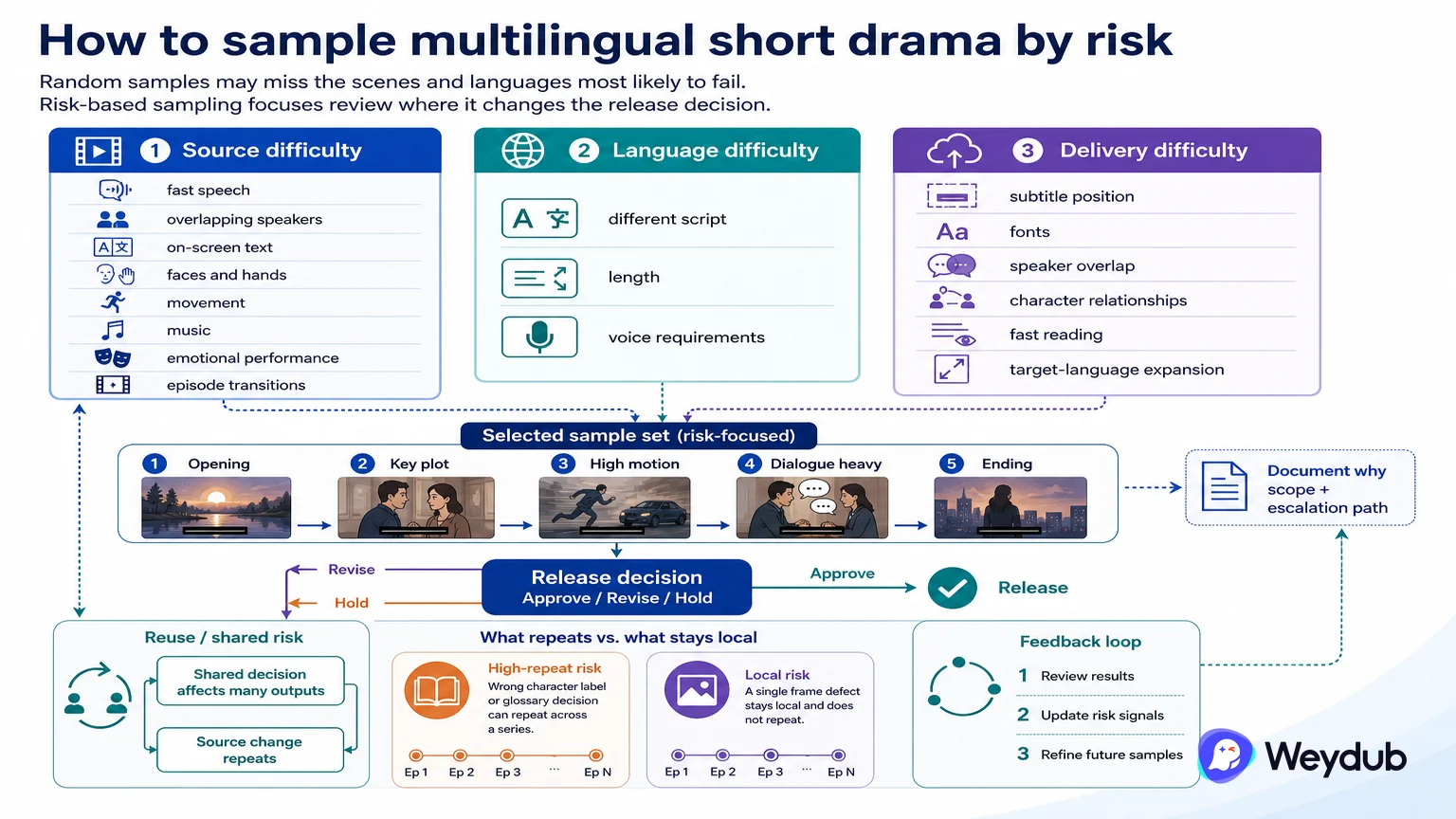
Random samples can miss the scenes and languages most likely to fail; risk-based sampling puts review effort where it changes the release decision.
Key conclusions
- Sample source difficulty, language difficulty, and delivery difficulty separately.
- Include opening, key-plot, high-motion, dialogue-heavy, and ending scenes.
- Increase coverage when a shared decision or source change affects many outputs.
A useful sample includes more than the first episode. Choose scenes with fast speech, overlapping speakers, on-screen text, faces and hands, movement, music, emotional performance, and episode transitions. Add languages with different script, length, or voice requirements.
Risk is also affected by reuse. A wrong character label or glossary decision may repeat across a series, while a single frame defect may remain local. The sample should test both likely frequency and likely consequence.
Document why the sample was chosen and what it represents. Sampling does not prove that unreviewed material is perfect; it supports a release decision with a known scope and a defined escalation path.
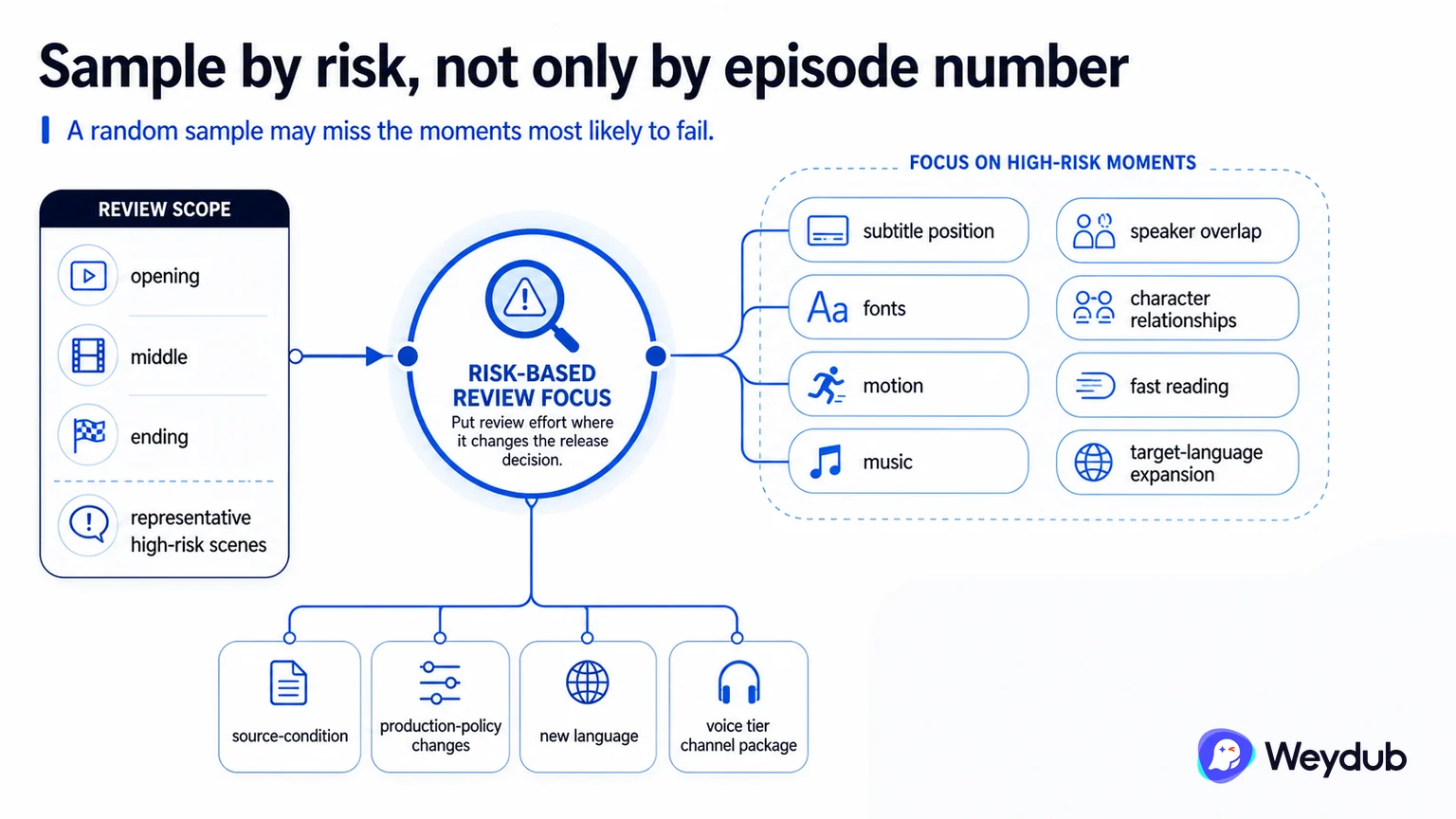
Sample by risk, not only by episode number
A random sample may miss the moments most likely to fail. Include changes in subtitle position, fonts, motion, music, speaker overlap, character relationships, fast reading, and target-language expansion.
- Cover source-condition and production-policy changes.
- Include opening, middle, ending, and representative high-risk scenes.
- Increase coverage for a new language, voice tier, or channel package.
Keep the sampling hypothesis explicit
A sample should answer a question: does OCR work across subtitle styles, can the target language stay readable, does the dubbed performance fit the scene, or does a channel package pass? Change one meaningful condition at a time so the result informs the next decision.
| Sampling question | Choose samples for | Decision |
|---|---|---|
| Source recovery | Resolution, region, motion, compression | Use source, restore, or stop |
| Language | Names, dense cues, idioms, key plot | Adjust context or review |
| Dubbing | Emotion, pauses, overlaps, duration | Change voice or timing tier |
| Delivery | First/last units, metadata, channel | Release or hold |
Turn the sample into a batch rule
Record what passed, what failed, how much review was required, and which policy changed. Then run a small batch before scaling. A risk model is useful only when it changes coverage or production behavior.
- State the risk hypothesis.
- Select representative and boundary samples.
- Review with the intended acceptance bar.
- Adjust policy, tier, or scope.
- Validate on a small batch and record the rule.
Frequently asked questions
Is random sampling ever useful?
Yes, as one component. It can reveal ordinary defects, but it should be combined with deliberate high-risk sampling.
Should a stable batch keep the same sample forever?
No. New source versions, languages, channels, models, and failure patterns should change the sample.
Related theme: Quality and review
Weydub workflow
Take the next production step
Organize source, language, picture, audio, and delivery checks around the version that is actually going to ship.