
Dubbing translation
How should dubbing translation control line length and pauses?
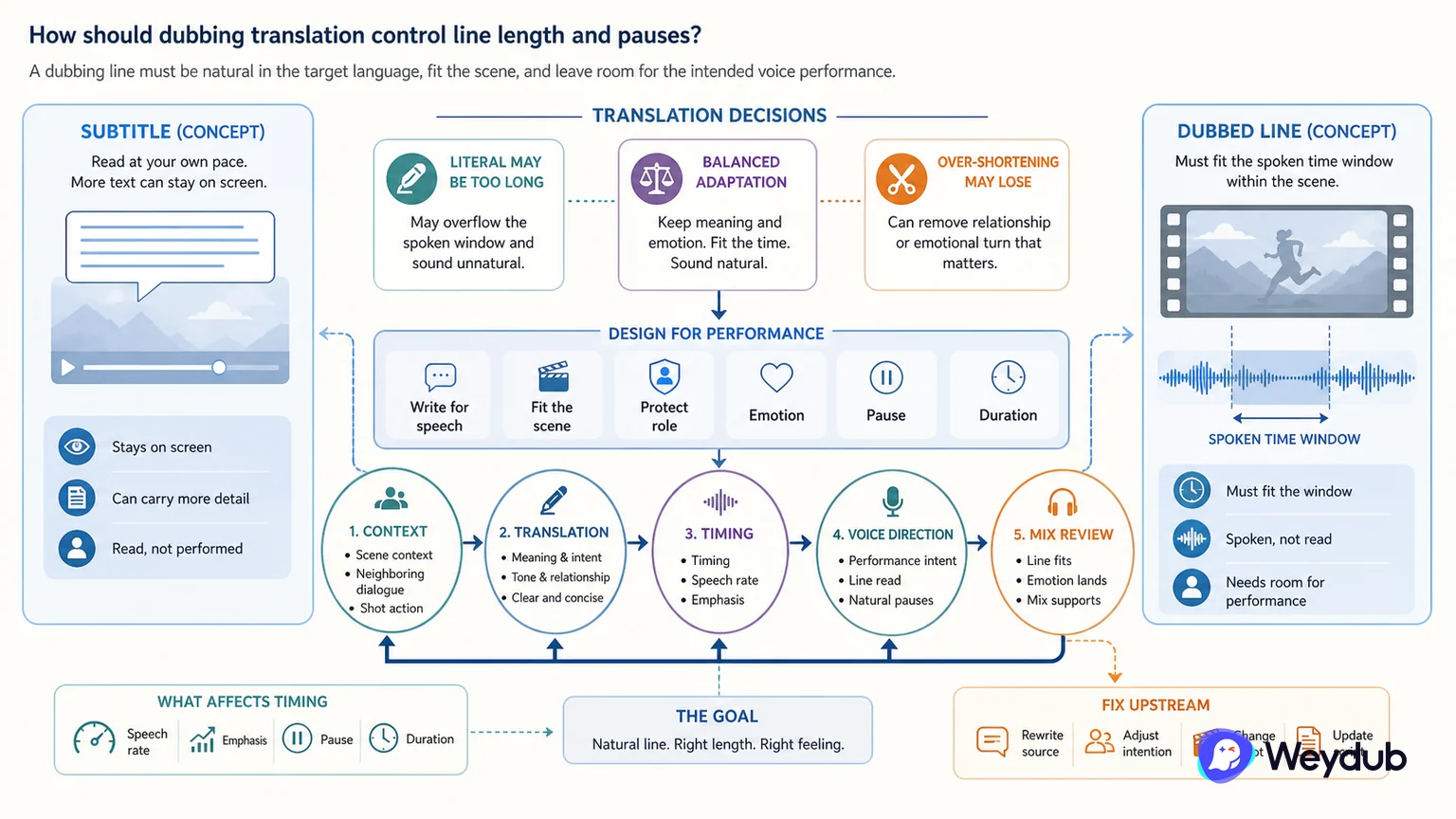
A dubbing line must be natural in the target language, fit the scene, and leave room for the intended voice performance.
Key conclusions
- Write for speech, not only for on-screen reading.
- Protect role, emotion, pause, and duration together.
- Coordinate translation, timing, voice direction, and mix review.
A subtitle can remain on screen while a viewer reads it, but a dubbed line must be spoken within a defined time. Literal translation may be too long, while aggressive shortening may remove a relationship or emotional turn.
Line length should be considered with speech rate, pauses, emphasis, shot action, and neighboring dialogue. The translator and voice team need the scene context and role information before the final line is approved.
Review the recorded performance against the picture. If the timing is wrong because the translation is wrong, fix the language upstream rather than forcing the voice to speak unnaturally.
Dubbing lines are written for speech
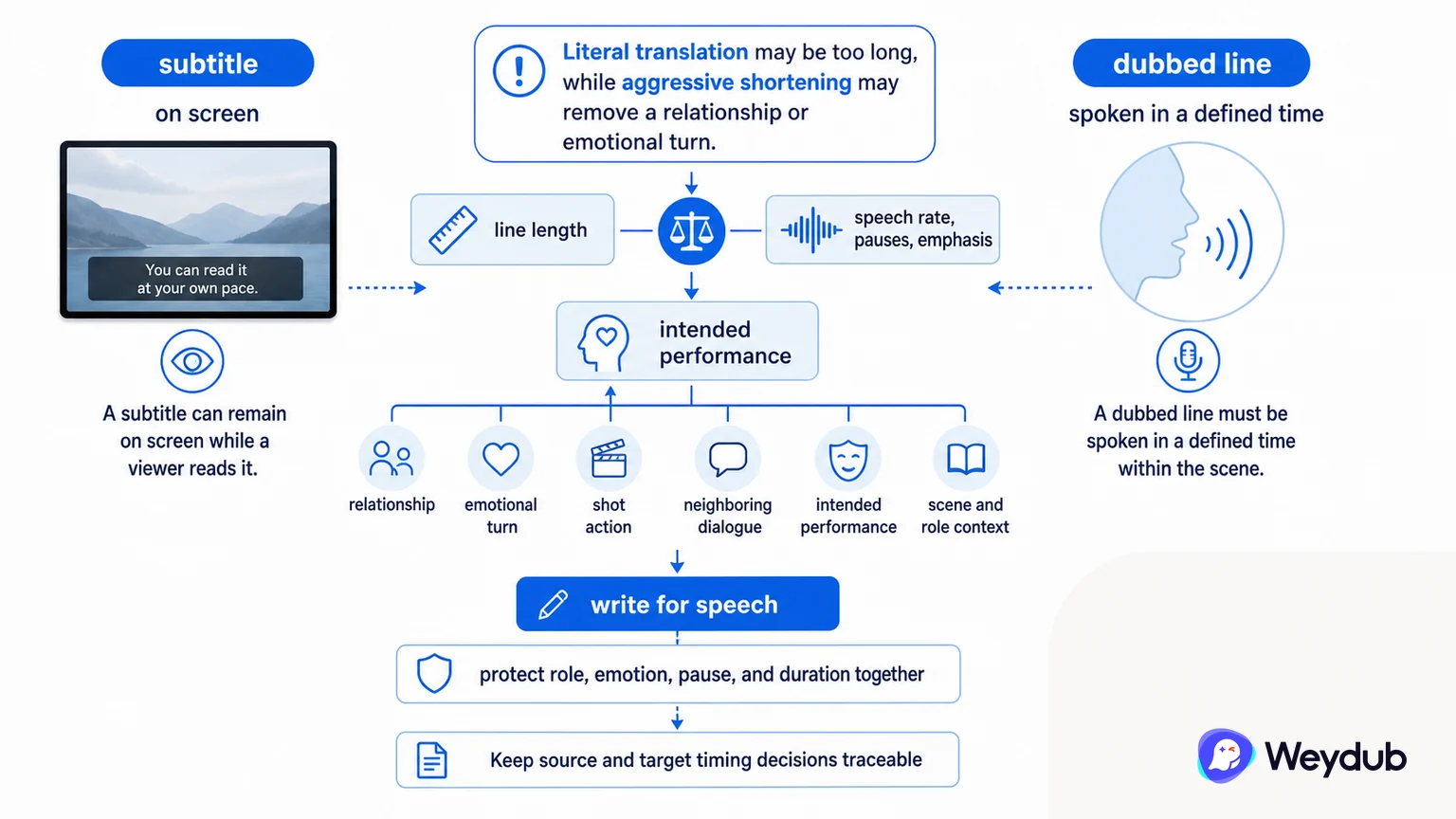
A subtitle can remain on screen while a viewer reads it, but a dubbed line must be spoken in a defined time. Literal translation may be too long, while aggressive shortening may remove a relationship or emotional turn.
Line length must be considered with speech rate, pauses, emphasis, shot action, neighboring dialogue, and the intended performance. The voice team needs scene and role context, not only translated words.
- Write for speech, not only on-screen reading.
- Protect role, emotion, pause, and duration together.
- Keep source and target timing decisions traceable.
Fix language upstream when timing is wrong
If the recorded line sounds rushed or forces an unnatural pause, first ask whether the translation or segmentation is the cause. Tuning a voice to conceal an overlong line can preserve the wrong language decision and weaken the performance.
Review the recorded performance against picture, subtitles, music, effects, and mix. The final acceptance unit is audiovisual, not a voice sample in isolation.
| Problem | Likely cause | Repair path |
|---|---|---|
| Line too long | Translation or segmentation | Rewrite for speech and context |
| Pause feels wrong | Timing or scene interpretation | Retiming and redirection |
| Emotion is flat | Role or performance brief | Review intent and direction |
| Mix hides speech | Audio balance or source | Recheck mix and effects |
Coordinate translation, voice, and mix
Approve the context-rich line before final recording, then preserve the role, pronunciation, timing, and performance decisions for later episodes. This makes a correction local when possible and prevents isolated lines from drifting across a series.
- Confirm role, scene, and performance intent.
- Write and time the target line for speech.
- Record or generate the candidate performance.
- Review against picture, subtitles, music, and effects.
- Approve the language and audio version together.
Frequently asked questions
Can a subtitle translation be sent directly to dubbing?
Sometimes, but it should be checked for speech length, pauses, performance, and scene timing. A readable subtitle is not automatically a recordable line.
Should voice speed be changed before rewriting a long line?
Usually fix the language or timing upstream first. An unnatural speed can hide the actual translation problem.
Related theme: Distribution and delivery
Weydub workflow
Take the next production step
Prepare a localized version with subtitles, voice, timing, and a delivery path that matches the destination.