
API workflow
How should a short-drama localization API handle tasks, callbacks, retries, and delivery?
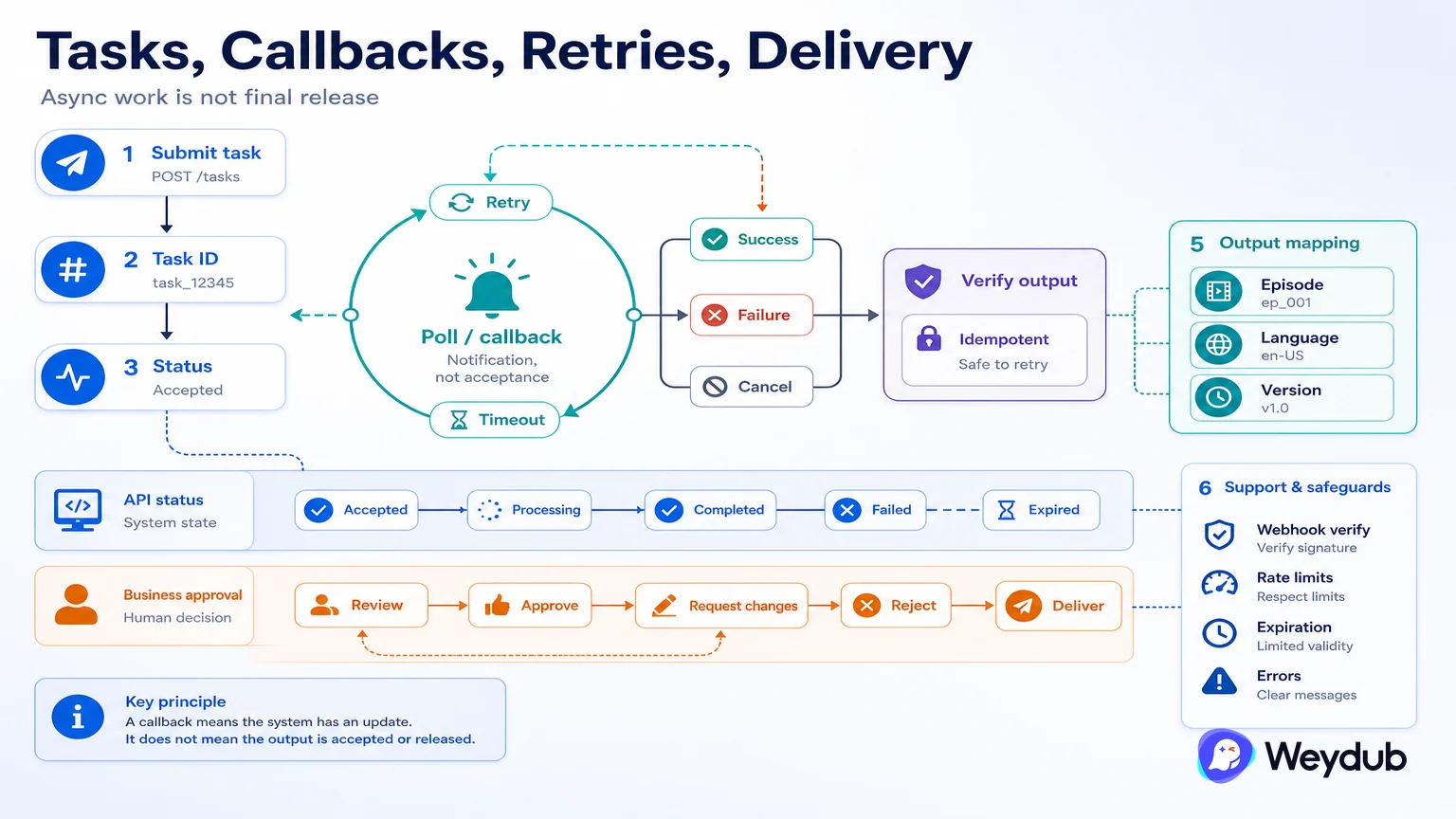
An API integration should model asynchronous work and review state instead of treating a request response as the final release.
Key conclusions
- Give every job an idempotent identity and observable status.
- Use callbacks or polling with explicit retry and failure handling.
- Map technical outputs to episode, language, version, review, and delivery state.
Video processing is usually asynchronous. The client should submit a task, store its relationship to the series and episode, observe progress, and handle success, failure, timeout, and cancellation without creating duplicate work.
A callback is a notification, not necessarily an acceptance. The system still needs to fetch or verify the output, attach it to the intended language and version, and route it through review. Retries should be scoped so a network error does not create multiple identical tasks.
The integration contract should explain output identifiers, formats, expiration, errors, rate limits, webhook verification, and delivery handoff. API status and business approval are related but not interchangeable.
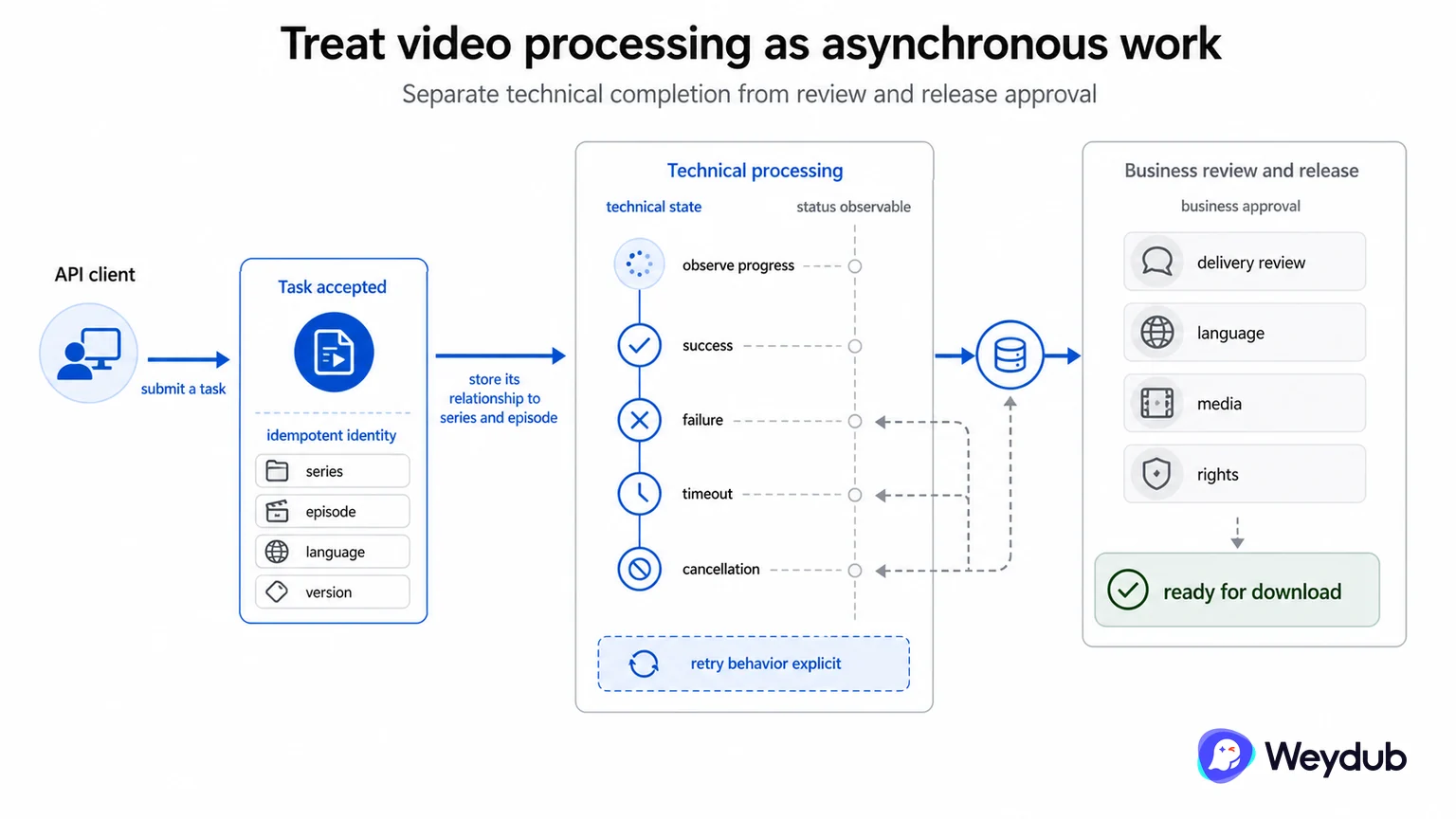
Treat video processing as asynchronous work
An API client should submit a task, store its relationship to series and episode, observe progress, and handle success, failure, timeout, and cancellation without creating duplicate work. A request response is not automatically a publishable release.
Give each job an idempotent identity and keep technical state separate from business approval. The output may be ready for download while still requiring language, media, rights, or delivery review.
- Store task, series, episode, language, and version identifiers together.
- Make status observable and retry behavior explicit.
- Separate technical completion from review and release approval.
Callbacks notify; they do not approve
A callback or polling result should be verified, attached to the intended language and version, and routed through review. Network failure and processing failure need different retry behavior. A broad retry can create duplicate tasks or replace an approved output unexpectedly.
| State | What it means | Next control |
|---|---|---|
| Submitted | Request accepted | Store identity and scope |
| Processing | Work is ongoing | Observe timeout and cancellation |
| Succeeded | Technical output exists | Fetch, verify, and review |
| Failed | Task did not complete | Classify and retry safely |
| Approved | Business acceptance recorded | Attach to delivery package |
Define the integration contract
Document output identifiers, formats, expiration, errors, rate limits, webhook verification, retries, and delivery handoff. The API integration should make it possible to trace an output back to the source and forward to its release package.
- Create an idempotent task with source scope.
- Persist status and callback or polling evidence.
- Verify output and attach it to the correct version.
- Retry only the failed or safe-to-repeat unit.
- Route through review and delivery acceptance.
Frequently asked questions
Does a succeeded API task mean the video is ready to publish?
No. It means a technical output exists. The output still needs verification, review, rights, package, and release acceptance.
Should every failed request be retried automatically?
No. Classify the error, check idempotency and state, and retry only when it is safe and useful.
Related theme: Localization production
Weydub workflow
Take the next production step
Connect episodes, language work, review, and delivery when a short drama needs more than a one-off file transformation.