
Quality acceptance
How to accept short-drama localization without asking only whether the translation is accurate
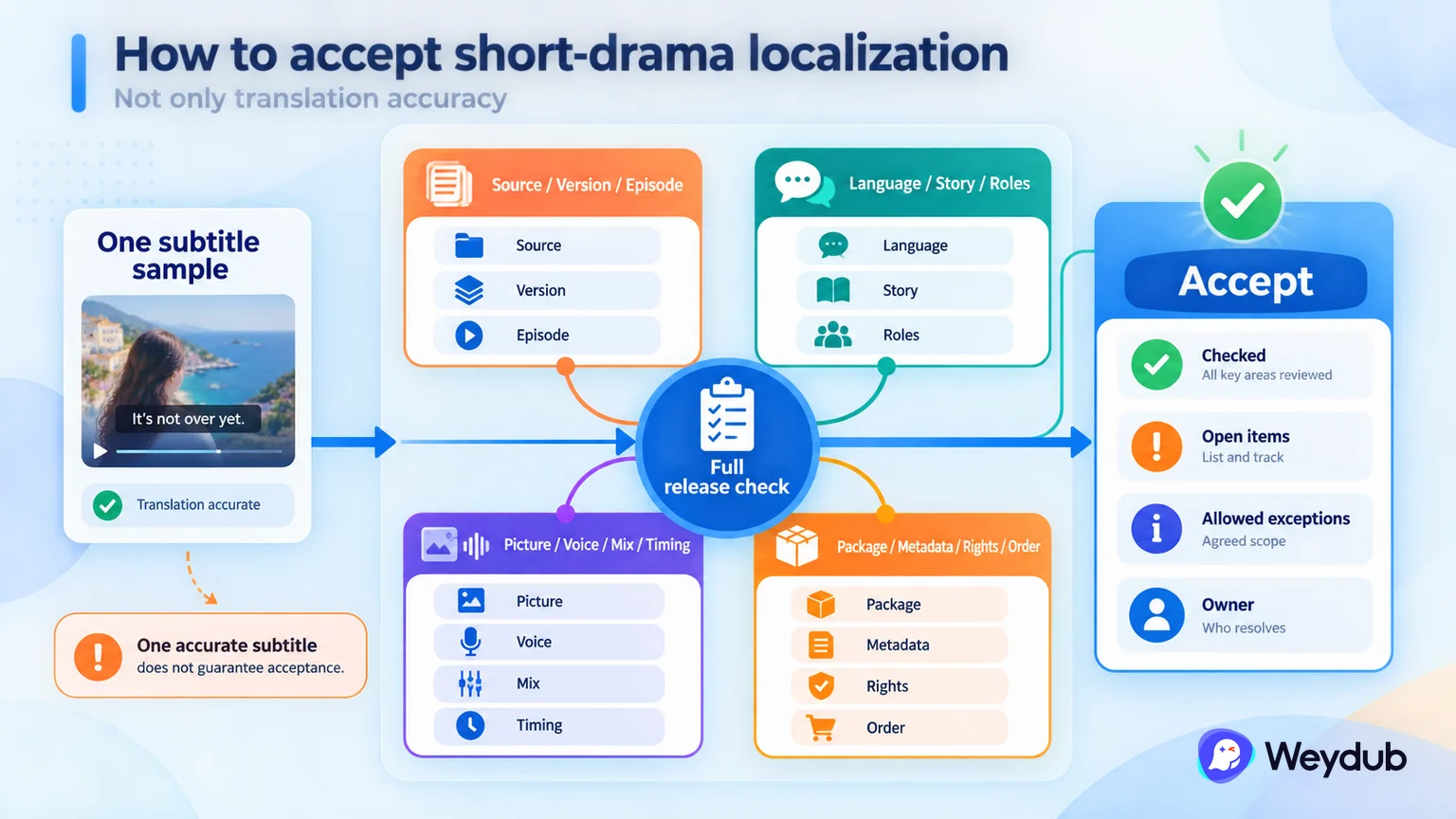
A release can fail in source, language, picture, audio, timing, version, or delivery even when one subtitle sample reads well.
Key conclusions
- Review the complete output across subtitle, picture, voice, and package.
- Separate source defects from language and delivery defects.
- Use acceptance criteria that match the release channel and rights scope.
A useful acceptance pass checks whether the right source and episode were used, whether the localized language carries the story and roles, whether picture restoration is clean, whether the voice and mix fit the scene, and whether subtitles meet timing and reading requirements.
The review should also confirm version and package. The correct video paired with the wrong SRT, language metadata, artwork, or episode order is still a delivery failure. Each defect needs a scope and owner so it can be fixed without losing unrelated work.
Acceptance is not a single score. It is a decision that names what was checked, what remains open, which exceptions are allowed, and who approved the release.
Define acceptance across the whole release
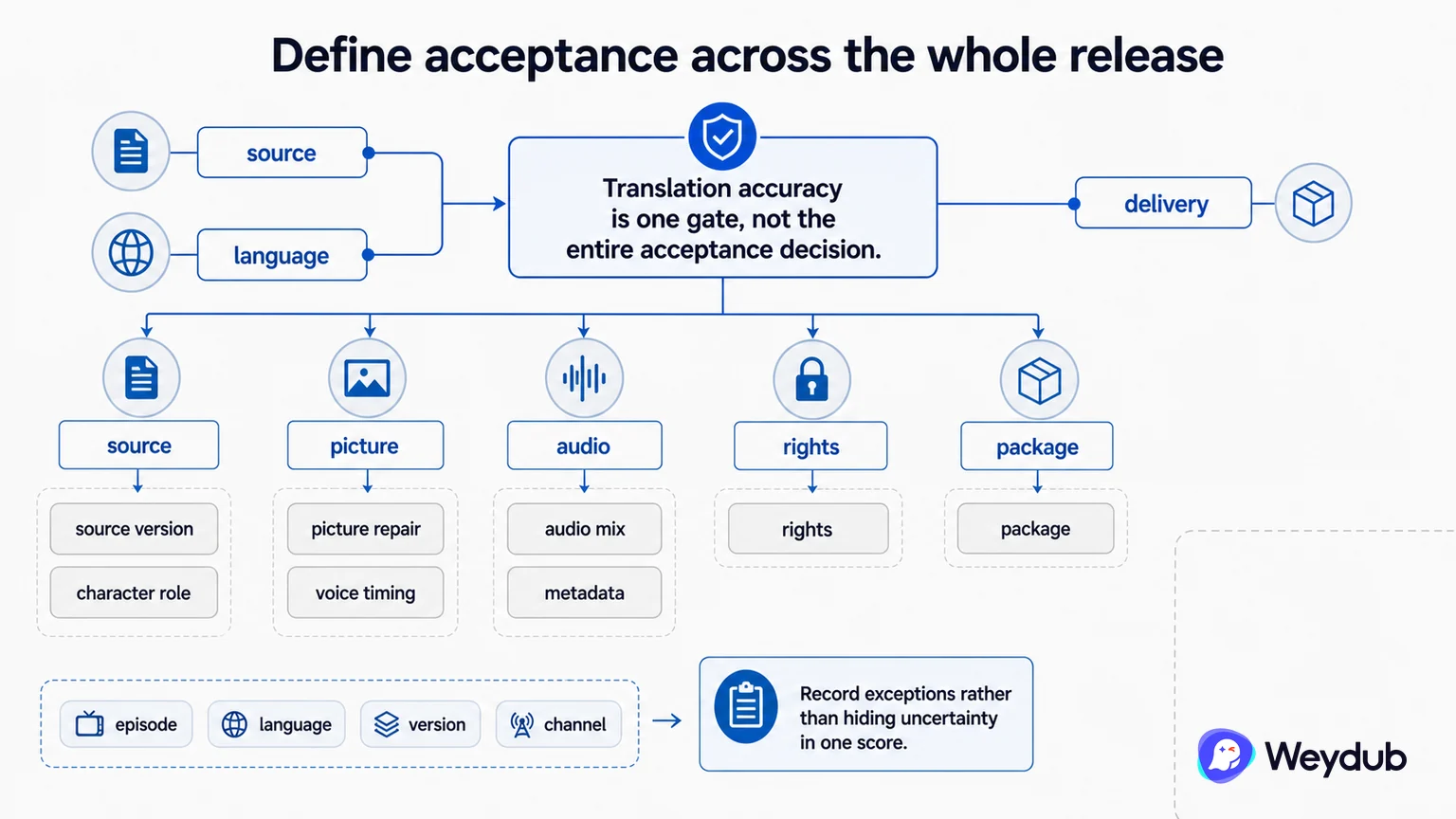
Translation accuracy is one gate, not the entire acceptance decision. A localized episode can fail because the source version, character role, picture repair, voice timing, audio mix, metadata, rights, or package is wrong.
- Separate source, language, picture, audio, and delivery gates.
- Set the acceptance scope by episode, language, version, and channel.
- Record exceptions rather than hiding uncertainty in one score.
Use evidence that matches the defect
A subtitle issue needs the cue, scene, language, and source comparison. A picture issue needs continuous playback around the repaired region. An audio issue needs the voice, timing, mix, and surrounding scene. A delivery issue needs the actual file and destination specification.
| Gate | Evidence | Typical decision |
|---|---|---|
| Source | Approved master, version, episode context | Accept or block upstream |
| Language | Meaning, role, terms, timing, density | Approve or request correction |
| Picture | Region and time-range playback | Accept repair or route manual |
| Audio | Voice, performance, sync, mix | Approve track or rework |
| Delivery | Files, metadata, rights, channel | Release or hold package |
Make approval reusable
Approval should identify who reviewed what, when, against which version, and what downstream outputs it covers. This lets a later language or channel request reuse accepted evidence without treating it as universal approval.
- Name the scope and acceptance criteria.
- Review representative and high-risk units.
- Log defect, evidence, owner, and repair.
- Approve the exact version and exceptions.
- Propagate only the dependencies that changed.
Frequently asked questions
Can one quality score decide release?
A score can summarize a sample, but it should not replace evidence for source, language, picture, audio, package, and unresolved exceptions.
Does language approval cover every channel?
No. Encoding, aspect ratio, metadata, rights, audio, and platform rules remain separate release gates.
Related theme: Quality and review
Weydub workflow
Take the next production step
Organize source, language, picture, audio, and delivery checks around the version that is actually going to ship.