
Context reuse
Why fast-moving short drama still needs a glossary and character bible
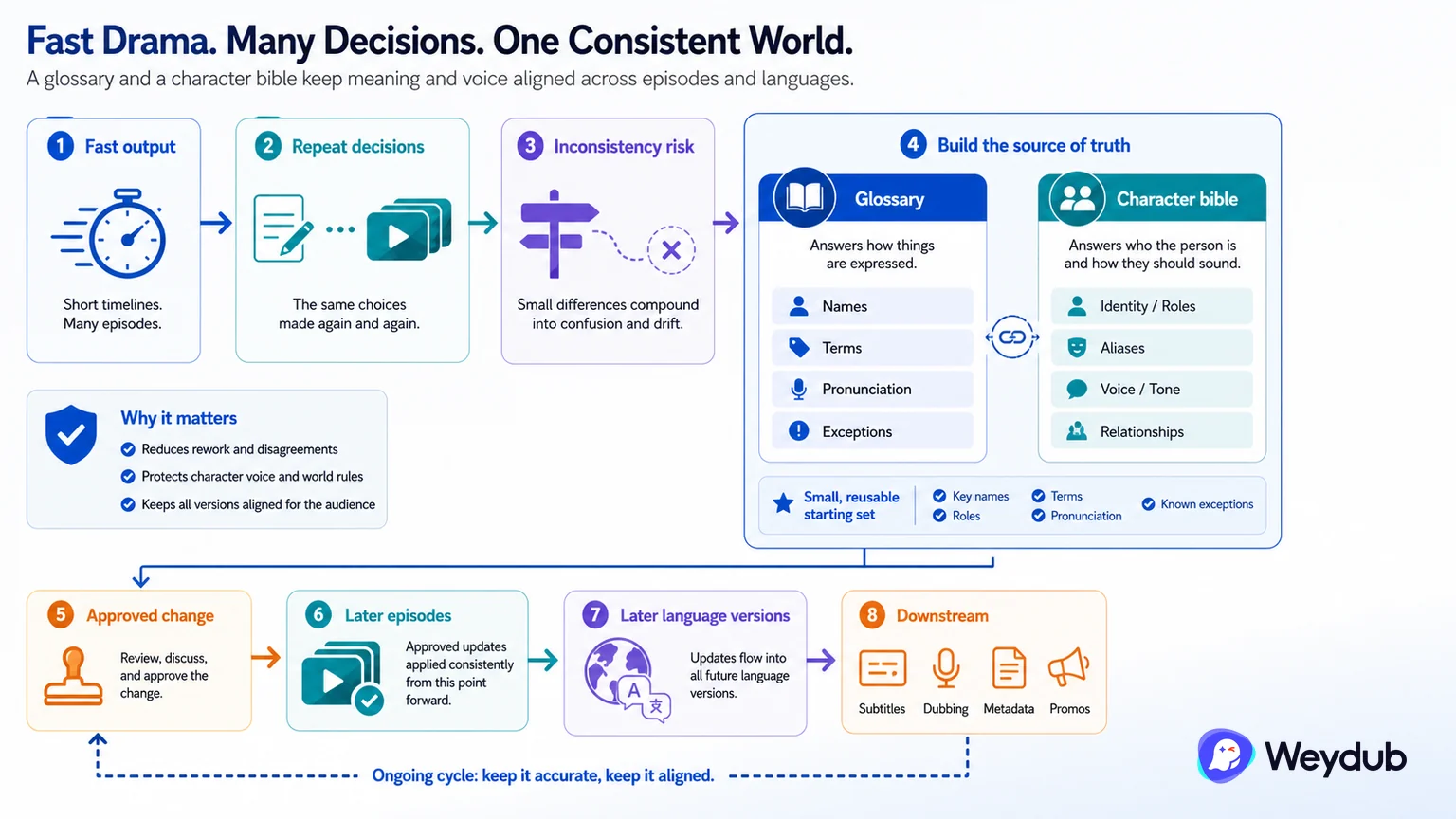
High publishing speed increases the cost of repeating a terminology or role decision in every episode.
Key conclusions
- Use a glossary for terms and a character record for identity and voice context.
- Start with a small reusable set instead of waiting for perfect documentation.
- Let approved changes flow into later episodes and language versions.
A glossary answers how a name, organization, object, or recurring phrase should be expressed. A character bible answers who the person is, how they relate to others, what aliases they use, and what voice or tone the localized version should preserve. They solve related but different problems.
Fast content production makes reuse more valuable. Without it, each episode can make a locally reasonable decision that becomes inconsistent across the series. The error may appear in subtitles, dubbing, metadata, or promotional clips after the source has already moved downstream.
The first version can be small: key names, roles, terms, pronunciation, and known exceptions. Update it when a decision is approved, and connect it to the tasks and outputs that depend on it.
Speed multiplies inconsistency
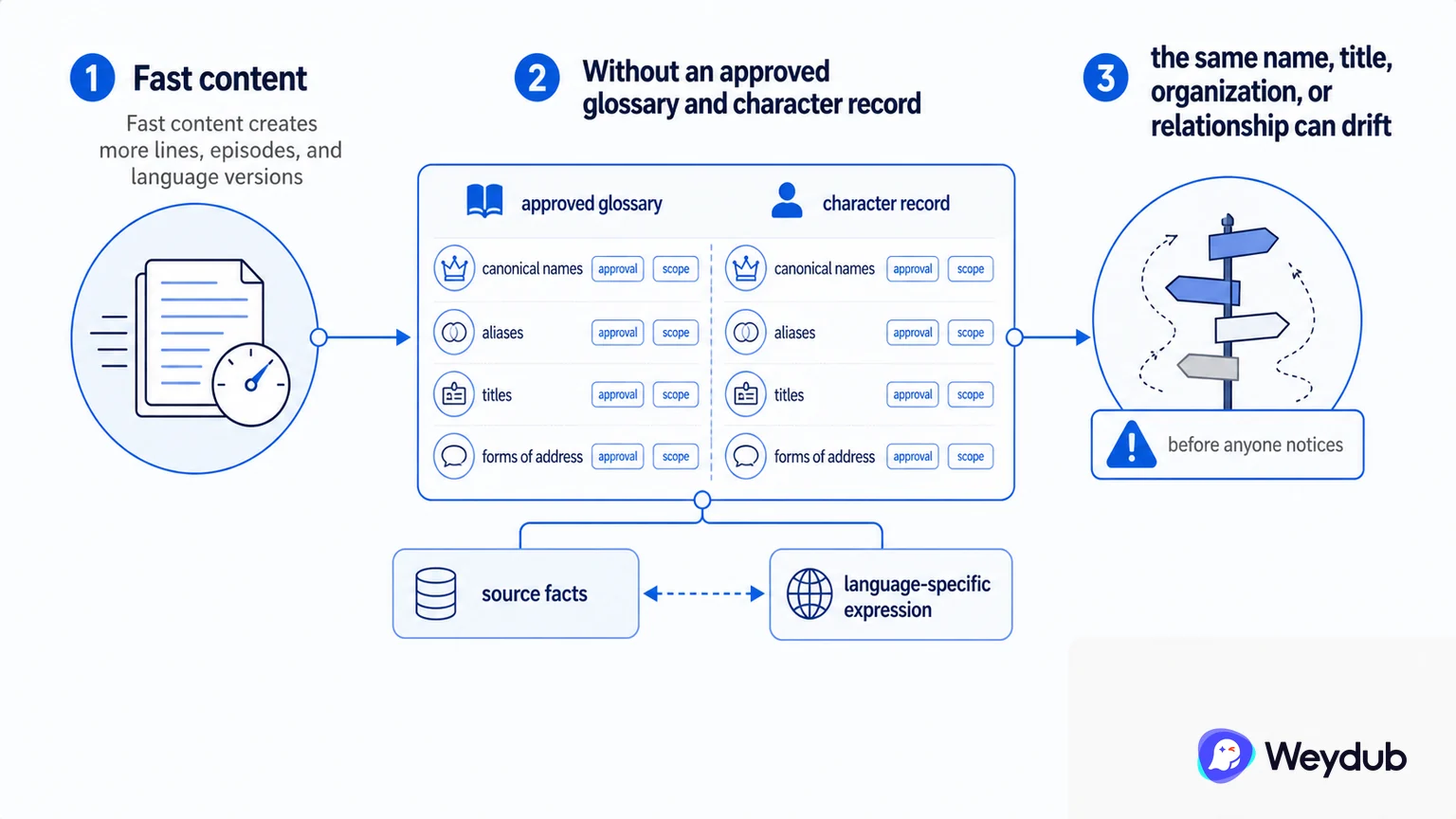
Fast content creates more lines, episodes, and language versions in less time. Without an approved glossary and character record, the same name, title, organization, or relationship can drift before anyone notices.
- Record canonical names, aliases, titles, and forms of address.
- Separate source facts from language-specific expression.
- Attach approval and scope to each term or character decision.
Keep the records operational
A glossary is not only a list of translations. A character bible should explain role, relationships, voice intent, and exceptions that affect dialogue. The record should be short enough to use during production and versioned enough to audit.
| Record | Example fields | Downstream use |
|---|---|---|
| Character | Canonical name, alias, role, voice intent | Attribution, translation, dubbing |
| Term | Source, approved target, scope, notes | Subtitles, metadata, marketing |
| Exception | Episode, scene, alternate form | Local review without global drift |
| Version | Owner, date, approval state | Rework and release traceability |
Reuse approved decisions, not blind strings
A source correction should notify every language, while a target-language naturalization should not overwrite the other languages. Preserve shared story facts and let each language branch retain its own judgment.
- Extract names, roles, and recurring terms.
- Resolve ambiguity with series context.
- Approve scope and language-specific forms.
- Apply to new episodes and review exceptions.
- Propagate source changes through dependent outputs.
Frequently asked questions
Is a glossary only useful for human translators?
No. It gives automated drafts, reviewers, voice workflows, metadata, and future languages a shared reference.
Should every language use the same character name?
Shared identity should remain stable, but display names, forms of address, and performance choices may differ by language.
Related theme: Localization production
Weydub workflow
Take the next production step
Connect episodes, language work, review, and delivery when a short drama needs more than a one-off file transformation.