
Industry observation
Will stronger AI models eliminate localization work?
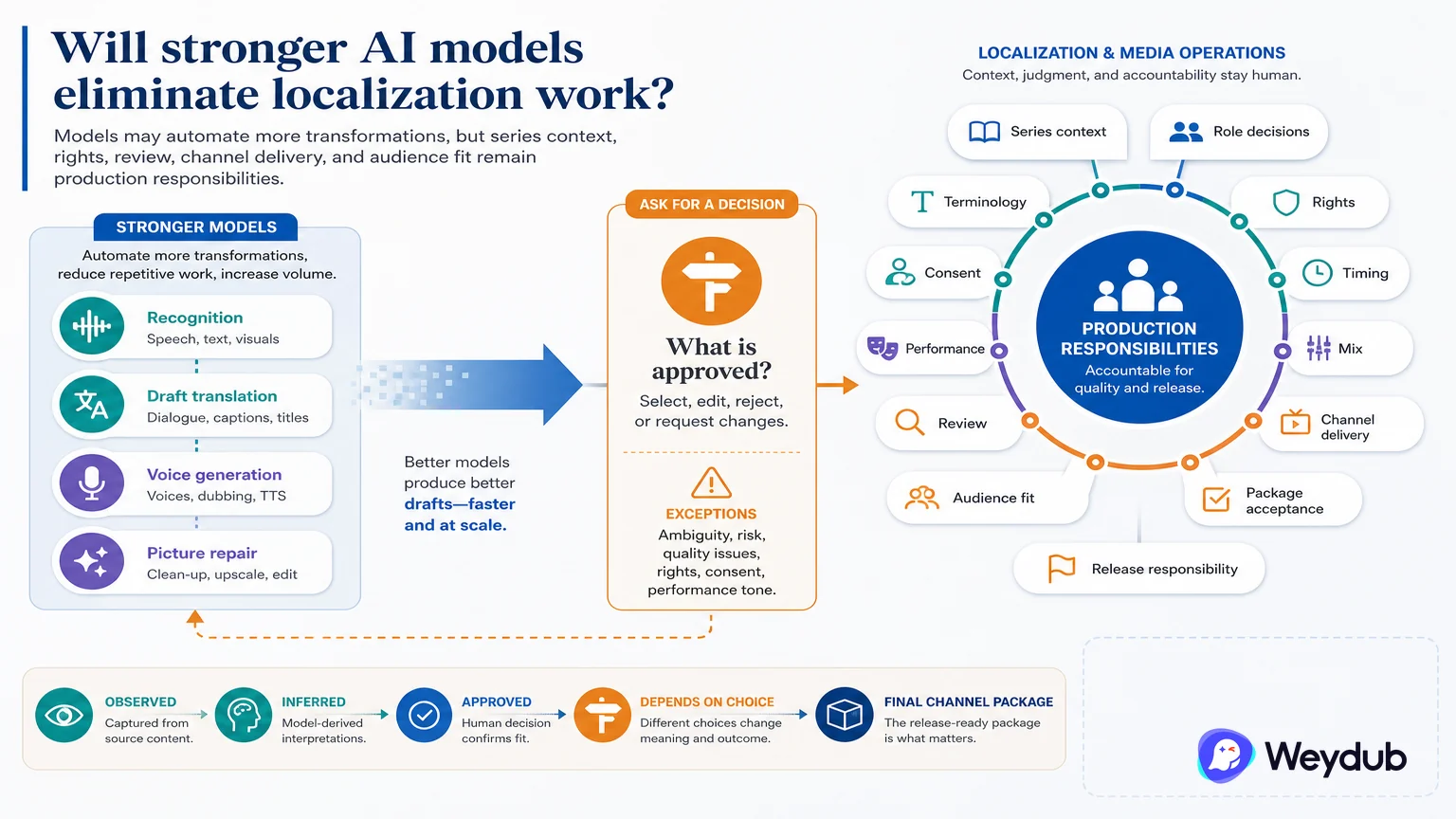
Models may automate more transformations, but series context, rights, review, channel delivery, and audience fit remain production responsibilities.
Key conclusions
- Separate generation from approval and release responsibility.
- Expect automation to move human work toward selection, exception handling, and context management.
- Measure the final channel package, not only the first model output.
Localization is more than converting one language into another. A release may require source recovery, subtitle timing, picture cleanup, role-aware translation, voice performance, metadata, rights checks, and a package that matches a particular channel.
Better models can reduce repetitive work and produce stronger candidates. They can also increase output volume, which makes inconsistent terminology, wrong character attribution, and hidden delivery defects harder to catch without an operating system. Human review can become more targeted without becoming irrelevant.
The useful question is where automation should stop or ask for a decision. A production workflow should show what was observed, what was inferred, what was approved, and which downstream outputs depend on the choice.
Localization is a chain of decisions
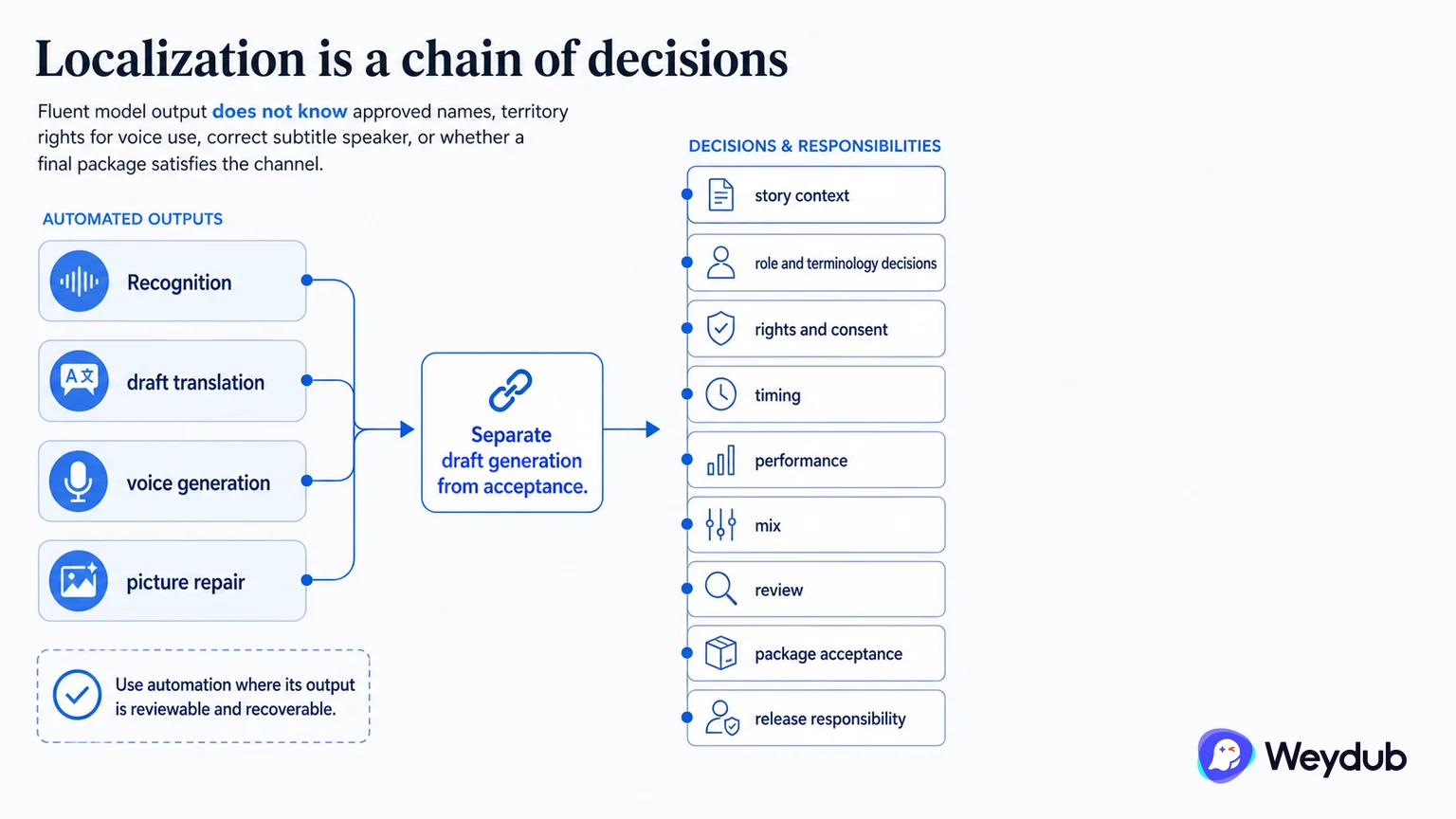
Recognition, draft translation, voice generation, and picture repair can become more automated. Localization also includes story context, role and terminology decisions, rights and consent, timing, performance, mix, review, package acceptance, and release responsibility.
A fluent model output does not know by itself which name is approved, whether a voice may be used in a territory, whether a subtitle belongs to the right speaker, or whether a final package satisfies the channel.
- Separate draft generation from acceptance.
- Keep rights, role, terminology, and version decisions explicit.
- Use automation where its output is reviewable and recoverable.
Human work moves toward judgment and exceptions
As routine generation improves, teams may spend less time producing a first draft and more time selecting the right source, resolving ambiguous context, directing performance, checking high-risk scenes, and deciding what can ship. The work becomes more concentrated rather than disappearing.
The balance depends on language, source quality, channel, audience, rights, and release risk. An internal draft and a flagship commercial release should not share the same acceptance bar.
| Work area | Automation may help with | Decision still required |
|---|---|---|
| Source extraction | Candidate text and timing | Evidence quality and fallback |
| Translation | Draft wording and alternatives | Context, terms, roles, naturalness |
| Dubbing | Voice generation and alignment | Consent, performance, mix, acceptance |
| Picture | Detection and restoration | Region policy and visual integrity |
| Delivery | Packaging and status | Rights, channel rules, release approval |
Make the automation boundary visible
The practical question is not whether AI replaces a job title. It is whether the workflow shows which output is a draft, who reviews it, what evidence supports a correction, and which dependent versions must be checked. Teams that preserve context and review state can increase automation without pretending uncertainty has disappeared.
- Map the production chain and decision owners.
- Automate repeatable steps with inspectable outputs.
- Set risk-based review and rights gates.
- Record exceptions and downstream dependencies.
- Adjust automation depth from measured release evidence.
Frequently asked questions
Will translators and reviewers disappear?
Some repetitive tasks may shrink, but contextual judgment, language quality, rights, performance, review, and release responsibility remain important.
Where is it safest to increase automation?
Start with repeatable, reviewable, reversible steps whose inputs and outputs are explicit. Keep high-risk decisions visible to accountable people.
Related theme: Industry observations
Weydub workflow
Take the next production step
Apply the decision framework to a repeatable localization workflow with visible assets, tasks, and handoffs.