
Language operations
How to build a short-drama terminology guide
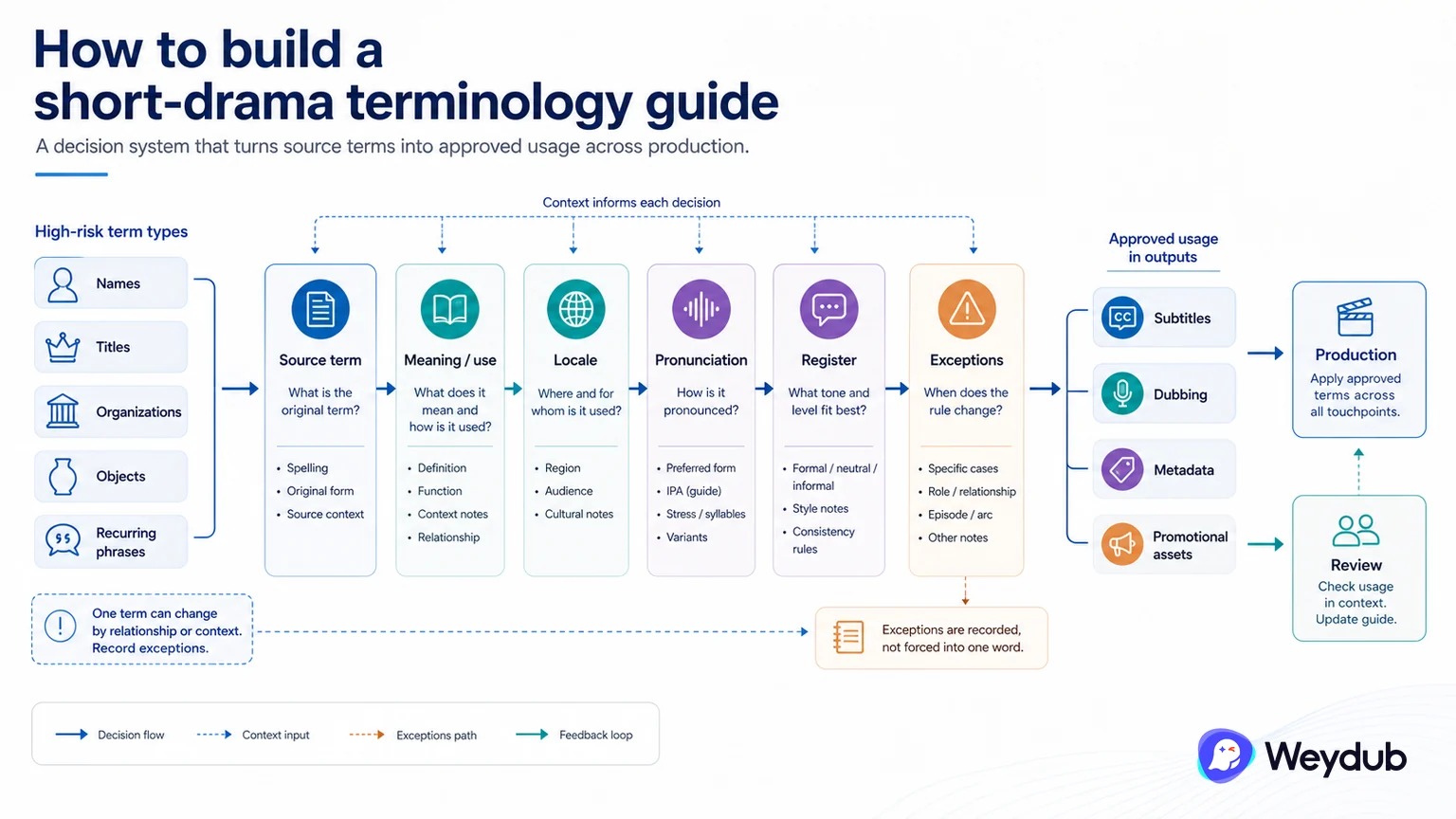
Names, titles, organizations, world-building terms, and recurring phrases need an explicit policy before a series is translated at speed.
Key conclusions
- Separate names, forms of address, organizations, objects, and recurring phrases.
- Record locale, pronunciation, register, and approved exceptions.
- Let approved terminology reach subtitles, dubbing, metadata, and promotional assets.
A terminology guide is more than a list of translations. It should say what the source term refers to, who uses it, how formal it should sound, whether it changes by relationship, and how it should be pronounced for voice work.
Start with the terms that create the most downstream risk: names, titles, family and workplace address, organizations, fictional systems, key objects, and repeated hooks. Add examples and exceptions rather than forcing a single word into every context.
When a term changes, record why and which outputs depend on it. The guide becomes useful when it is connected to production and review, not when it sits as an unversioned spreadsheet.
A terminology guide is more than a translation list
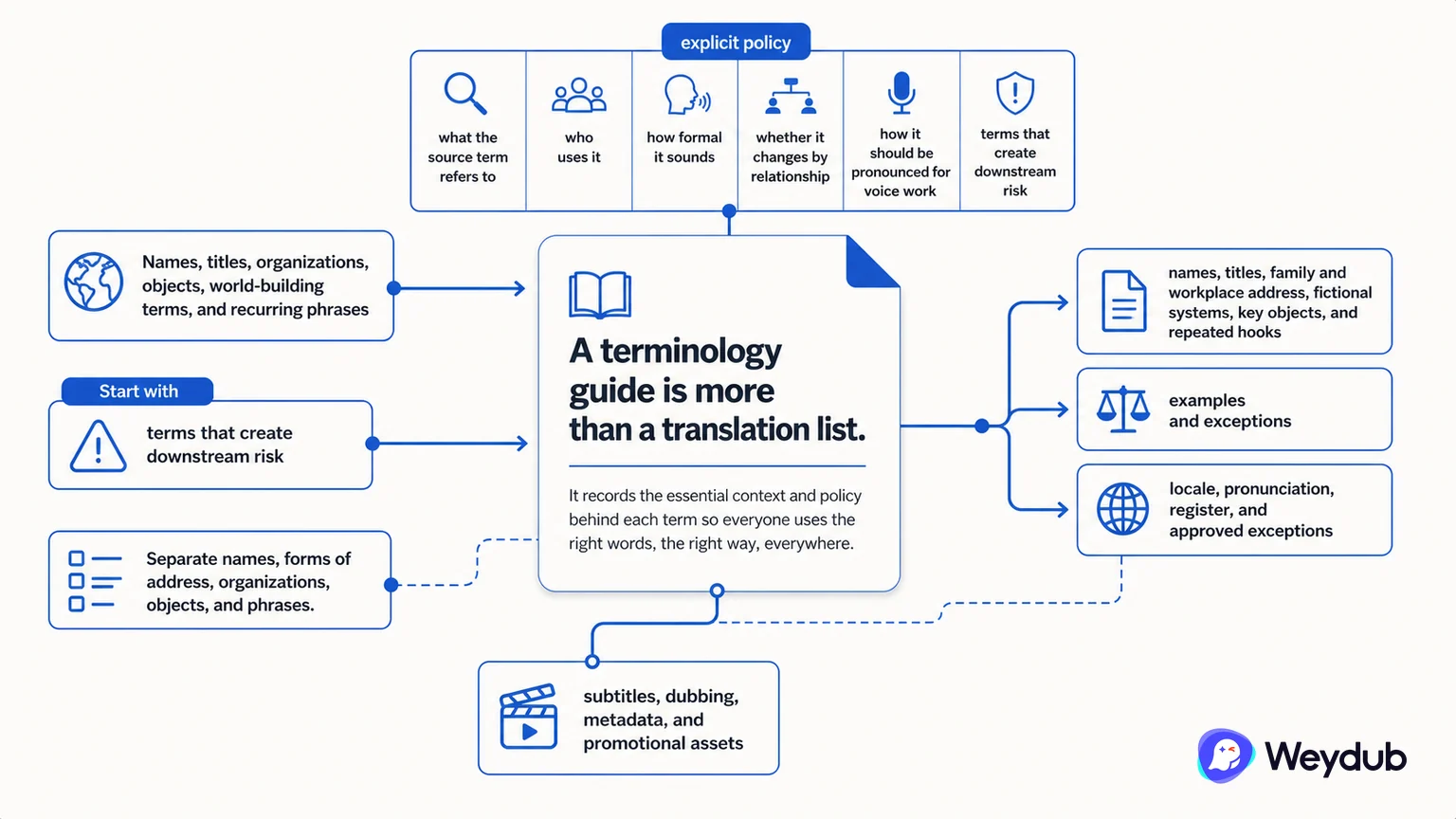
Names, titles, organizations, objects, world-building terms, and recurring phrases need an explicit policy before a series is translated at speed. The guide should explain what the source term refers to, who uses it, how formal it sounds, whether it changes by relationship, and how it should be pronounced for voice work.
Start with terms that create downstream risk: names, titles, family and workplace address, fictional systems, key objects, and repeated hooks. Add examples and exceptions rather than forcing one word into every context.
- Separate names, forms of address, organizations, objects, and phrases.
- Record locale, pronunciation, register, and approved exceptions.
- Send approved terms to subtitles, dubbing, metadata, and promotional assets.
Version terminology with the series
When a term changes, record why and which outputs depend on it. A translator or reviewer should be able to see the current approved form, source meaning, examples, and any language-specific choice. An unversioned spreadsheet cannot reliably protect a multi-episode release.
| Term class | Context to record | Downstream use |
|---|---|---|
| Name or alias | Identity, spelling, pronunciation | Subtitle, voice, metadata |
| Title or address | Relationship and register | Dialogue and performance |
| Organization or object | World meaning and repetition | Translation and captions |
| Hook or phrase | Scene intent and exceptions | Promotion and key plot moments |
Make the guide part of review
The guide becomes useful when it is connected to production and review. A correction should point to affected cues, languages, voices, metadata, and episodes, while a new approved term should be inherited by later work.
- Extract high-risk recurring terms.
- Add meaning, context, locale, and pronunciation.
- Review examples across episodes.
- Version approvals and exceptions.
- Propagate changes to dependent language assets.
Frequently asked questions
Should one translation be forced for every use of a term?
Not always. Record the approved default and the contextual exceptions, especially for forms of address and spoken performance.
Does a glossary replace human review?
No. It preserves decisions and reduces drift; reviewers still decide whether a term fits the scene and target audience.
Related theme: Subtitle and language systems
Weydub workflow
Take the next production step
Turn source video into reviewable subtitle material, then carry approved context into translation and delivery.