
Studio workflow
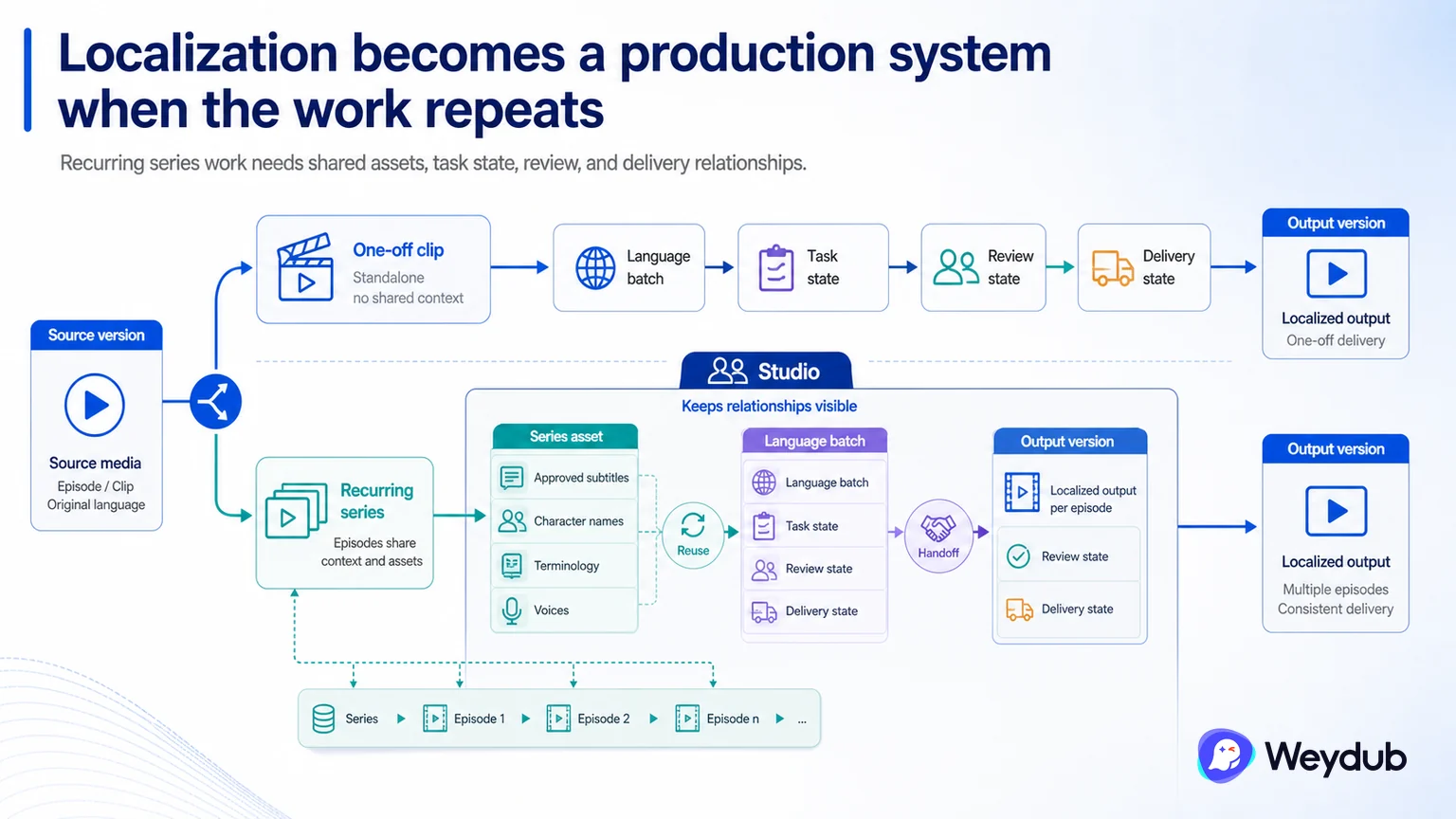
Localization becomes a production system when the work repeats
Recurring series work needs shared assets, task state, review, and delivery relationships.
Key conclusions
- Organize work by series and project context.
- Reuse approved subtitles, roles, terminology, and voices where appropriate.
- Keep review and delivery state attached to the output version.
A one-off clip can be handled as a focused task. A recurring series is different: dozens of episodes share character names, terminology, source decisions, and delivery expectations. Treating every episode as an unrelated file creates avoidable rework and makes version mistakes hard to find.
A production system keeps the relationships visible. Source media becomes a series asset; subtitle and character decisions can be reviewed and reused; language batches can be tracked; and each localized work can be connected to its source and delivery state.
This is the role of Studio in the Weydub product model. Focused tools remain useful for isolated jobs. Studio becomes valuable when teams need repeatable production, review, handoff, and API-connected automation.
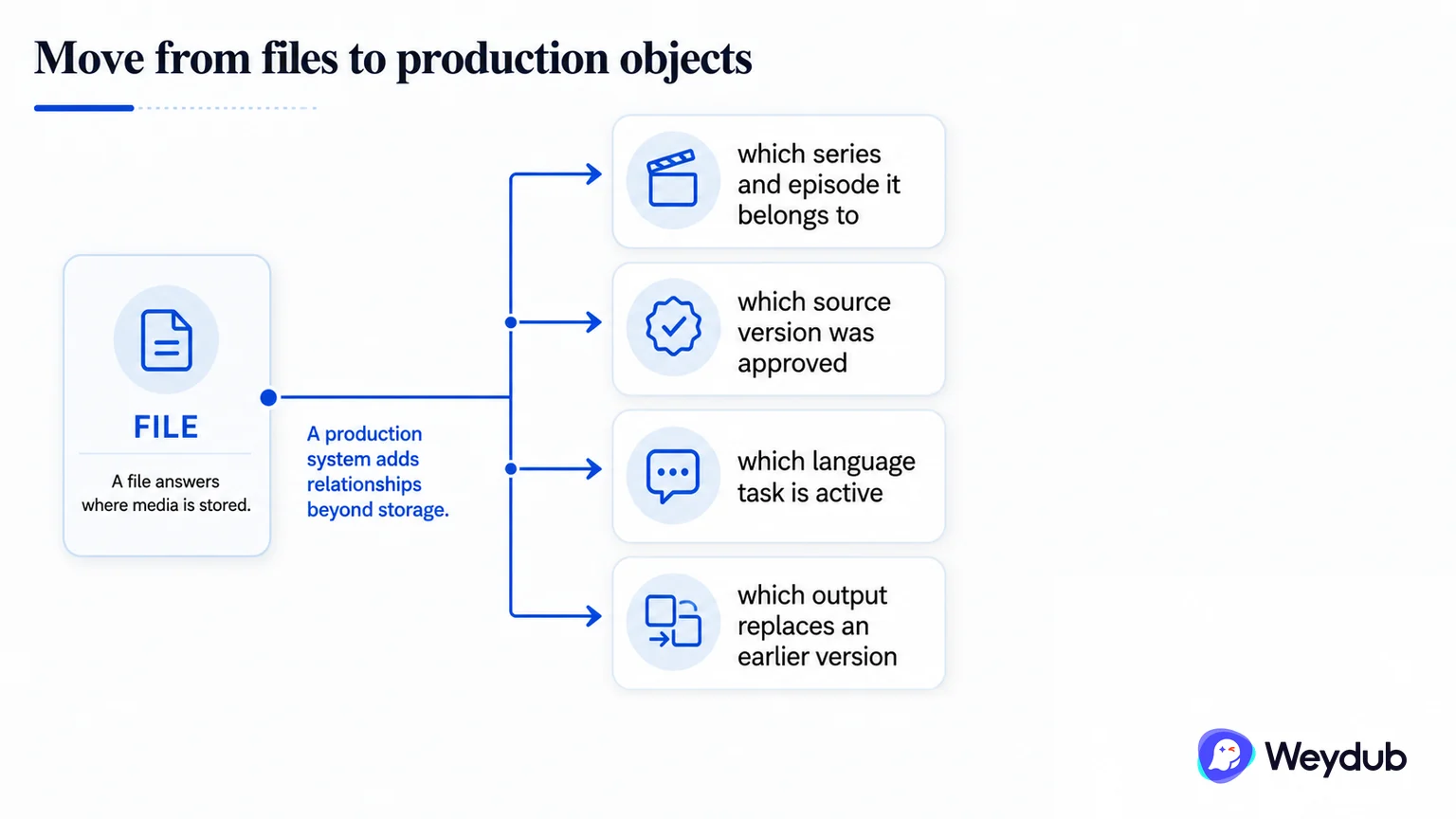
Move from files to production objects
A file answers where media is stored. A production system also needs to answer which series and episode it belongs to, which source version was approved, which language task is active, and which output replaces an earlier version.
| Object | Question it answers | Example state |
|---|---|---|
| Series and episode | What story and release unit is this? | Episode order and shared context |
| Asset | Which source, subtitle, role, or audio is reusable? | Approved or superseded |
| Job | What transformation is running? | OCR, translation, dubbing, export |
| Review | What evidence is accepted or rejected? | Pending, changes requested, approved |
| Output | Which version can be delivered? | Language, channel, rights window |
Reuse decisions without hiding language differences
Series context should be reusable, but reuse is not blind copying. Character facts, glossary terms, approved source cues, and version relationships can travel. Target-language phrasing, register, timing, voice performance, and platform packaging still require their own review.
- Keep shared facts in the series record.
- Keep language-specific decisions in the language batch.
- Link every output to the source and approval state.
- Mark superseded versions instead of overwriting them.
Know when a focused tool is enough
A single clip or a one-time subtitle extraction may not need a full production workspace. Studio becomes more valuable when episodes repeat, languages multiply, reviewers hand work to one another, or API tasks and delivery state need to remain connected.
- Define the series, episode, and release job.
- Attach source media and reusable context.
- Run language or media tasks with visible state.
- Review exceptions and approve a version.
- Export a channel-specific package with lineage.
Make rework local and handoffs explicit
When a name changes, the system should reveal which subtitles, voices, and composites depend on it. When a channel needs another package, it should be a new delivery version, not a silent overwrite.
Frequently asked questions
Does Studio replace focused localization tools?
No. Focused tools remain useful for isolated jobs. Studio organizes repeated series work, shared context, review, handoff, and delivery relationships.
Can one approved translation be reused for every channel?
The language decision can be reused, but subtitles, audio, metadata, aspect ratio, rights, and channel acceptance may require separate outputs.
What is the smallest useful production unit?
It should be traceable: usually a series, episode, language task, asset, review decision, or delivery package rather than an ambiguous folder.
Related theme: Localization production
Weydub workflow
Take the next production step
Connect episodes, language work, review, and delivery when a short drama needs more than a one-off file transformation.