
Batch production
How to process a 100-episode short drama without multiplying one error by 100
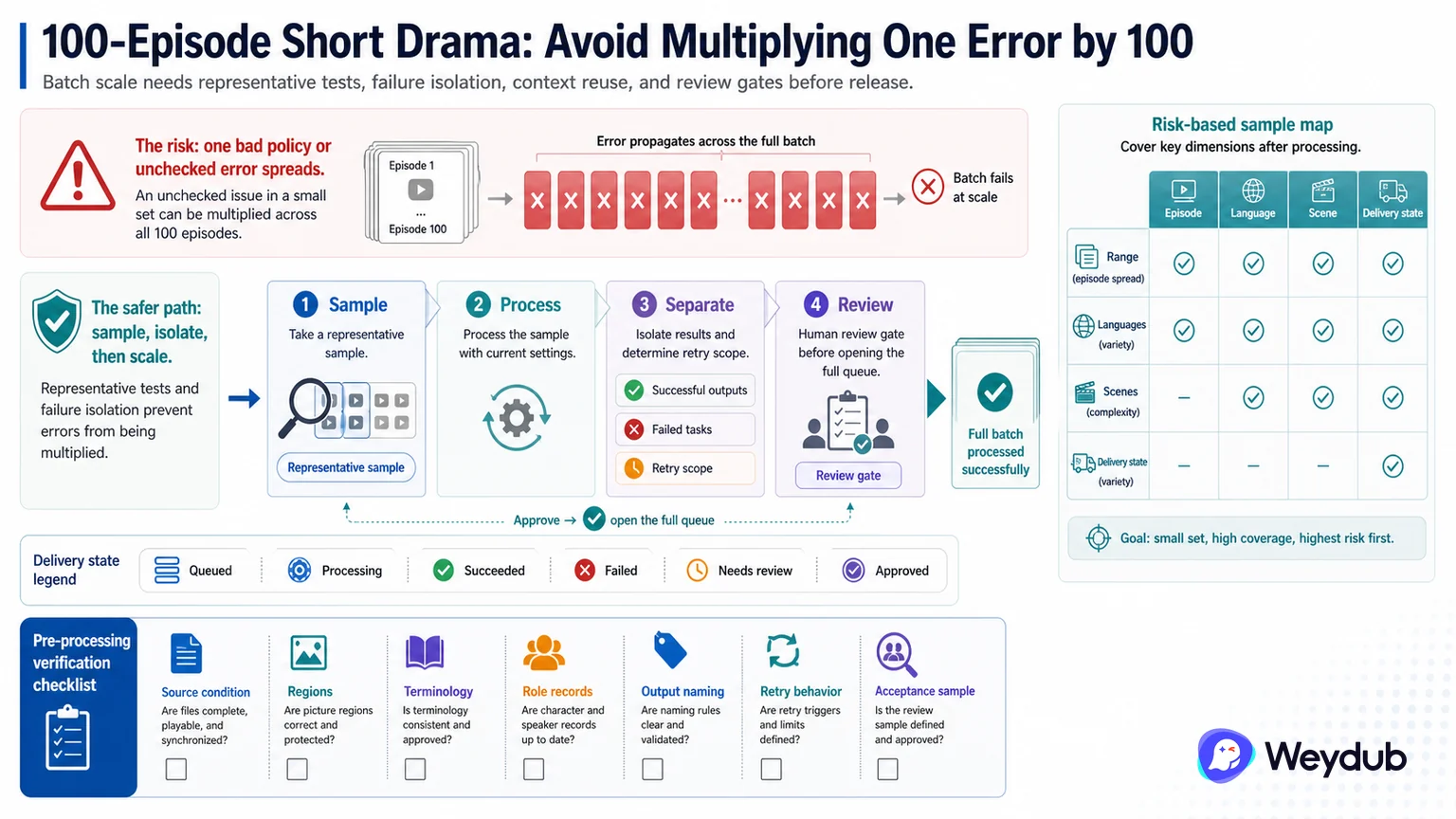
Batch scale needs representative tests, failure isolation, context reuse, and review gates before a full queue is released.
Key conclusions
- Run a representative sample before opening the full batch.
- Separate failed tasks from successful outputs and make retry scope explicit.
- Sample across episodes, languages, scenes, and delivery states after processing.
The fastest way to make a batch expensive is to treat the first successful task as proof that every input is equivalent. A representative sample should cover ordinary and difficult episodes, source conditions, language choices, and intended output formats.
Use statuses that distinguish queued, processing, succeeded, failed, needs review, and approved. A failure should not force the team to lose good outputs, and a success should not silently skip a required review step. Retry only the affected unit when the dependency graph allows it.
After processing, sample by risk rather than only by random position. Check role and terminology consistency, timing, picture regions, audio, episode order, and final package completeness. Batch scale is useful only when error isolation and recovery are designed with it.
Batching is a risk decision, not only a queue setting
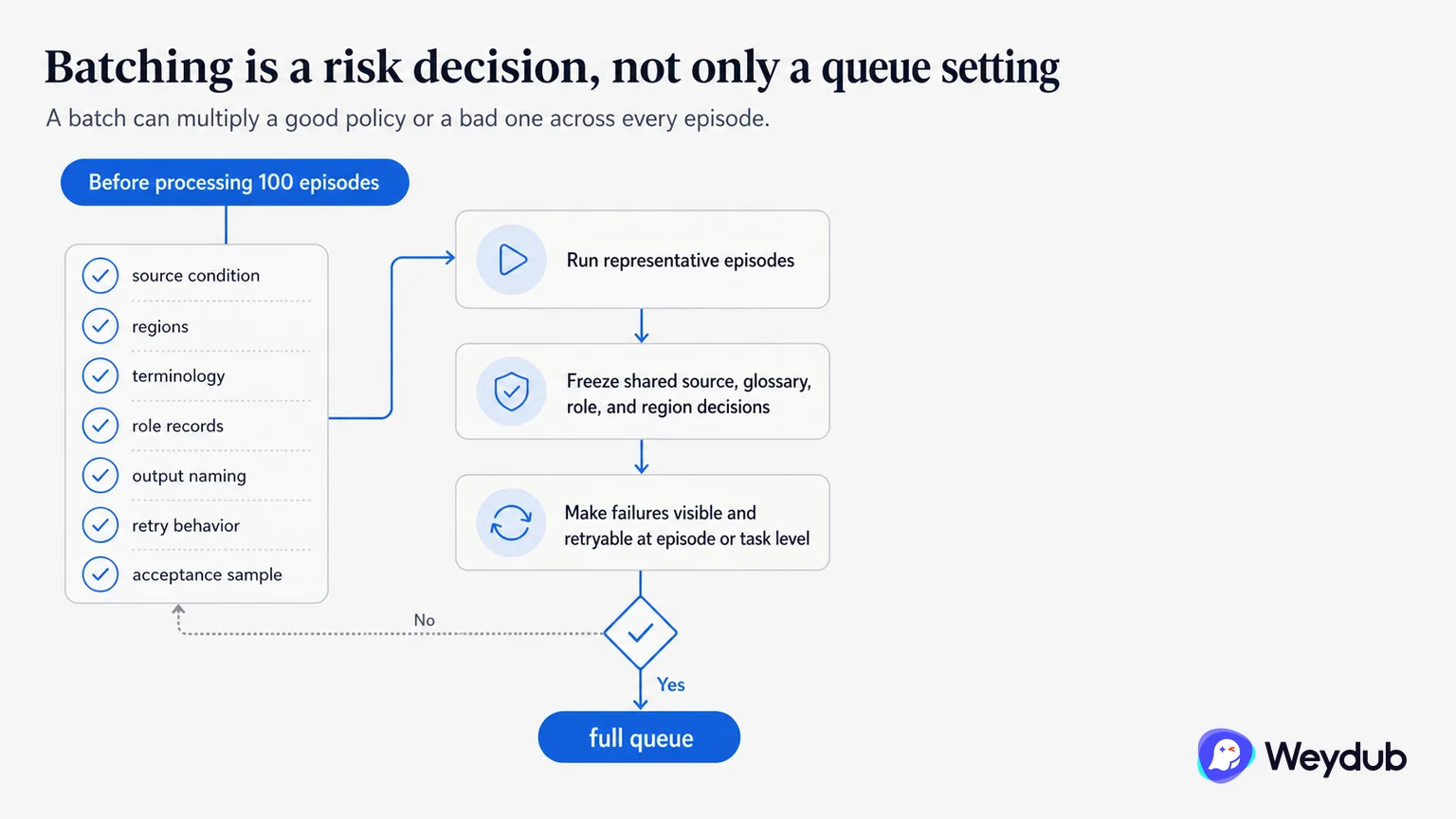
A batch can multiply a good policy or a bad one across every episode. Before processing 100 episodes, verify source condition, regions, terminology, role records, output naming, retry behavior, and the acceptance sample.
- Run representative episodes before the full queue.
- Freeze shared source, glossary, role, and region decisions.
- Make failures visible and retryable at episode or task level.
Use a small batch before scaling
Select opening, middle, difficult, and final episodes, plus scenes with motion, faces, multiple speakers, music, and changing subtitle regions. Confirm the output and review burden before committing the remaining episodes.
| Batch gate | Evidence | Action if failed |
|---|---|---|
| Input | Count, version, readability | Stop and reconcile source |
| Policy | Regions, terms, roles, timing | Correct shared rule |
| Output | Naming, format, playable result | Fix template or export |
| Review | Representative acceptance | Increase coverage or change tier |
Isolate failures and reconcile the result
A timeout, missing output, content defect, and changed requirement are different states. Retry only the affected unit after checking whether the previous task actually completed, then reconcile expected and delivered counts before release.
- Freeze inputs and shared policy.
- Run a representative pilot batch.
- Process in observable units with status.
- Retry only confirmed failed units.
- Reconcile files, review, and delivery manifest.
Use a release ledger rather than a single batch label
A 100-episode project describes the production scope, not a promised API request limit or turnaround time. Check current service parameters before selecting a batch size. Use one record per episode and target language so failures and revised exports remain identifiable.
| Record | What to keep | Why it matters |
|---|---|---|
| Source | Series, episode and source version. | A revised source can invalidate an earlier export. |
| Language | Target language and approved terminology. | Different language outputs need separate acceptance. |
| Task | Returned task identifier, state and result reference. | A submitted job is not necessarily a completed export. |
| Delivery | Reviewed output and release decision. | A successful task is not necessarily a publishable episode. |
Separate technical completion from release approval
The states below are an editorial workflow model, not literal API enum names. Read the documented response fields in your integration. A team can accept the task result technically while still withholding publication because of a dialogue or rendering issue.
- Sample accepted: source, terminology and output settings are approved.
- Work submitted: store the returned task identifier next to the intended episode and language.
- Result available: retrieve the documented output and inspect the file.
- Release approved: text, picture, audio and naming match the release checklist.
| Situation | Safe next step |
|---|---|
| One task fails | Inspect its returned status and error; diagnose before resubmitting that work. |
| A callback is repeated | Reconcile it with the stored task record before starting dependent work. |
| A language glossary changes | Identify affected outputs; do not silently mix versions. |
| Some episodes are missing | Compare expected episode-language pairs with reviewed outputs. |
Give reviewers a source-to-output handoff
Keep the source video, reviewed subtitles and returned language version attached to a clear production record. The project-management screenshot shows organization, not an automatic 100-episode acceptance result.
Frequently asked questions
Should a failed batch be retried in full?
Not by default. Identify whether the failure is system, incomplete output, content, or requirement related and retry the smallest valid unit.
How many pilot episodes are enough?
Enough to cover the source and risk conditions that could change the policy. A random clean sample alone is weak evidence.
Related theme: Localization production
Weydub workflow
Take the next production step
Connect episodes, language work, review, and delivery when a short drama needs more than a one-off file transformation.