
Story and retention
Why short dramas keep viewers watching: conflict, reversal, and emotional rhythm
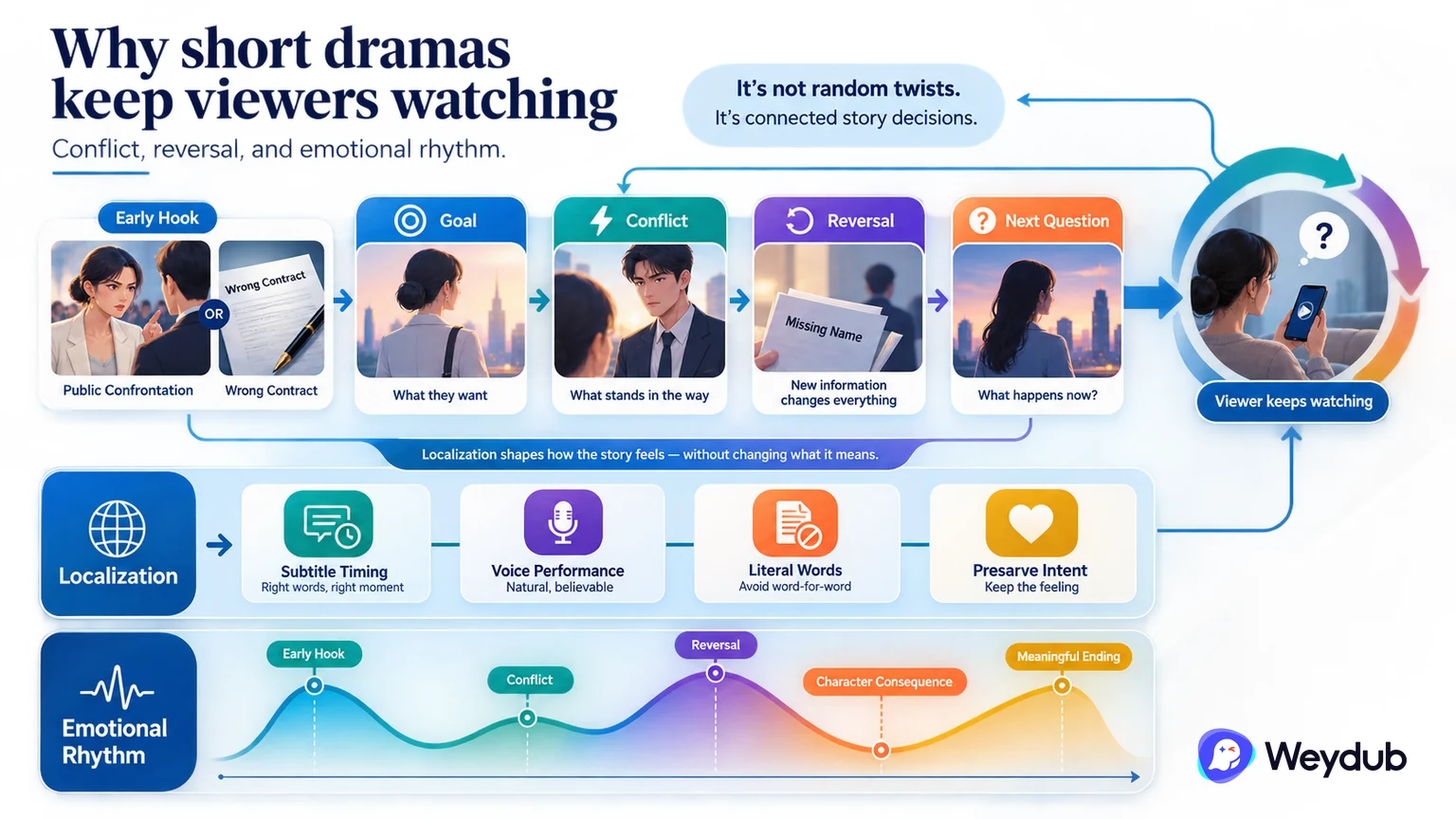
Short-drama momentum comes from connected story decisions, not from adding a random twist every few seconds.
Key conclusions
- Make the character goal and conflict legible early.
- Use episode endings to open a meaningful next question.
- Localization should preserve emotional intent, not only literal wording.
Short episodes reduce the time available for setup, so the audience needs to understand what matters quickly. A clear goal, an active obstacle, and a change in the relationship can create momentum without relying on noise.
Reversals work when they alter the audience's understanding of the situation. If every episode ends with an interchangeable shock, the series may move quickly while losing character and consequence. The strongest cliffhangers connect to a question the viewer already cares about.
Translation and dubbing affect this curve. A line that sounds neutral in one language may carry threat, respect, or intimacy in another. Review should therefore consider the scene's emotional function, subtitle timing, and voice performance together.
Fast does not mean loud from the first second
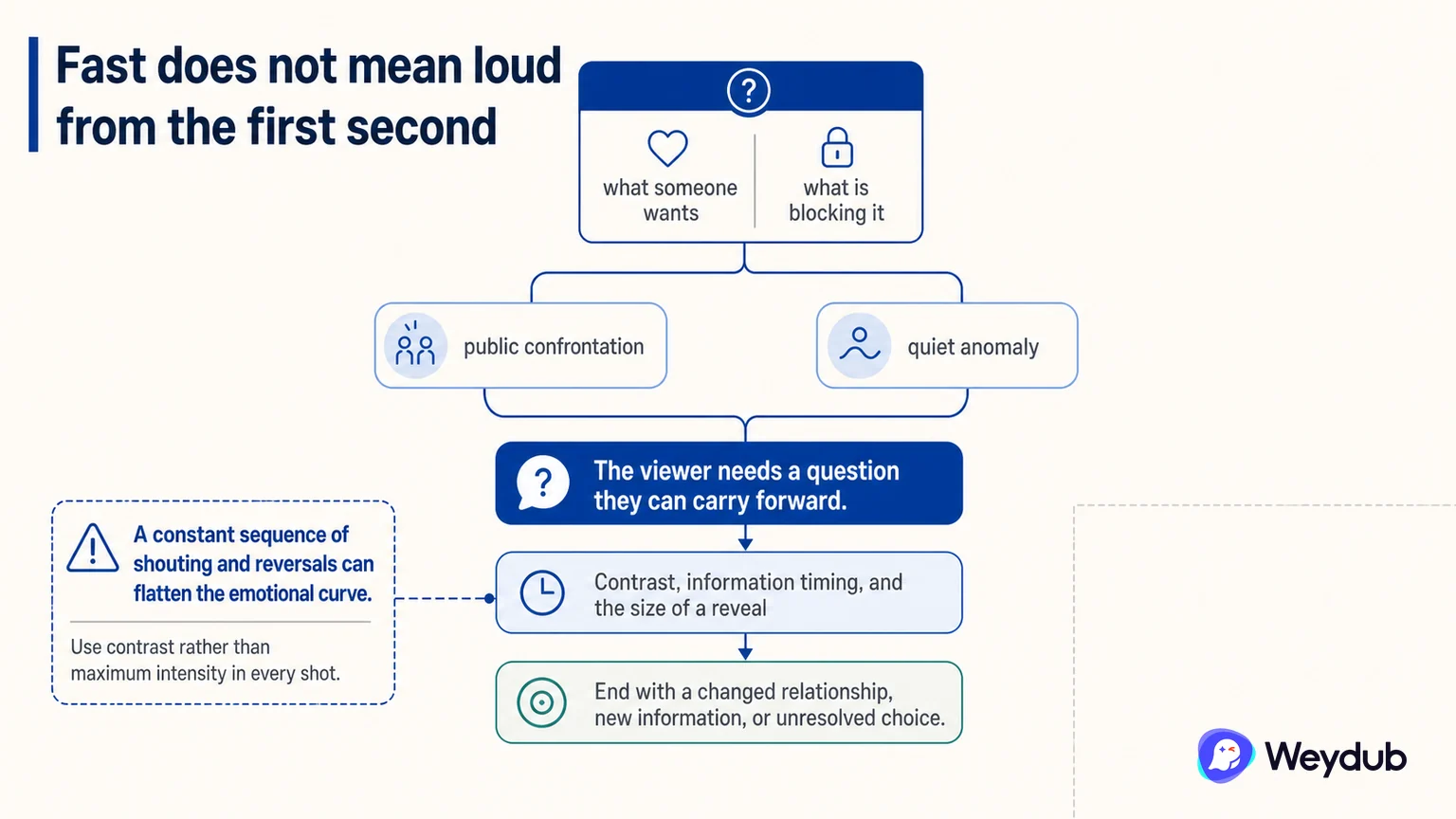
A short-drama opening should quickly show what someone wants and what is blocking it. The trigger can be a public confrontation or a quiet anomaly, such as a missing person at a wedding or a name that is wrong on a contract. The viewer needs a question they can carry forward.
A constant sequence of shouting and reversals can flatten the emotional curve. Contrast, information timing, and the size of a reveal help the audience understand why the next episode matters.
- Introduce a concrete desire or problem early.
- Use contrast rather than maximum intensity in every shot.
- End with a changed relationship, new information, or unresolved choice.
Localization must preserve the curve, not only the words
Translation choices affect whether a line feels like a threat, joke, confession, or plot clue. Subtitle timing, line breaks, character address, voice performance, music, and sound effects all contribute to the audience's interpretation of a turn.
A target-language line can be grammatically correct and still arrive too late, sound too formal, or remove the relationship information that makes the moment work. Review key turns in picture and sound context.
| Story moment | Localization risk | Review focus |
|---|---|---|
| Opening hook | Context is delayed or unclear | First cues, names, action, reading density |
| Reversal | Information loses force | Timing, emphasis, terminology |
| Emotional peak | Voice or mix flattens intent | Performance, pauses, music, effects |
| Cliffhanger | Next question is not visible | Final line, picture, transition, metadata |
Sample the moments that carry the series
A review sample should include the opening, first relationship definition, major reveal, emotional peak, and episode exit. These scenes deserve attention across subtitles, dubbing, picture cleanup, and delivery even when ordinary dialogue is sampled more lightly.
- Map the emotional and plot turns.
- Mark names, relationships, and recurring terms.
- Review target subtitles and voices in context.
- Check picture, mix, and transition at the key moments.
- Carry approved decisions into later episodes.
Frequently asked questions
Does localization need to preserve every source word?
It needs to preserve story meaning, character intent, and audience effect within the target language and timing. Literal wording is not always the best way to preserve the curve.
Can a strong voice make up for weak subtitle timing?
No. Voice, subtitle, picture, and sound work together, but each has its own acceptance requirement.
Related theme: Short-drama format and economics
Weydub workflow
Take the next production step
Connect episodes, language work, review, and delivery when a short drama needs more than a one-off file transformation.