
Source intake
Why does a rights purchase sometimes arrive with only a hard-subtitled master?
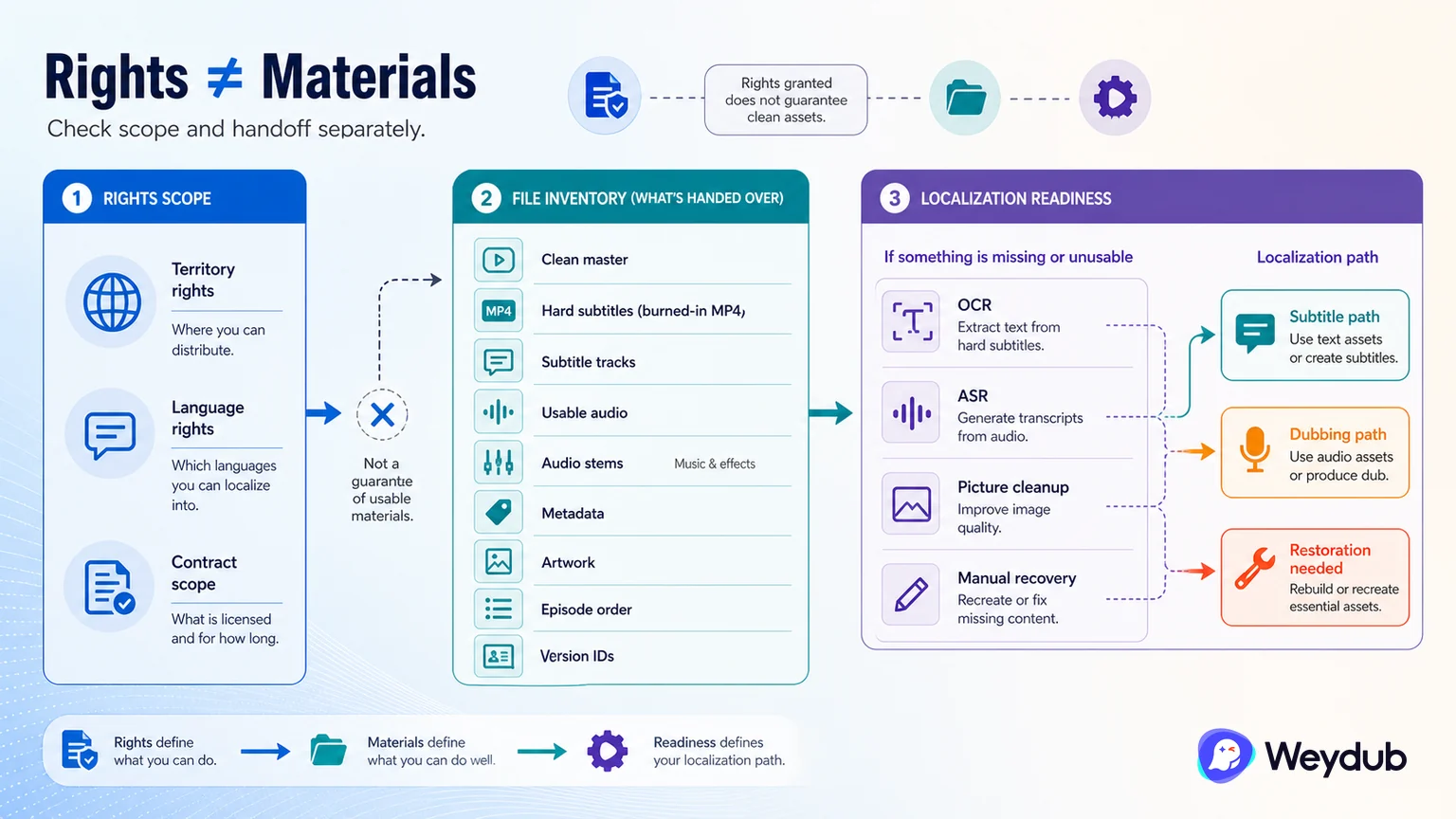
Rights, source materials, and localization readiness are separate parts of a delivery, and a contract does not guarantee that every clean asset is in the folder.
Key conclusions
- Check the rights scope and material inventory separately.
- Identify whether the source has a clean master, hard subtitles, soft subtitles, or usable audio.
- Choose OCR, ASR, picture cleanup, or manual recovery only after the source condition is documented.
A buyer may be authorized to release a series in a territory while receiving a compressed video with burned-in subtitles and no separate text or audio tracks. That is a production constraint, not automatically a rights defect. The team needs to record both facts before estimating localization.
A clean master can support a direct subtitle or dubbing path. A hard-subtitled master may require picture restoration before a new language version is finished. A speech-only source may need ASR and timing recovery. The same title can therefore have very different localization cost depending on what was actually handed over.
The next purchase should specify the file-level inventory: master, clean picture, subtitle tracks, audio stems, music and effects, metadata, artwork, episode order, and version identifiers. Documenting the handoff makes missing assets visible before the batch begins.
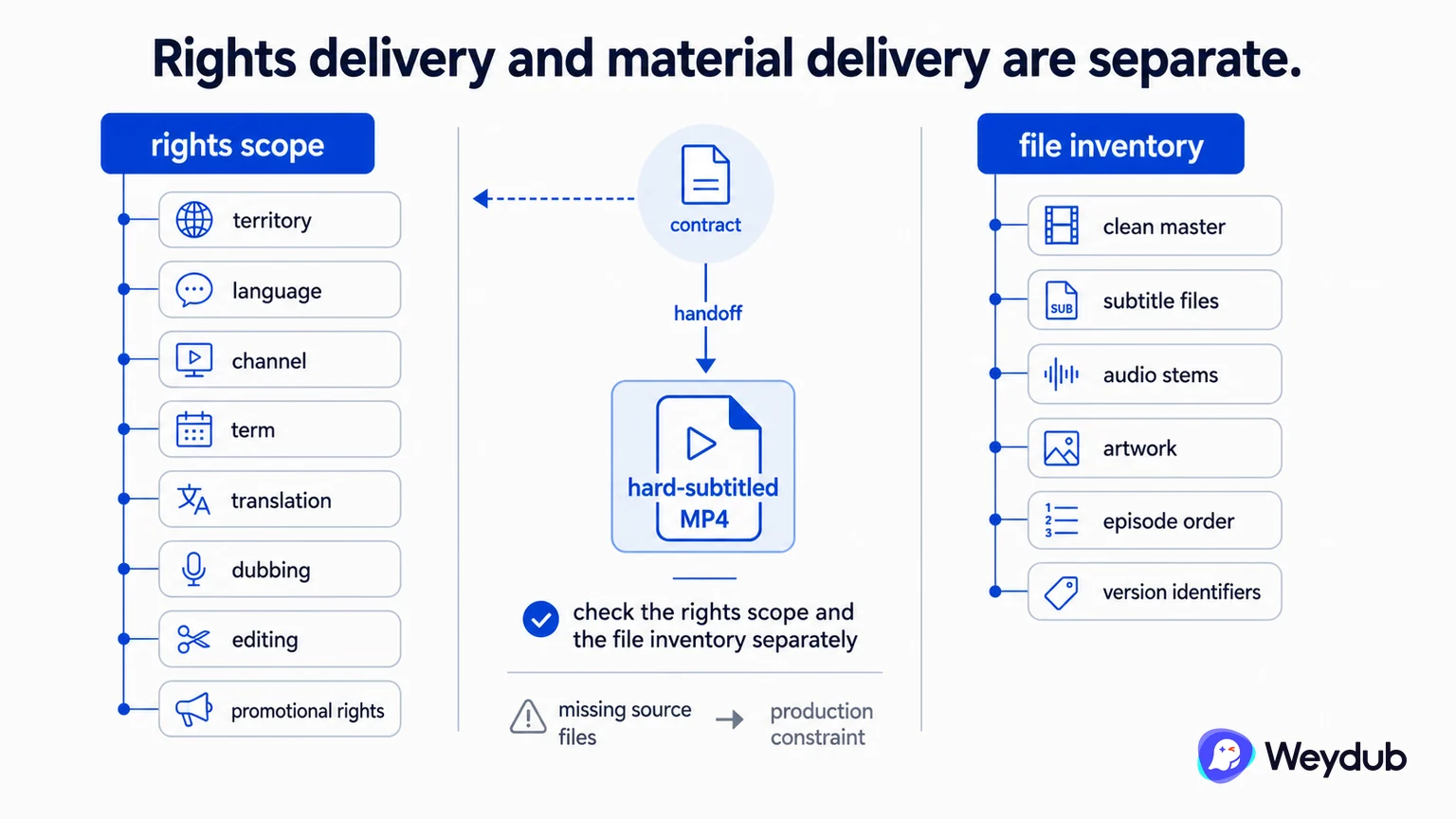
Rights delivery and material delivery are separate
A contract may grant territory and language rights while the handoff contains only a hard-subtitled MP4. Confirm the rights scope and the file inventory separately before estimating localization work.
- Check territory, language, channel, term, translation, dubbing, editing, and promotional rights.
- Inventory clean master, subtitle files, audio stems, artwork, episode order, and version identifiers.
- Treat missing source files as a production constraint until the contract and handoff prove otherwise.
Sample the missing material before choosing recovery
Use samples that expose the difficult cases: fixed subtitle regions, moving backgrounds, faces and hands, low resolution, music, quiet speech, overlap, and multiple speakers. A clean-looking shot is not evidence that an entire batch is recoverable.
| Source condition | Likely starting path | Risk to estimate |
|---|---|---|
| Clean master plus editable subtitles | Validate and translate | Version and timing mismatch |
| Clean master without subtitle file | ASR and timed review | Audio clarity and segmentation |
| Hard subtitles plus clear audio | OCR and ASR cross-check | Restoration and conflicting cues |
| Low-quality hard-subbed video | Seek source or run a narrow pilot | Faces, motion, compression, manual work |
Recover once, then reuse the result
If a clean source cannot be supplied, extract and correct the text, restore only the required regions, and preserve the accepted clean master, subtitle source, exceptions, and version notes. New languages should start from those approved inputs instead of repeating recovery.
- Check the contract, delivery list, and upstream source.
- Select difficult representative clips.
- Extract text with OCR, ASR, or both.
- Restore regions and inspect continuous playback.
- Run a small batch before scaling the full series.
Frequently asked questions
Does buying translation rights guarantee a clean master?
No. Rights scope and material delivery are separate contract questions.
Can a hard-subtitled master still support an overseas version?
Sometimes. Test OCR, ASR, picture restoration, audio quality, and the hardest scenes before committing to a batch.
Which is better, OCR or ASR?
OCR reads visible text and ASR reconstructs speech. Choose based on the available evidence; when both are clear, cross-checking can help.
Related theme: Short-drama globalization
Weydub workflow
Take the next production step
Move from a market and source decision to a reviewable multi-episode localization workflow.