
Market evidence
How large is the overseas short-drama market?
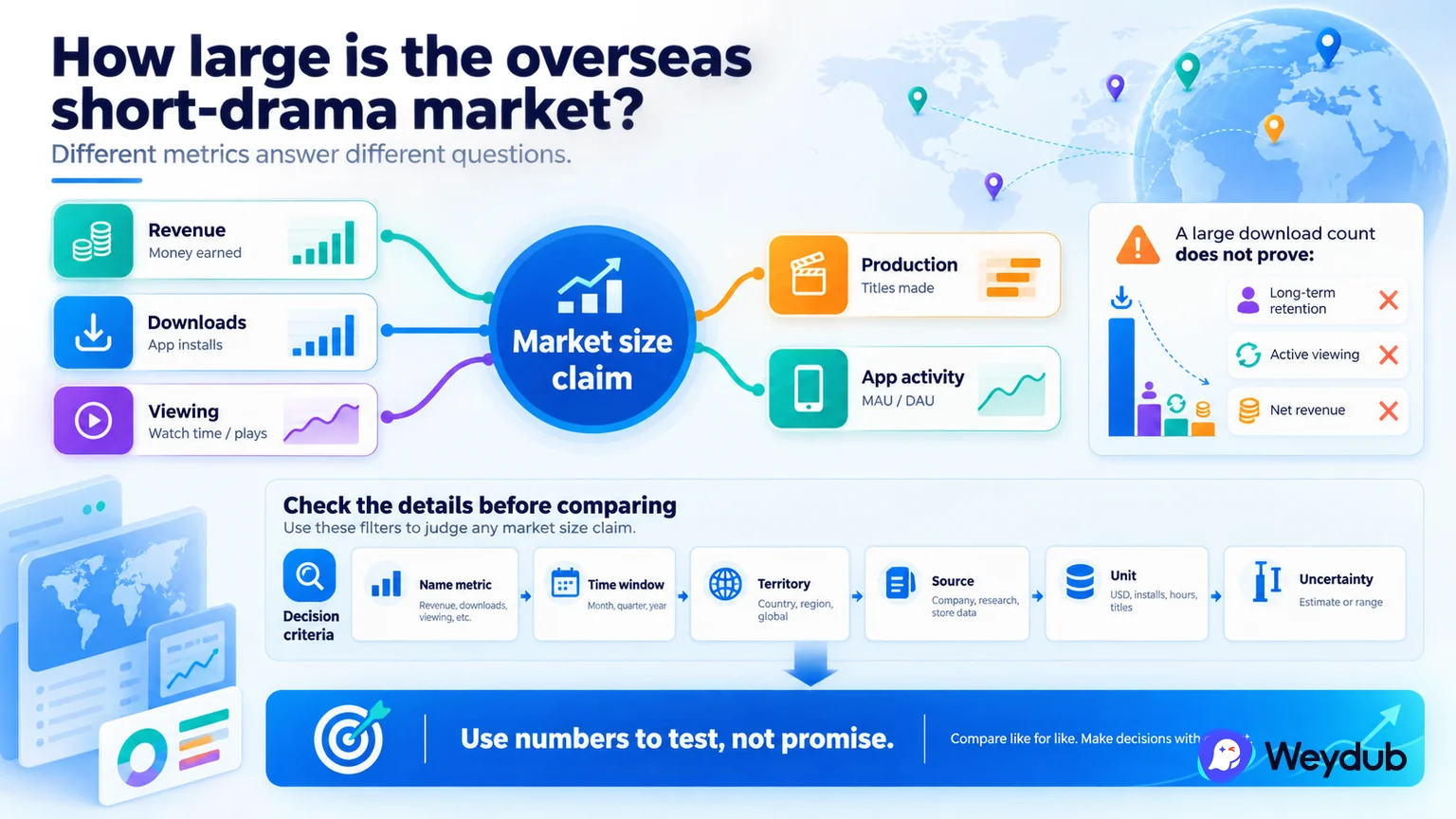
Downloads, viewing, revenue, production volume, and app activity are different measures and should not be blended into one headline.
Key conclusions
- Name the metric, time window, territory, and source before comparing market claims.
- Separate platform revenue from content production and app downloads.
- Use market numbers to frame a test, not to guarantee a title's performance.
A market-size statement can refer to money spent by viewers, money received by platforms, advertising value, number of episodes, number of apps, or audience activity. Each measure answers a different question. A large download count does not automatically reveal retention or net revenue.
Territory and time also matter. A global estimate may hide very different language, rights, pricing, and channel conditions. A short period of platform growth may describe a signal without proving that every genre or title will follow it.
A careful brief records the source, date, unit, market definition, and uncertainty. It then uses the information to choose a test and a decision threshold rather than repeating an impressive number as a product promise.
Market size is not one number
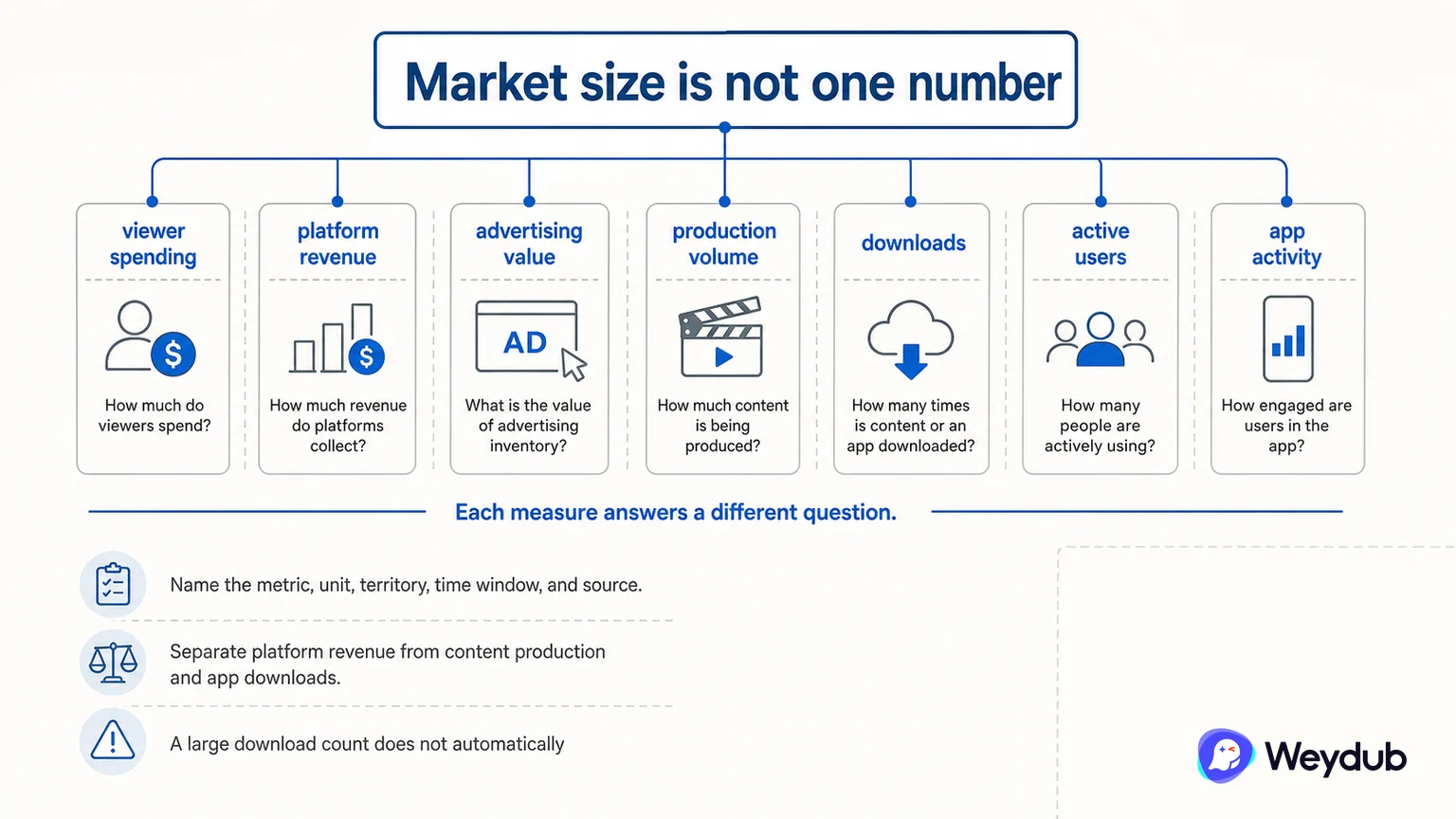
A market-size statement may refer to viewer spending, platform revenue, advertising value, production volume, downloads, active users, or app activity. Each measure answers a different question. A large download count does not automatically reveal retention or net revenue.
Territory and time also matter. A global estimate can hide different language, rights, pricing, and channel conditions; a short period of platform growth may show a signal without proving that every genre or title will follow it.
- Name the metric, unit, territory, time window, and source.
- Separate platform revenue from content production and app downloads.
- Record uncertainty instead of turning an estimate into a guarantee.
Use market numbers to frame a test
A careful brief records the market definition and date, then asks what decision the number can support: which language to sample, which channel to test, or what audience behavior to measure. It should not be repeated as a product promise when the source does not support title-level performance.
The strongest evidence combines external context with the team's own release data. A market signal can justify a controlled experiment; it cannot replace rights, audience, language, channel, and cost analysis.
| Metric | What it can indicate | What it cannot prove alone |
|---|---|---|
| Downloads | Distribution or acquisition reach | Retention, viewing, or net revenue |
| Viewer spending | Demand and payment activity | A specific title's conversion |
| Platform revenue | Operator or channel recovery | Rights-holder profit |
| Production volume | Supply and industry activity | Audience quality or content fit |
State the evidence before scaling
Choose a representative title, language, channel, and measurement window. Keep the sample and the market claim linked so the team can say exactly which conditions were tested and which remain unknown.
- Define the market and metric.
- Check source, date, unit, and territory.
- Choose a testable title and release path.
- Measure audience, monetization, and operational results.
- Update the hypothesis without inflating the original number.
Frequently asked questions
Can one market-size estimate predict a title's revenue?
No. It provides context. Title performance depends on story, audience, channel, rights, localization, acquisition, and monetization.
Why separate downloads from revenue?
A download may not lead to viewing or payment, and revenue may include behavior from a different period or product scope.
Related theme: Short-drama globalization
Weydub workflow
Take the next production step
Move from a market and source decision to a reviewable multi-episode localization workflow.