
Release planning
Should a short drama launch with subtitles or dubbing first?
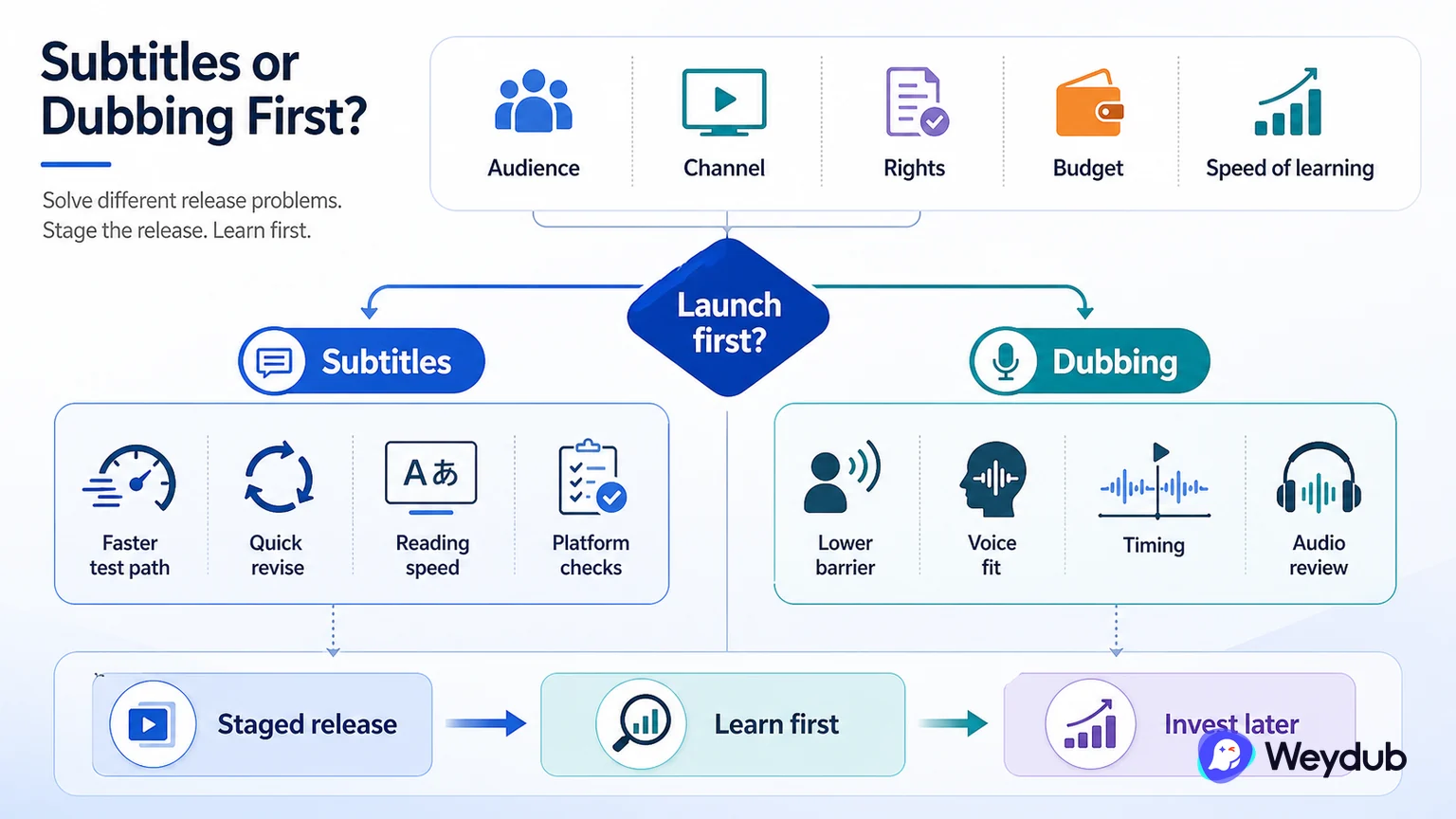
The answer depends on audience, channel, rights, budget, and the speed of learning you need.
Key conclusions
- Subtitles usually create a faster test path.
- Dubbing can lower the language barrier but adds voice, timing, and audio review.
- A staged release can separate market learning from full production investment.
Subtitles and dubbing solve different release problems. Subtitles can be produced and revised quickly, while dubbing can make a story easier to follow for audiences who prefer listening or who encounter the content in a feed where reading is difficult.
The tradeoff is not only price. Dubbing adds role attribution, voice fit, performance continuity, timing reconstruction, and sound-mix review. Subtitles still require translation quality, reading speed, placement, and platform checks.
For an uncertain market, teams often benefit from a staged decision: test a focused subtitle package, learn which episodes and audiences respond, then invest in dubbing where the expected value justifies the extra review and delivery work.
Decide what the first release needs to learn
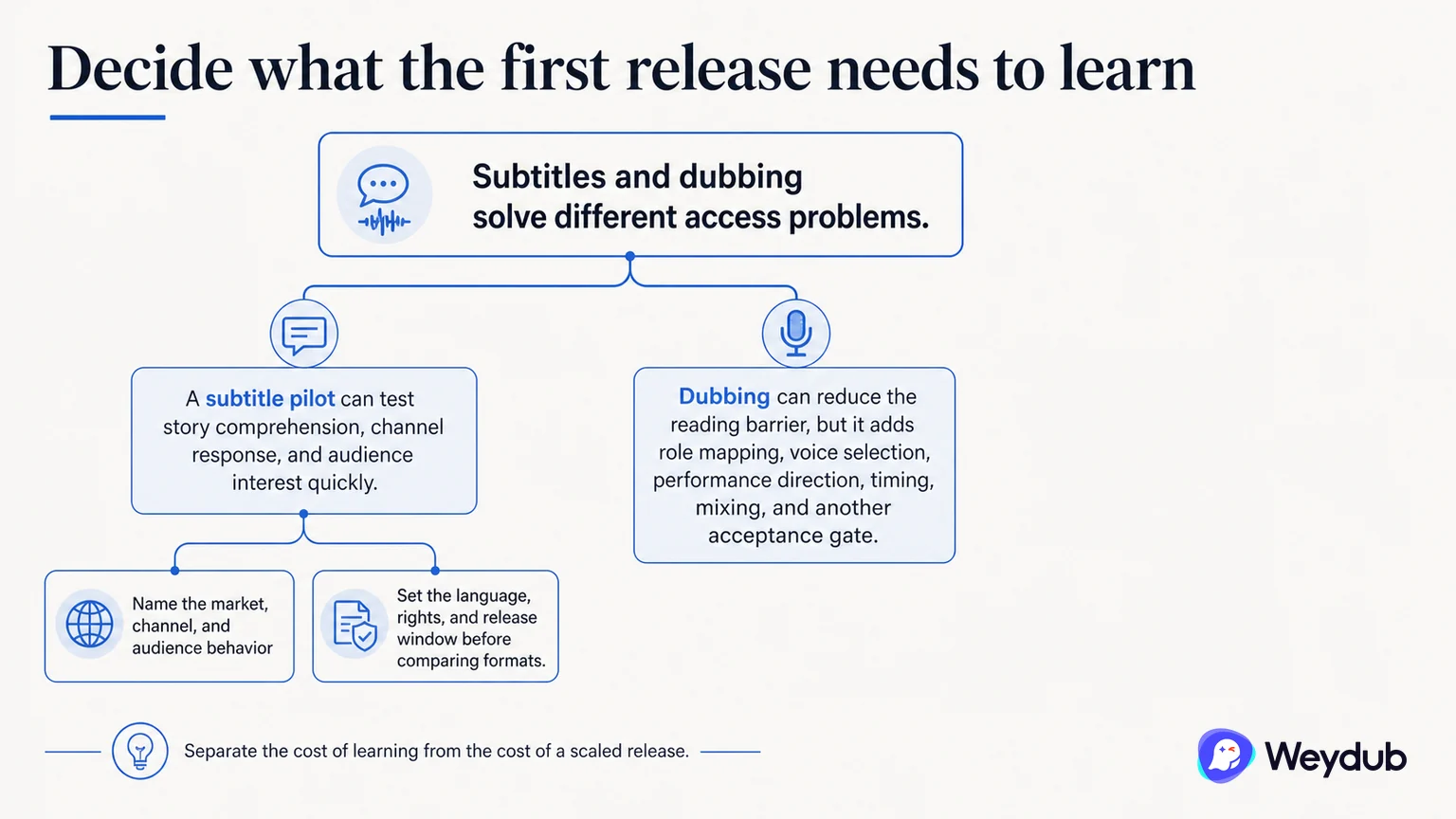
Subtitles and dubbing solve different access problems. A subtitle pilot can test story comprehension, channel response, and audience interest quickly. Dubbing can reduce the reading barrier, but it adds role mapping, voice selection, performance direction, timing, mixing, and another acceptance gate.
- Name the market, channel, and audience behavior the pilot must test.
- Set the language, rights, and release window before comparing formats.
- Separate the cost of learning from the cost of a scaled release.
Compare the full production path
The relevant comparison is not a single subtitle quote versus a single voice quote. Subtitles require translation, segmentation, reading-speed, placement, and platform review. Dubbing adds role-aware translation, voice continuity, performance, duration control, mix, and downstream picture checks.
| Question | Subtitle-first | Dubbing-first |
|---|---|---|
| Speed to test | Usually faster | Needs more preparation |
| Audience access | Requires reading | Better for listening-first viewing |
| Rework surface | Text, timing, placement | Text, role, voice, timing, mix |
| Best evidence | Comprehension and retention | Listening access and performance fit |
Use a staged release when the market is uncertain
A focused subtitle package can reduce uncertainty before a team invests in a full dubbed library. Upgrade the series, episodes, or scenes where audience behavior, channel requirements, and rights economics justify the additional work. The staged path is a decision process, not a promise that subtitles are always cheaper or dubbing always wins.
- Define the release job and acceptance bar.
- Prepare a representative subtitle package.
- Measure audience and production signals in context.
- Select the episodes or markets worth dubbing.
- Review the dubbed output as an audiovisual version.
Frequently asked questions
Is subtitle-first always the low-budget option?
No. A high-quality subtitle release can require substantial review, and a simple dubbed version may fit a specific audience. Budget should follow the release job and acceptance bar.
Can a subtitle pilot prove that dubbing will be profitable?
No. It can reduce uncertainty about story and channel fit, but dubbing adds different costs and audience behavior that need their own evidence.
Related theme: Distribution and delivery
Weydub workflow
Take the next production step
Prepare a localized version with subtitles, voice, timing, and a delivery path that matches the destination.