
Selection guide
A four-step method for selecting a short drama
Start with the market and channel, then test story, source and rights, and finally decide how much to produce.
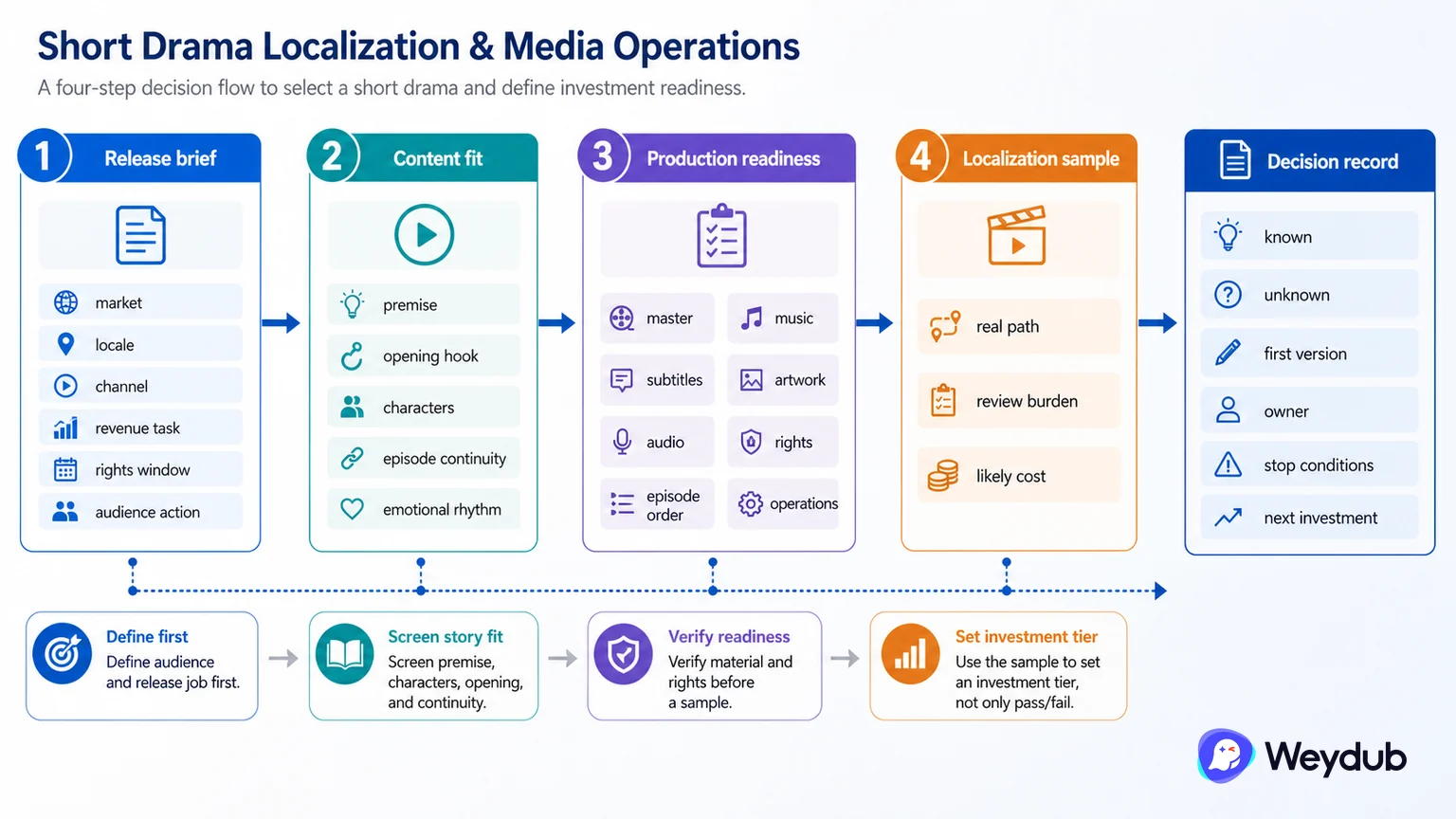
Key conclusions
- Define the audience and release job first.
- Screen premise, characters, opening, and episode continuity.
- Verify material and rights before a localization sample.
- Use the sample to set an investment tier, not only a pass/fail label.
Step one is the release brief: market, language or locale, channel, business model, rights window, and audience action. Step two is content selection: premise, opening hook, character clarity, emotional rhythm, and the ability to sustain the series.
Step three is production readiness. Check the master, hard or soft subtitles, audio, episode order, music, artwork, rights, and permitted operations. Step four is a representative sample that tests the real localization path and the likely review burden.
The output of selection should be a decision record: what is known, what remains uncertain, which version to produce first, what it will cost, and what evidence will trigger the next investment.
Write the release job first
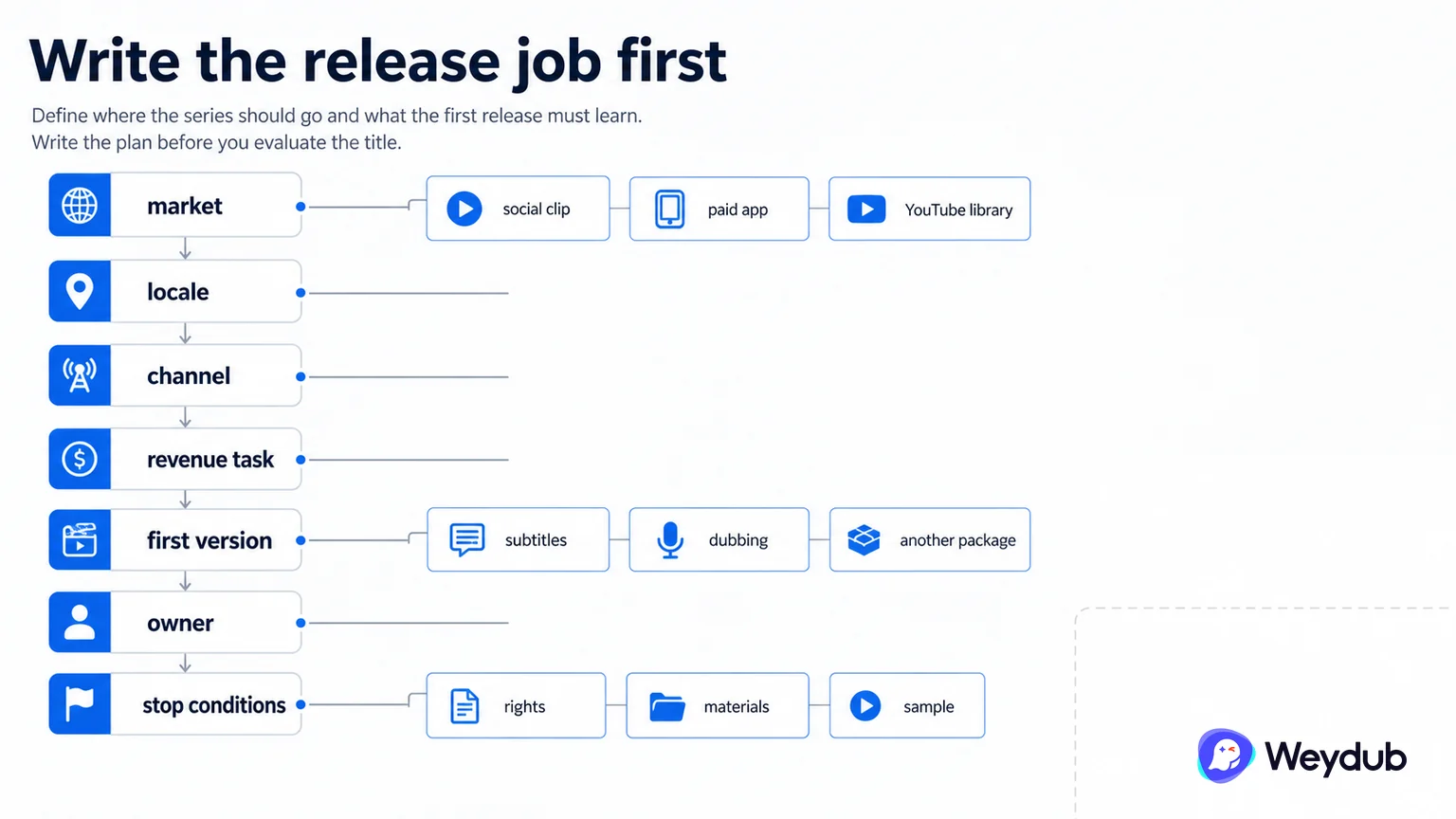
The same series may be tested as a social clip, launched in a paid app, or added to a YouTube library. Write the market, locale, channel, revenue task, first version, owner, and stop conditions before evaluating the title.
- Define where the series should go and what the first release must learn.
- State whether the first version is subtitles, dubbing, or another package.
- Allow a candidate to stop when rights, materials, or the sample fail.
Four gates keep selection actionable
Topic, materials, rights, and sample answer different questions. A compelling story does not bypass an incomplete source; complete rights do not make a low-quality master recoverable; a successful sample does not remove the need for a controlled batch.
| Gate | What to check | Possible decision |
|---|---|---|
| Topic | Opening, characters, conflict, cultural distance | Test hypothesis or stop |
| Materials | Master, subtitles, audio, episode order, picture | Supplement, restore, or adjust scope |
| Rights | Territory, language, channel, term, editing | Authorize or change release plan |
| Sample | Story comprehension and production quality | Scale, retest, or stop |
Use a sample that separates content from production
Cover the opening, relationship change, emotional scene, multiple speakers, and difficult picture. Keep the variables stable: change the title when testing content, and change subtitle or dubbing depth when testing production. A sample should end in a decision record, not only pass or fail.
- Set market, channel, language, and business task.
- Screen topic and representative scenes.
- Inspect materials and rights separately.
- Run the sample with defined acceptance criteria.
- Assign continue, supplement, adjust, or stop.
Hand the decision into series production
When a title moves forward, preserve the sample version, source text, role and glossary records, unresolved issues, and acceptance bar. Weydub can carry approved context into multi-episode localization, but it does not replace content selection, rights review, or channel testing.
Frequently asked questions
Does every candidate need one total score?
Not necessarily. Hard gates plus explicit hypotheses and evidence usually guide the next action better than a single composite score.
Should the sample be only the first episode?
No. Include relationship changes, emotional scenes, multiple speakers, and difficult visuals so content and production risks are visible.
Can a team stop after buying rights?
Yes. Rights purchase does not make further production rational. Continue based on the current channel task, source, sample, and investment tier.
Related theme: Short-drama globalization
Weydub workflow
Take the next production step
Move from a market and source decision to a reviewable multi-episode localization workflow.