
Localization economics
Are subtitled or dubbed short dramas more profitable?
Subtitles and dubbing change audience access, production depth, review load, and release speed in different ways.
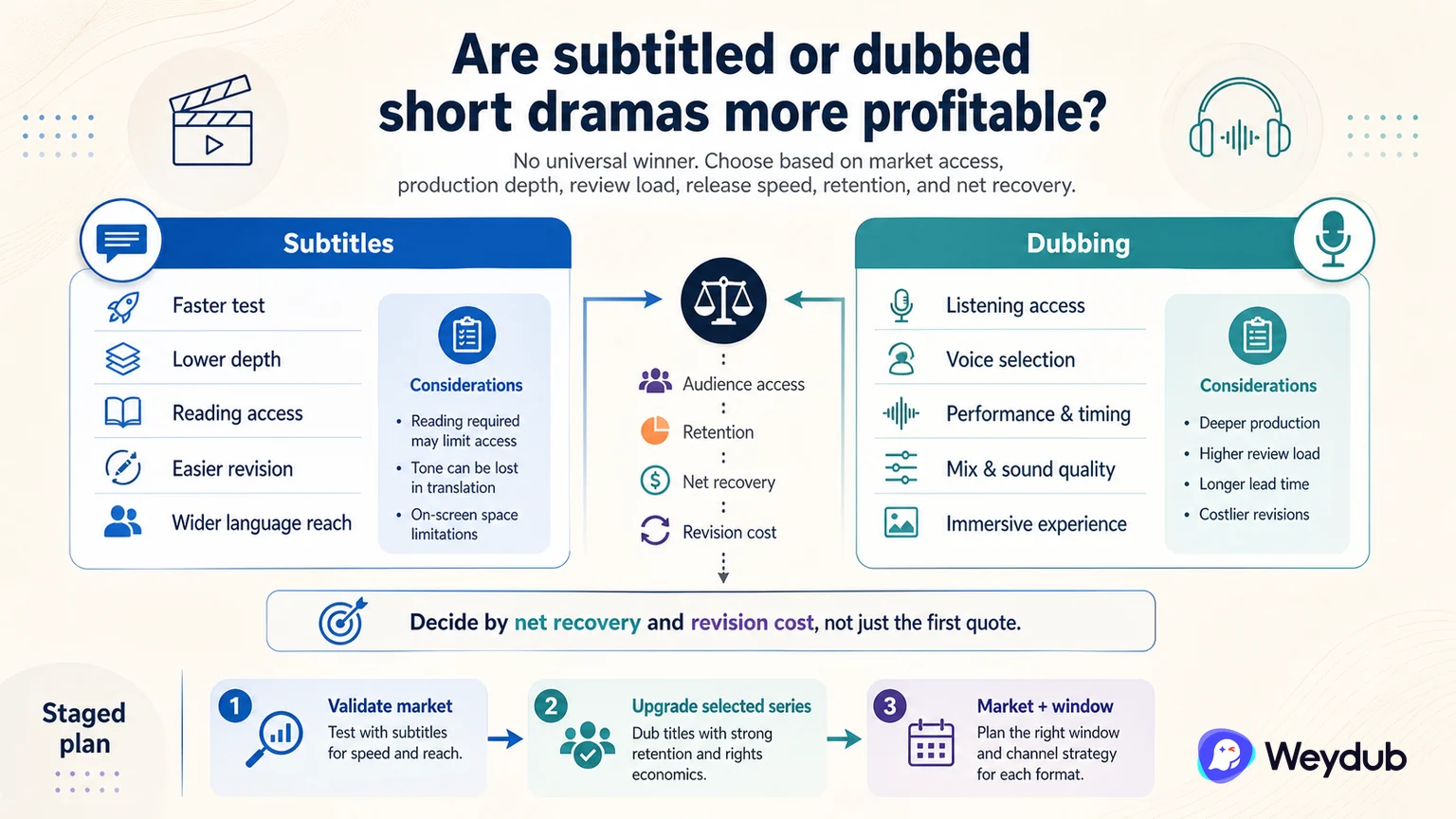
Key conclusions
- Use subtitles for a faster, lower-depth market test when reading access is acceptable.
- Use dubbing when listening access, retention, or channel behavior justifies deeper production.
- Compare net recovery and revision cost, not only the first localization quote.
There is no universal winner because the two versions solve different audience and channel problems. Subtitles usually preserve the original performance and can be revised quickly, but they ask viewers to read. Dubbing reduces that reading barrier while adding role mapping, voice selection, performance, timing, audio mix, and another review surface.
Profitability depends on what the audience does after release. A cheaper subtitle version is not automatically better if it cannot support the channel or loses viewers at the same point. A dubbed version is not automatically better if the additional cost is spent on a market that has not been validated.
A staged plan can be useful: test the story and channel with a focused subtitle package, then upgrade selected series or episodes when the observed audience and rights economics support it. Keep the decision tied to a market and release window rather than making it a permanent rule.
Subtitles save some production time; dubbing changes access
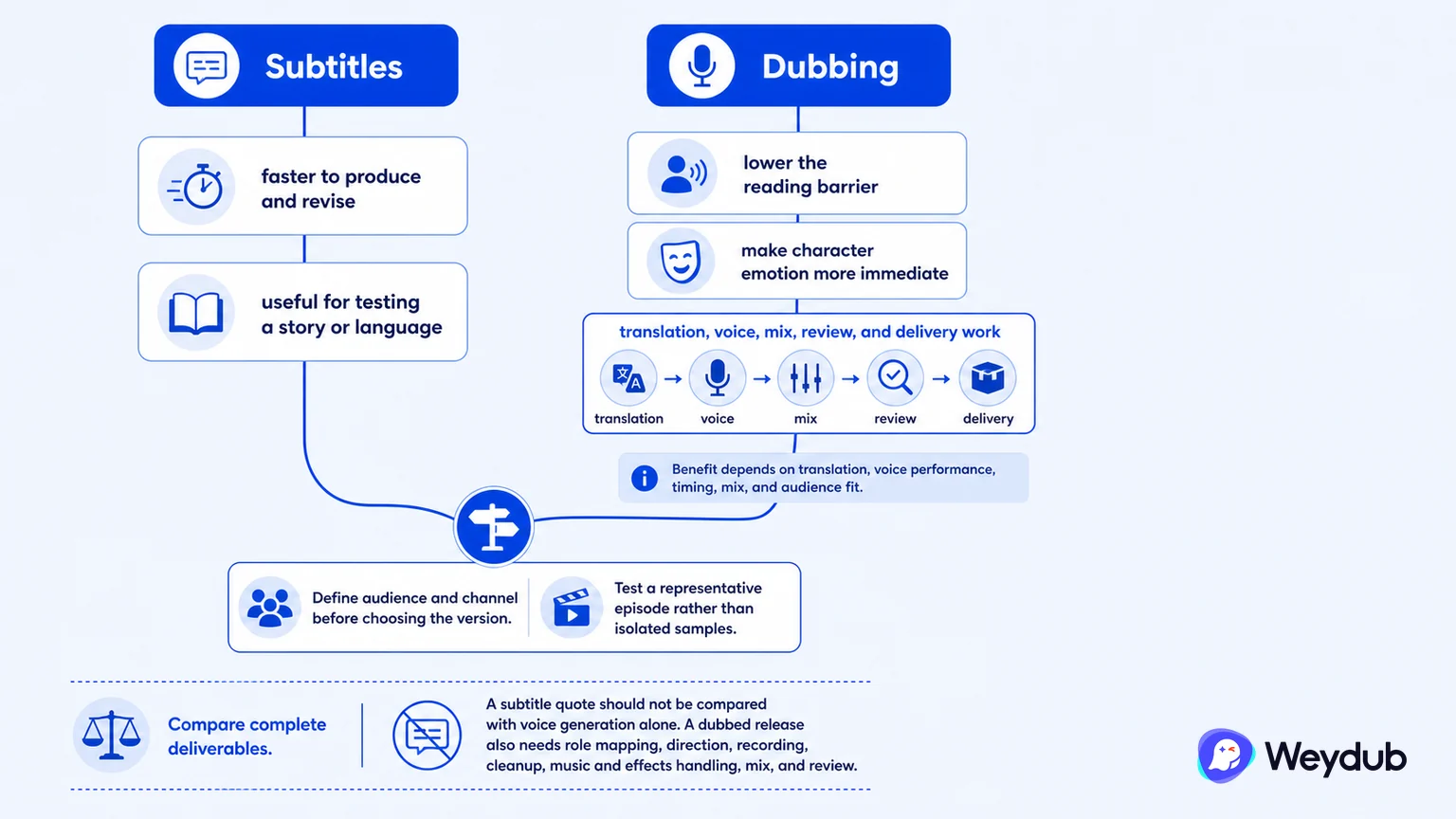
Subtitles are often faster to produce and revise, which makes them useful for testing a story or language. Dubbing can lower the reading barrier and make character emotion more immediate, but the benefit depends on translation, voice performance, timing, mix, and audience fit.
Compare complete deliverables. A subtitle quote should not be compared with voice generation alone when a dubbed release also needs role mapping, direction, recording, cleanup, music and effects handling, mix, and review.
- Define audience and channel before choosing the version.
- Count translation, timing, voice, mix, review, and delivery work.
- Test a representative episode rather than isolated samples.
The business model changes the acceptance bar
An early market test may prioritize speed and learning, while a flagship or audio-first release may justify deeper voice and performance work. There is no universal rule that dubbing earns more; the channel and audience determine whether the extra work is recovered.
| Question | Subtitle-first | Dubbing-first |
|---|---|---|
| Fast test | Usually lower setup | Needs voice and mix planning |
| Audience access | Requires comfortable reading | Can reduce reading barrier |
| Continuity | Terms, timing, style | Terms, roles, voices, performance |
| Best evidence | Reading and retention | Listening and audiovisual review |
Decide with a staged release
A team can use subtitles to test story, audience, and channel fit, then add dubbing where the evidence supports the investment. Keep subtitle and voice assets connected to the same approved source and terminology so the route can change without restarting context decisions.
- Define audience, channel, and monetization objective.
- Prepare a representative sample.
- Review language, timing, picture, voice, and mix together.
- Measure continuation and rework.
- Expand version depth only when the result supports it.
Frequently asked questions
Is dubbing always more profitable?
No. It can improve access for some audiences, but the added production and review cost must be recovered by the specific channel and business model.
Can a subtitle version later become a dubbing source?
Yes, when the source subtitle is corrected, context-rich, and timed for the dubbing workflow. A subtitle export alone is not always a ready dubbing script.
Related theme: Distribution and delivery
Weydub workflow
Take the next production step
Prepare a localized version with subtitles, voice, timing, and a delivery path that matches the destination.