
Delivery operations
What should a short-drama delivery package contain?
A release package should make the target version usable without forcing the receiving team to reconstruct the project history.
Key conclusions
- Align video, subtitle, audio, metadata, artwork, and episode order.
- Record language, locale, territory, channel, rights window, and version.
- Include manifests or acceptance notes for the destination.
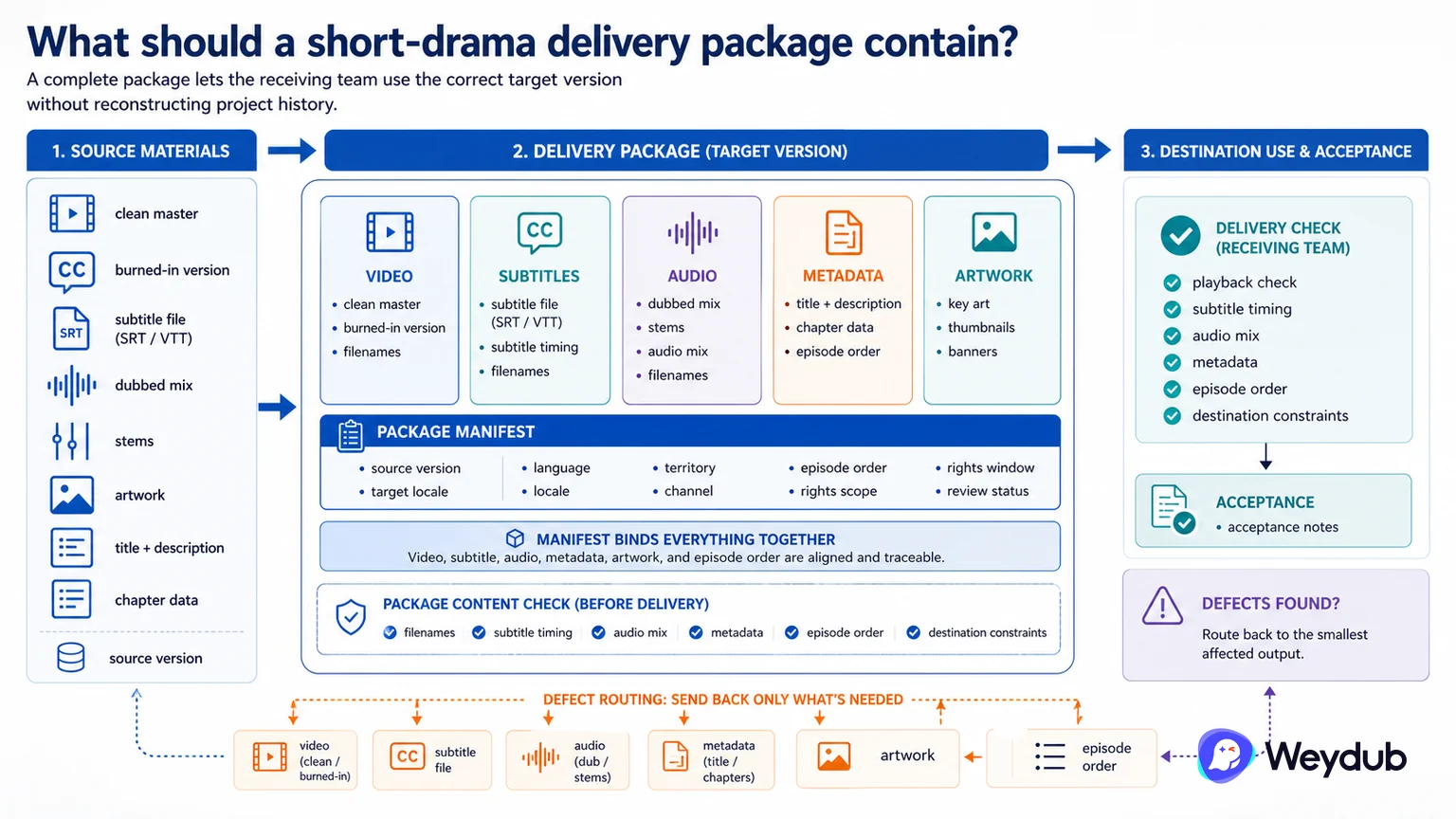
The exact files vary by channel and contract, but the receiving party should be able to identify the correct picture, text, audio, and release state. That may mean a clean master, burned-in version, separate SRT or VTT, dubbed mix, stems, artwork, title and description, chapter data, or a manifest.
A package should also carry context: source version, target locale, episode order, channel, rights scope, and review status. Without it, a correct file can be paired with the wrong language or published outside its authorized window.
Make the delivery check explicit. Playback, subtitle timing, audio mix, metadata, filenames, and destination constraints should be reviewed before handoff, with defects routed back to the smallest affected output.
A delivery package is more than a rendered video
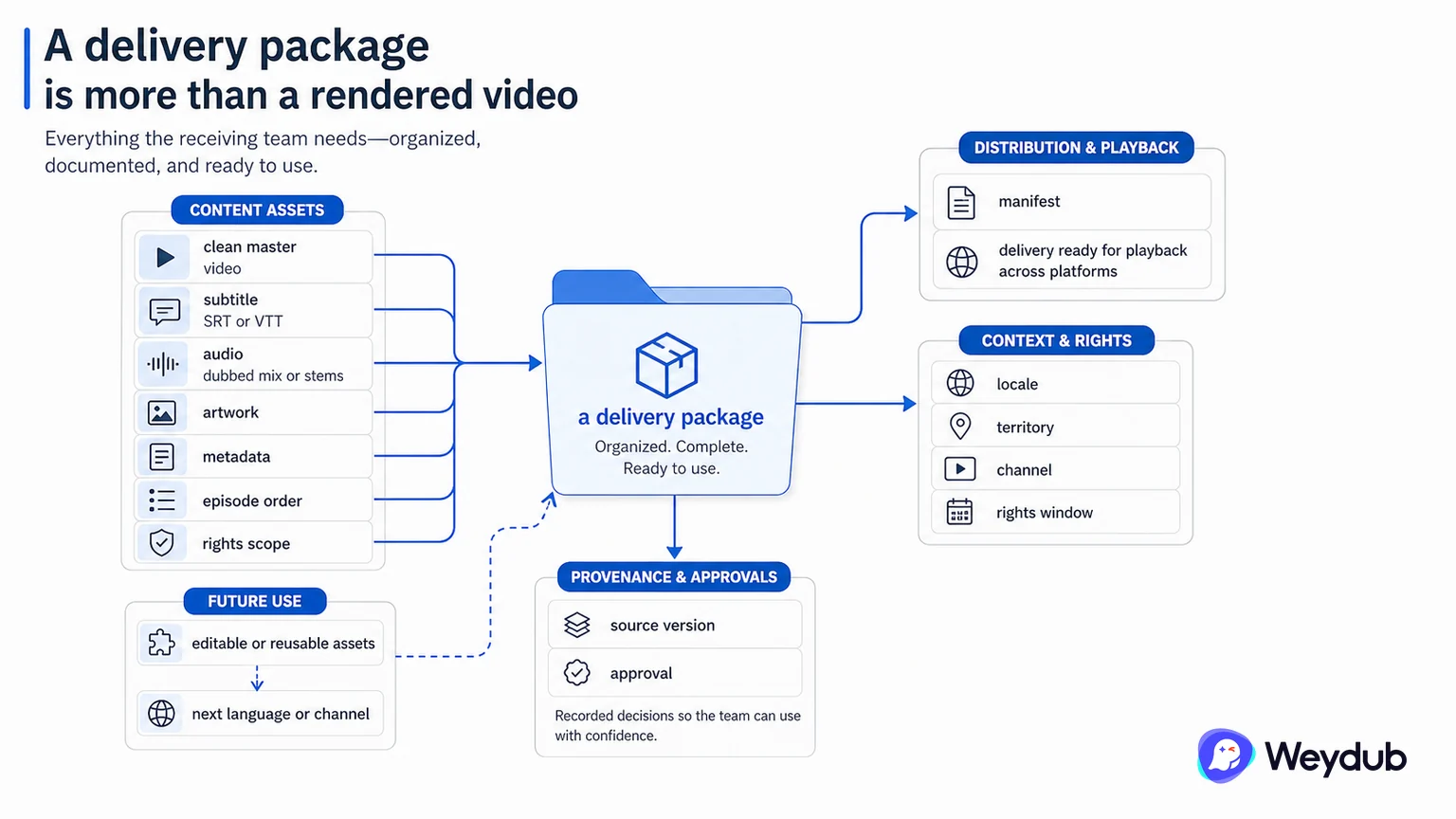
The receiving team should be able to identify and use the correct clean master, subtitle, audio, artwork, metadata, episode order, and rights scope without reconstructing the project history.
- Align video, SRT or VTT, dubbed mix or stems, artwork, metadata, and manifest.
- Record locale, territory, channel, rights window, source version, and approval.
- Keep editable or reusable assets when the next language or channel depends on them.
Match the package to its destination
App, YouTube, social, and partner delivery have different requirements. A separate subtitle track may be preferred in one destination, while another requires burned-in text, a specific audio mix, chapter data, or a different aspect ratio.
| Destination | Typical package | Extra attention |
|---|---|---|
| App | Video, language assets, metadata, artwork | Product locale and episode state |
| YouTube | Video, captions, title, thumbnail, chapters | Music, playlist, channel, rights |
| Social | Short cut, captions, cover, copy | Hook, format, platform policy |
| Partner | Master, tracks, manifest, rights notes | Acceptance and handoff evidence |
Use an acceptance manifest
List files, versions, owners, exceptions, and approval before handoff. The manifest should make it possible to add a language, replace a faulty episode, or adapt to another channel without losing the original source relationship.
- Freeze version, locale, channel, and rights.
- Assemble picture, text, audio, artwork, and metadata.
- Validate files and playback.
- Record exceptions and approval.
- Deliver and archive the accepted package.
Frequently asked questions
Should a delivery package include source files?
Include the reusable or editable assets required by the contract and next workflow; do not assume every destination needs the same set.
Can a package be accepted if the video plays?
Not by itself. Subtitle, audio, metadata, naming, rights, and destination requirements also need to pass.
Related theme: Distribution and delivery
Weydub workflow
Take the next production step
Prepare a localized version with subtitles, voice, timing, and a delivery path that matches the destination.