
Dubbing quality
Why can AI dubbing get the emotion right but the rhythm wrong?
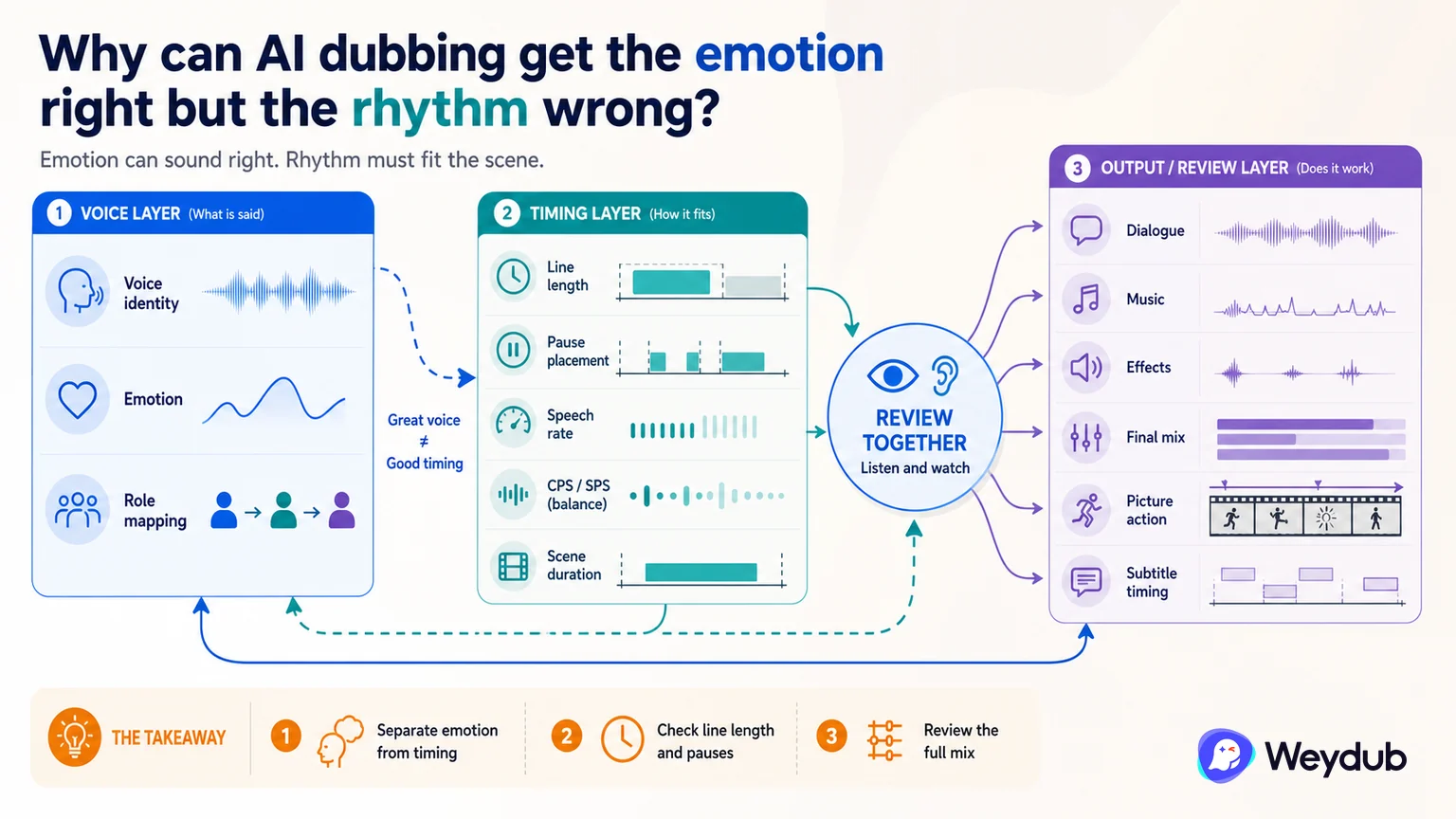
Voice emotion, line length, pause placement, speech rate, timing, and sound mix are separate dimensions of audiovisual reconstruction.
Key conclusions
- Separate voice identity and emotion from timing and performance fit.
- Review translated line length, pauses, CPS/SPS, and scene duration together.
- Check dialogue, music, effects, and the final mix as a complete output.
A voice can sound expressive while entering too late, ending too early, or using a pause that conflicts with the picture. The cause may be the translation length, segmentation, role mapping, voice direction, or timing reconstruction rather than the voice model alone.
Dubbing review should listen and watch at the same time. Check the intended emotion, character continuity, speech rate, pause, scene action, subtitle relationship, and audio layers. A good isolated sentence is not proof of a good episode performance.
Fix upstream problems first. If the target line is too long or assigned to the wrong role, changing the voice style will not solve the rhythm. Preserve the review decision in the language version so later episodes can reuse it.
Emotion is not the same as timing
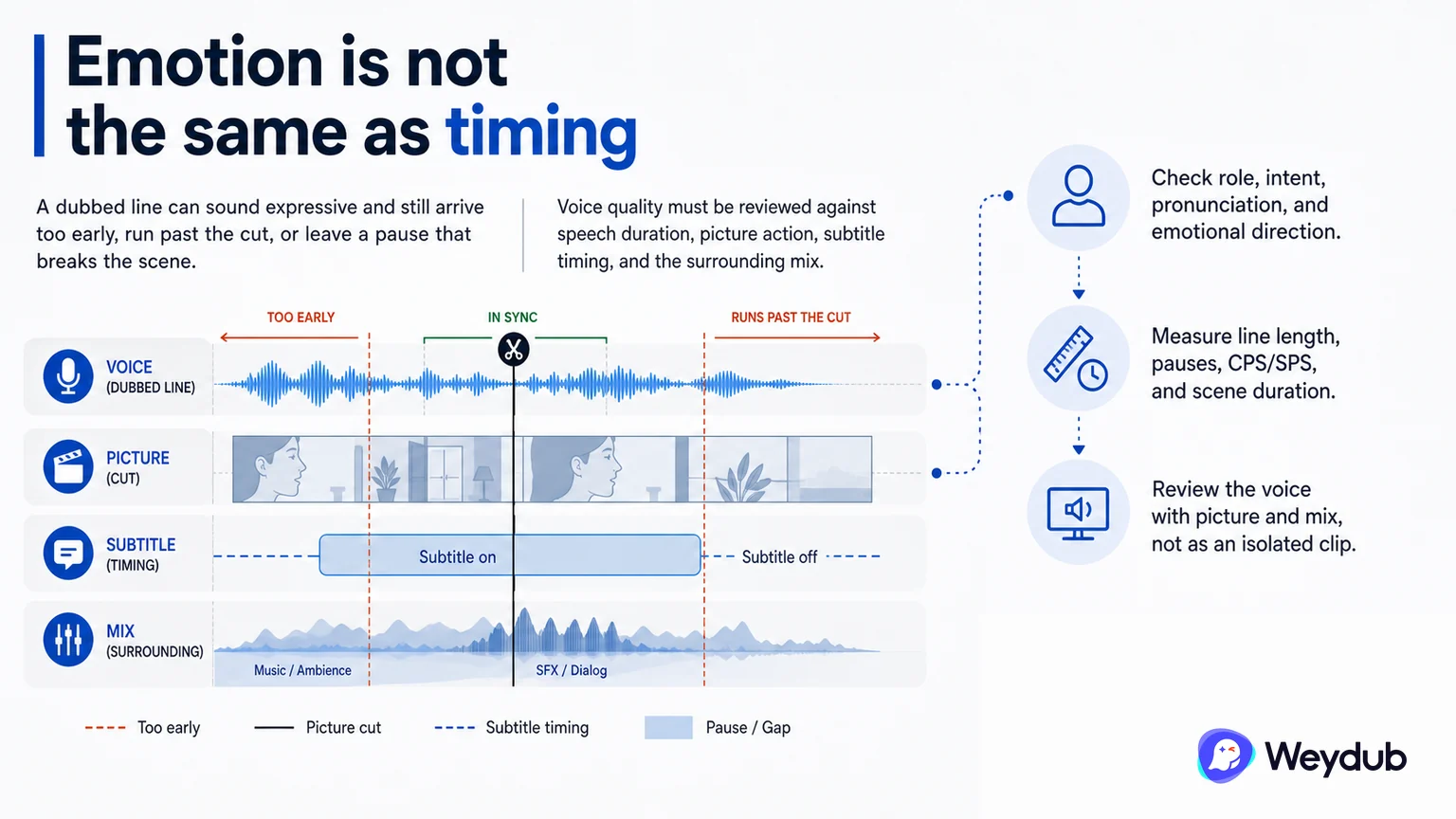
A dubbed line can sound expressive and still arrive too early, run past the cut, or leave a pause that breaks the scene. Voice quality must be reviewed against speech duration, picture action, subtitle timing, and the surrounding mix.
- Check role, intent, pronunciation, and emotional direction.
- Measure line length, pauses, CPS/SPS, and scene duration.
- Review the voice with picture and mix, not as an isolated clip.
Find the upstream cause
Rhythm problems often begin in translation or segmentation. A literal line may be too long, a pause may be missing, or a role decision may change the performance. Fix the source text or timing policy before repeatedly tuning the voice.
| Symptom | Likely cause | First repair |
|---|---|---|
| Emotion fits, line overruns | Translation length or segmentation | Shorten or re-segment with meaning intact |
| Correct words, wrong pause | Timing or scene boundary | Align cue and performance |
| Natural voice, wrong role | Character context | Correct role and voice mapping |
| Good line, broken mix | Track or level | Review audio layers and export |
Accept a dubbed scene as audiovisual work
Review the complete scene: character identity, translation, pronunciation, emotion, pause, duration, music, effects, and picture continuity. Keep the approved script and voice mapping so later episodes inherit the performance intent instead of starting from isolated lines.
- Confirm role and translation context.
- Constrain line length and timing.
- Generate or record the candidate voice.
- Review performance, picture, and mix together.
- Approve the track and preserve its dependencies.
Frequently asked questions
Can a more emotional voice fix a timing problem?
Usually not. Timing often requires a translation, segmentation, or direction change before the voice is tuned.
Is lip sync required for every dubbed release?
No. Audio-to-scene alignment is a core requirement; lip-sync reconstruction is an additional release decision.
Related theme: Distribution and delivery
Weydub workflow
Take the next production step
Prepare a localized version with subtitles, voice, timing, and a delivery path that matches the destination.