
Subtitle timing
How to review an SRT timeline: sync, segmentation, and reading speed
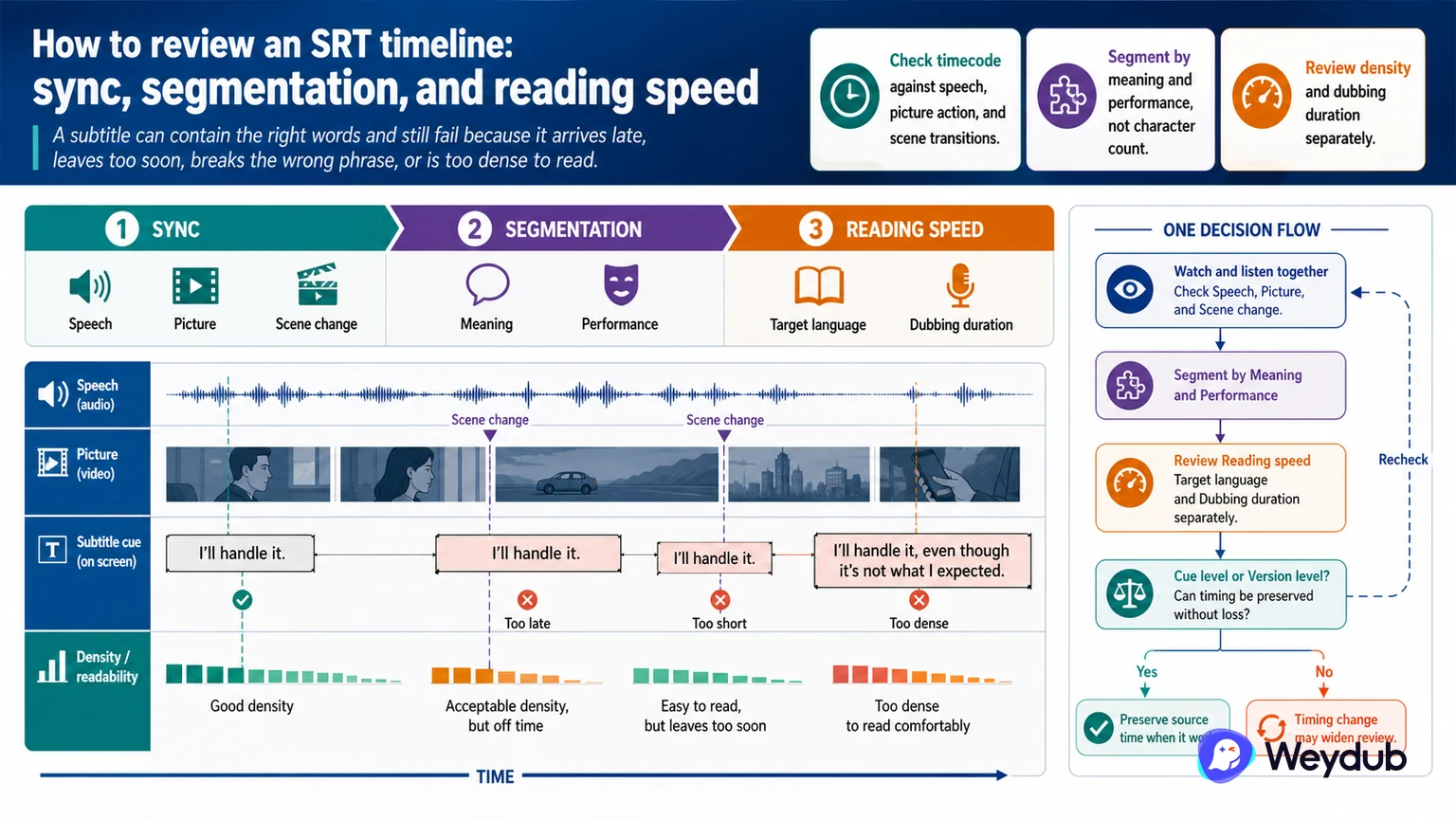
A subtitle can contain the right words and still fail because it arrives late, leaves too soon, breaks the wrong phrase, or is too dense to read.
Key conclusions
- Check timecode against speech, picture action, and scene transitions.
- Segment by meaning and performance rather than arbitrary character counts.
- Review target-language density and dubbing duration separately.
Timing review should watch and listen together. Check when the speaker begins, when the idea becomes relevant, when the shot changes, and whether the cue remains long enough to read. A transcript editor alone cannot see all of those constraints.
Line breaks should support meaning and reading rhythm. Target languages expand or contract differently, and a subtitle intended to feed dubbing has additional duration and pause requirements. The source time axis should be preserved where it works, but not treated as a reason to keep an unreadable cue.
Record timing changes at the cue or version level and recheck dependent outputs. A local segmentation fix may be enough; a source timing change may require a wider language or audio review.
Timing is meaning, not decoration
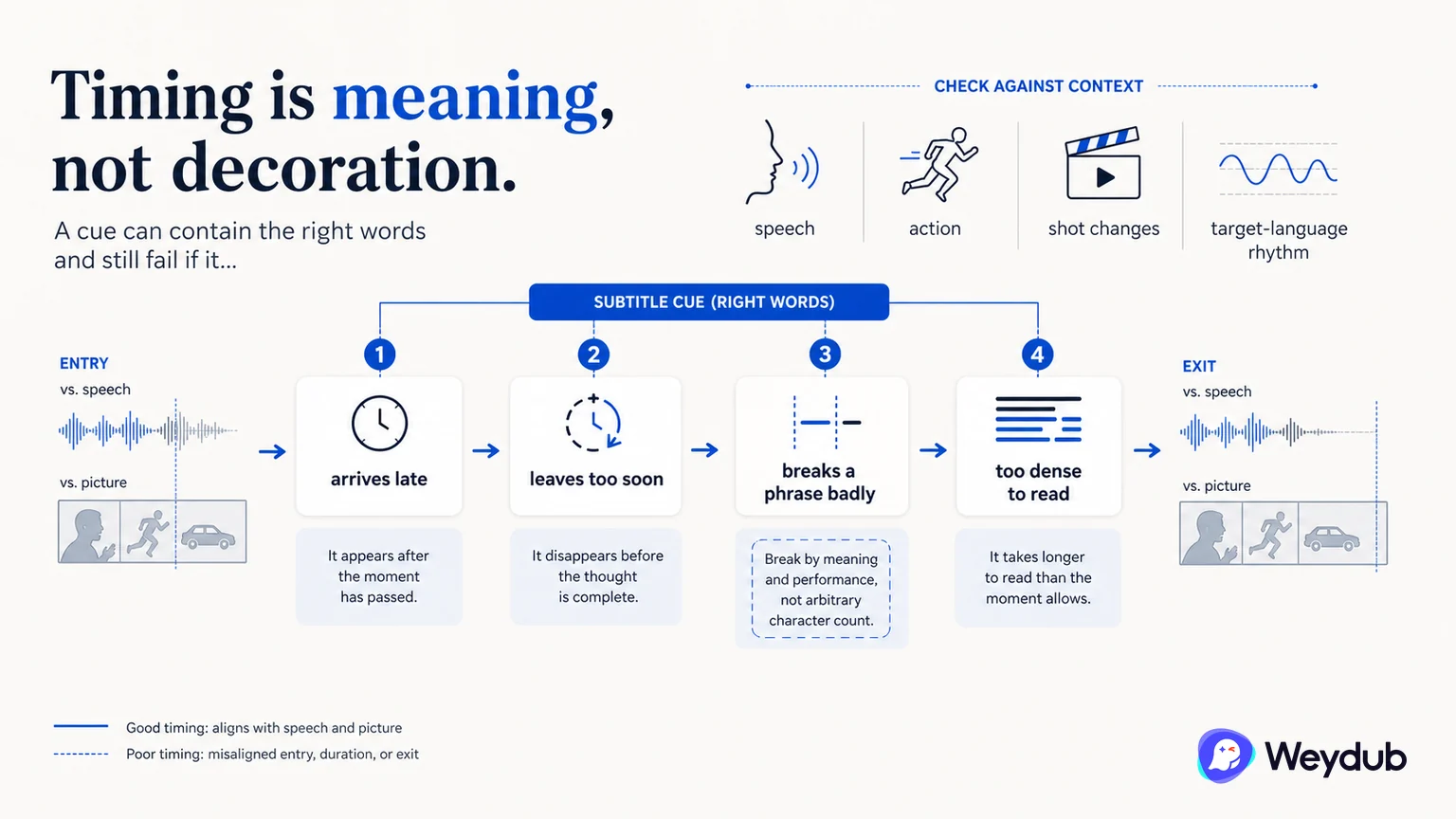
A cue can contain the right words and still fail if it arrives late, leaves too soon, breaks a phrase badly, or is too dense to read. Watch and listen against speech, action, shot changes, and target-language rhythm.
- Check entry and exit against speech and picture.
- Break by meaning and performance, not arbitrary character count.
- Measure target-language density and dubbing duration separately.
Review the timeline at three levels
First inspect each cue. Then inspect neighboring cues for gaps, overlaps, and unnatural rhythm. Finally inspect the scene and episode so a local change does not break a transition, song, or language-dependent performance.
| Level | Check | Typical repair |
|---|---|---|
| Cue | Start, end, break, density | Retiming or re-segmentation |
| Neighborhood | Gap, overlap, continuity | Shift adjacent cues |
| Scene | Action, cut, performance | Rebuild timing policy |
Keep the source and target versions linked
Preserve the source time axis where it works, but do not keep an unreadable cue just because it matches the source. Record target timing changes and recheck dependent voice, picture, and delivery outputs.
- Watch and listen to the source cue.
- Segment for meaning and target reading speed.
- Check neighboring and scene transitions.
- Review dubbing duration where relevant.
- Approve the version and update dependents.
Frequently asked questions
Is CPS a complete subtitle quality score?
No. It is a useful signal that must be read with meaning, line breaks, visual complexity, audience, and scene timing.
Should translated subtitles keep the source timecodes?
Keep them when they remain readable and aligned; adjust them when target-language length or scene timing requires it.
Related theme: Subtitle and language systems
Weydub workflow
Take the next production step
Turn source video into reviewable subtitle material, then carry approved context into translation and delivery.