
Quality control
How to review a localized episode without checking everything equally
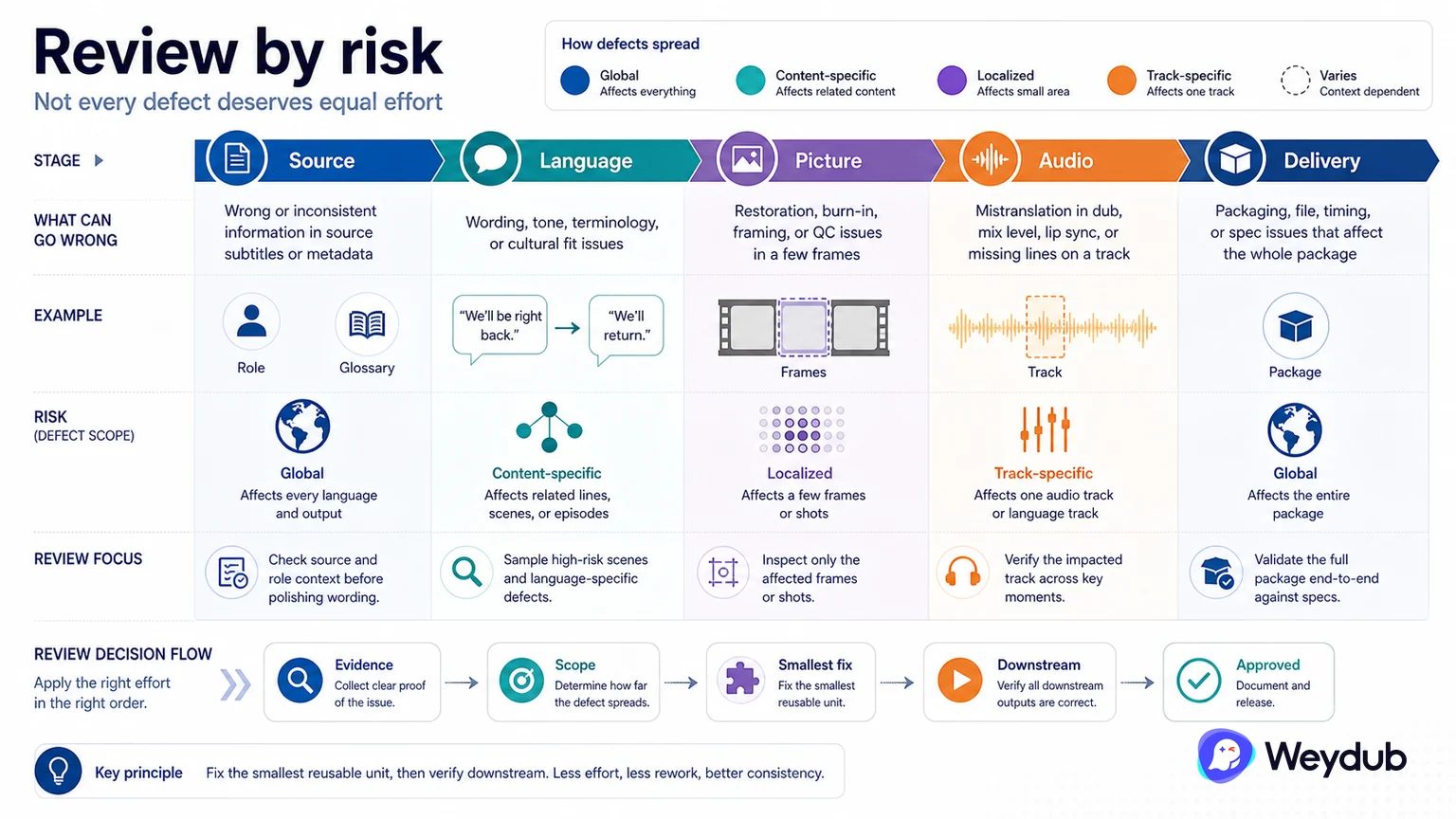
Review effort should follow production risk: source, language, picture, audio, and delivery do not fail in the same way.
Key conclusions
- Check source and role context before polishing wording.
- Sample high-risk scenes and language-specific defects.
- Fix the smallest reusable unit, then verify downstream outputs.
A useful review pass starts by separating defect types. Source subtitle errors can affect every language. A wrong character label can make translation and dubbing inconsistent. A picture restoration defect may be local to a few frames. A delivery defect may affect the whole package even when the video looks correct.
This is why a single overall score is rarely enough for operations. Teams need a checklist that identifies the evidence being reviewed, the scope of the defect, the smallest repair unit, and whether the correction must flow into other language versions.
The goal is not to remove human review. It is to spend it where it changes the final outcome, preserve approved decisions, and avoid regenerating work that is already correct.
Start with the approved source and version context
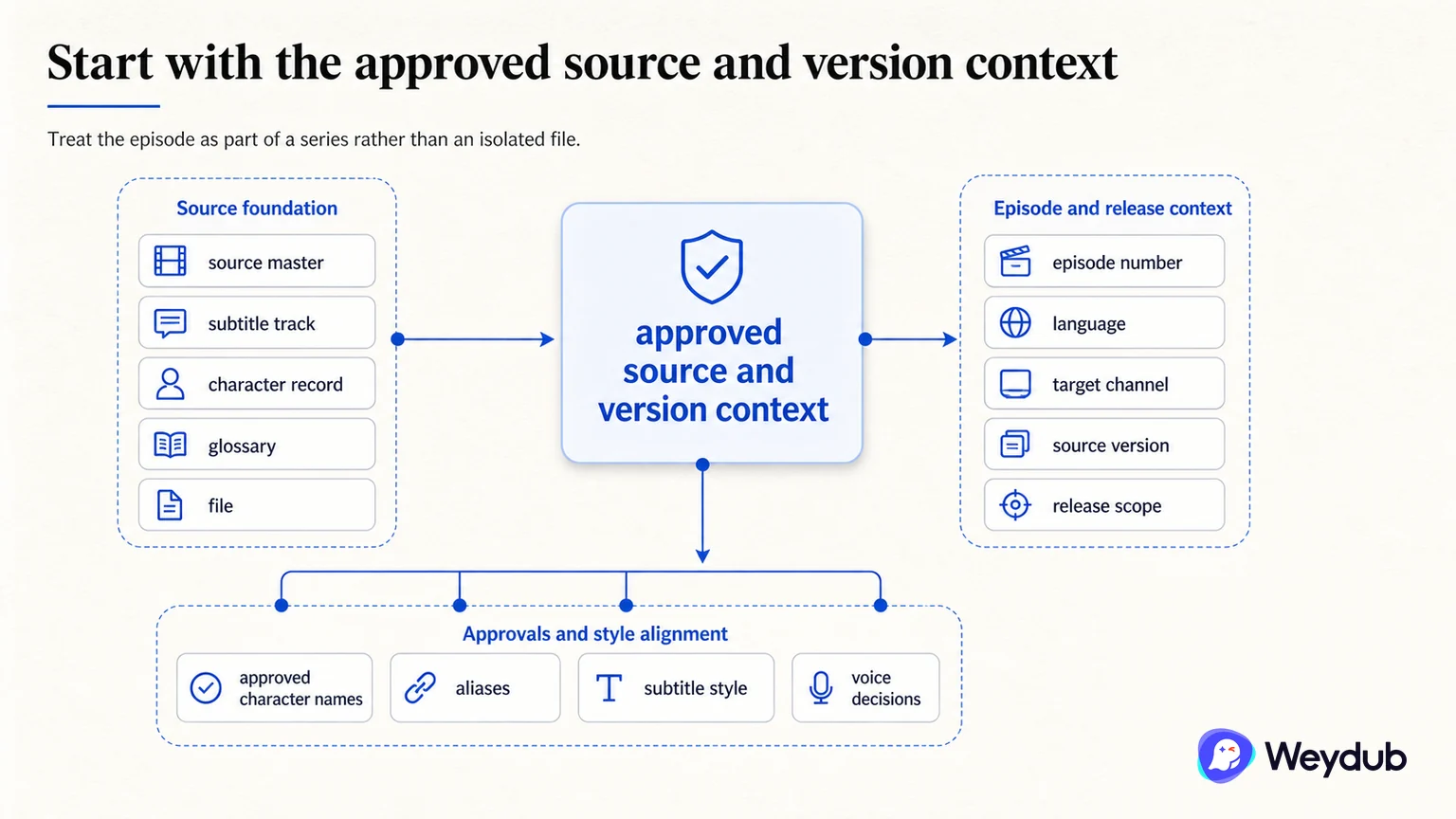
Before reviewing a localized episode, confirm which source master, subtitle track, character record, glossary, and output version are approved. A reviewer can correct a sentence perfectly and still send the project backward if the episode is built from an outdated source or an old role decision.
Treat the episode as part of a series rather than an isolated file. Check episode number, language, target channel, source version, and the file that the current output is meant to replace. This context makes later corrections traceable and prevents a clean-looking but obsolete export from entering delivery.
- Confirm source master, episode order, language, and release scope.
- Check the approved character names, aliases, glossary, subtitle style, and voice decisions.
- Record the version under review before changing any file.
Review four defect classes separately
Source defects can propagate into every target language. Language defects include meaning, terminology, role, register, and reading-density problems. Picture defects include subtitle removal, inpainting, flicker, and damage around faces, hands, or moving backgrounds. Audio defects include voice identity, pronunciation, timing, performance, music, effects, and mix.
A delivery defect may affect the whole package even when the episode itself looks correct: wrong filename, missing track, incorrect metadata, incomplete captions, or an unapproved version can all block release. Separating these classes tells the team which upstream asset needs repair and which outputs must be checked again.
- Source and role context: does the evidence itself match the approved master?
- Language and subtitle: are meaning, terms, timing, breaks, and density acceptable?
- Picture and audio: do restoration, voice, performance, sync, and mix survive continuous playback?
- Delivery: do files, metadata, naming, rights scope, and package state match the release?
Use risk-based sampling, then repair the smallest unit
Not every minute carries the same risk. Sample fast dialogue, scene changes, text over faces or hands, recurring names, emotional peaks, songs, overlapping speakers, and the first and last episodes of a batch. For a stable workflow, use representative scenes and targeted checks; for a high-visibility release, increase coverage around the moments that can change audience understanding or platform acceptance.
When a defect is found, locate it at the smallest reusable unit: cue, time range, region, role, voice line, episode, or delivery field. Reprocess the affected unit when possible, then verify the downstream outputs that depend on it. A local correction is only safe when its dependency boundary is known.
- Sample risk hotspots before trusting a large batch.
- Log episode, time range, language, asset, defect type, and proposed repair.
- Recheck dependent subtitle, audio, picture, metadata, and delivery outputs after a correction.
Finish with a release handoff
Approval should attach to a concrete episode, language, version, and package rather than remain as a message saying that the video is ready. The handoff should identify the approved master, localized outputs, unresolved exceptions, reviewer, date, target channel, and replacement relationship between old and new files.
This keeps human review focused and makes later language expansion safer. Teams do not need to regenerate work that is already correct, but they do need to know which source or decision a correction depends on.
- Name the reviewer, approval date, version, and release scope.
- List accepted exceptions instead of hiding uncertainty.
- Keep the original and replacement outputs linked for audit and future language work.
Frequently asked questions
Does risk-based review mean skipping human review?
No. It means concentrating human attention where an error is more likely or more expensive, while keeping mandatory checks for source, key plot moments, delivery, and high-risk media.
Should one overall quality score decide whether an episode ships?
Usually not. A score can summarize a sample, but release decisions need evidence about the source, language, picture, audio, package, and unresolved exceptions.
When should the whole episode be regenerated?
Only when the upstream source or decision invalidates dependent outputs. A cue, region, role, voice line, or metadata defect should remain local when its dependency boundary is local.
Related theme: Quality and review
Weydub workflow
Take the next production step
Organize source, language, picture, audio, and delivery checks around the version that is actually going to ship.