
Delivery
What belongs in a short-drama localization delivery package?
A playable file is only one part of a channel-ready localized release.
Key conclusions
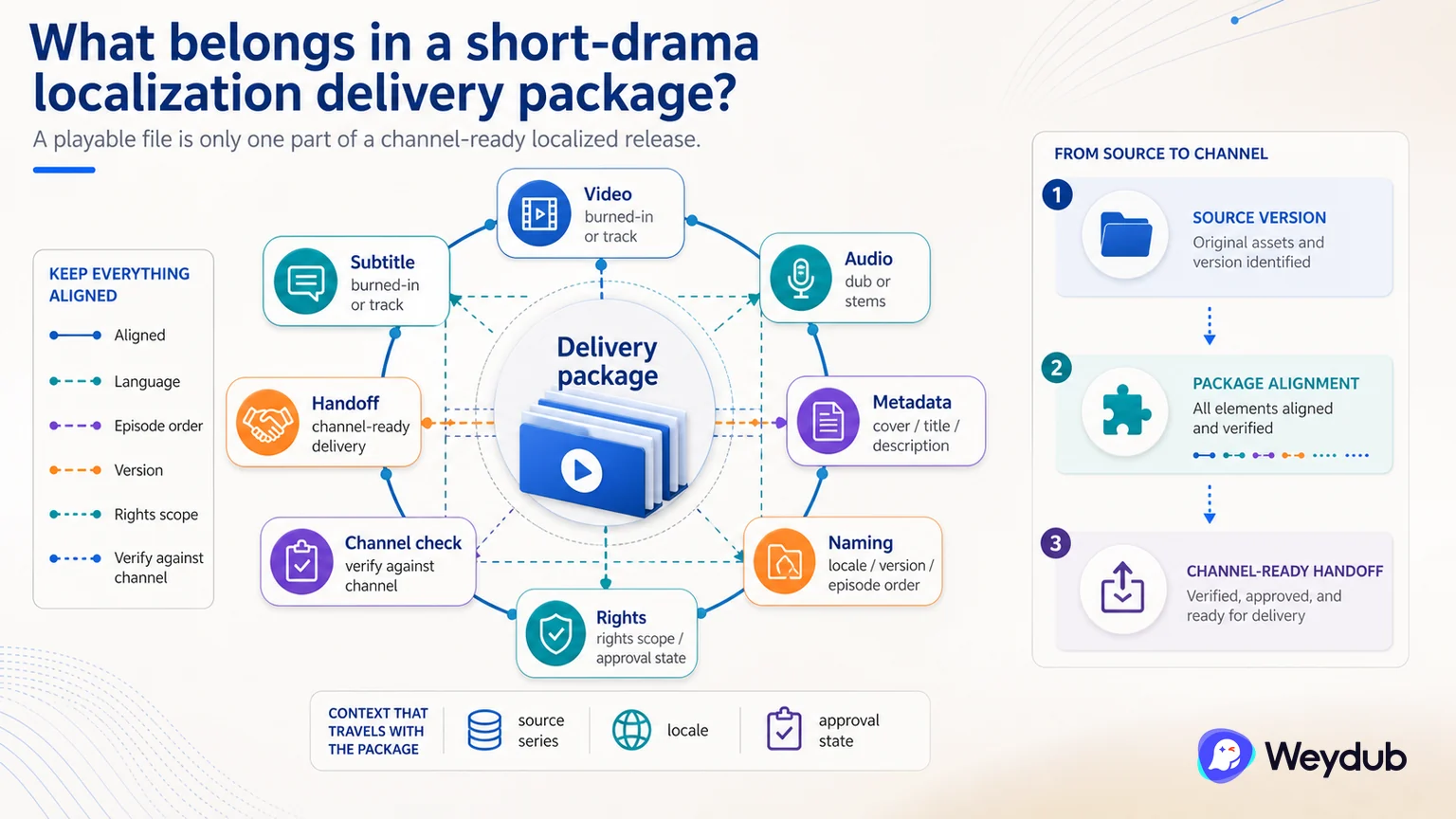
- Keep video, subtitle, audio, metadata, and naming aligned.
- Record language, episode order, version, and rights scope.
- Verify the package against the target channel before handoff.
A delivery package should make the target version unambiguous. The video, subtitle file, audio tracks, cover, title, description, episode order, and naming convention should all point to the same language and release state.
The required files vary by channel and contract. Some destinations need burned-in subtitles; others need a separate subtitle track. Some accept a dubbed mix, while others require separate stems or metadata fields. Rights and territory limitations can be as important as encoding settings.
A production workflow is easier to operate when these requirements are attached to the output version, checked before handoff, and kept traceable to the source series and language batch.
Make the target version unambiguous
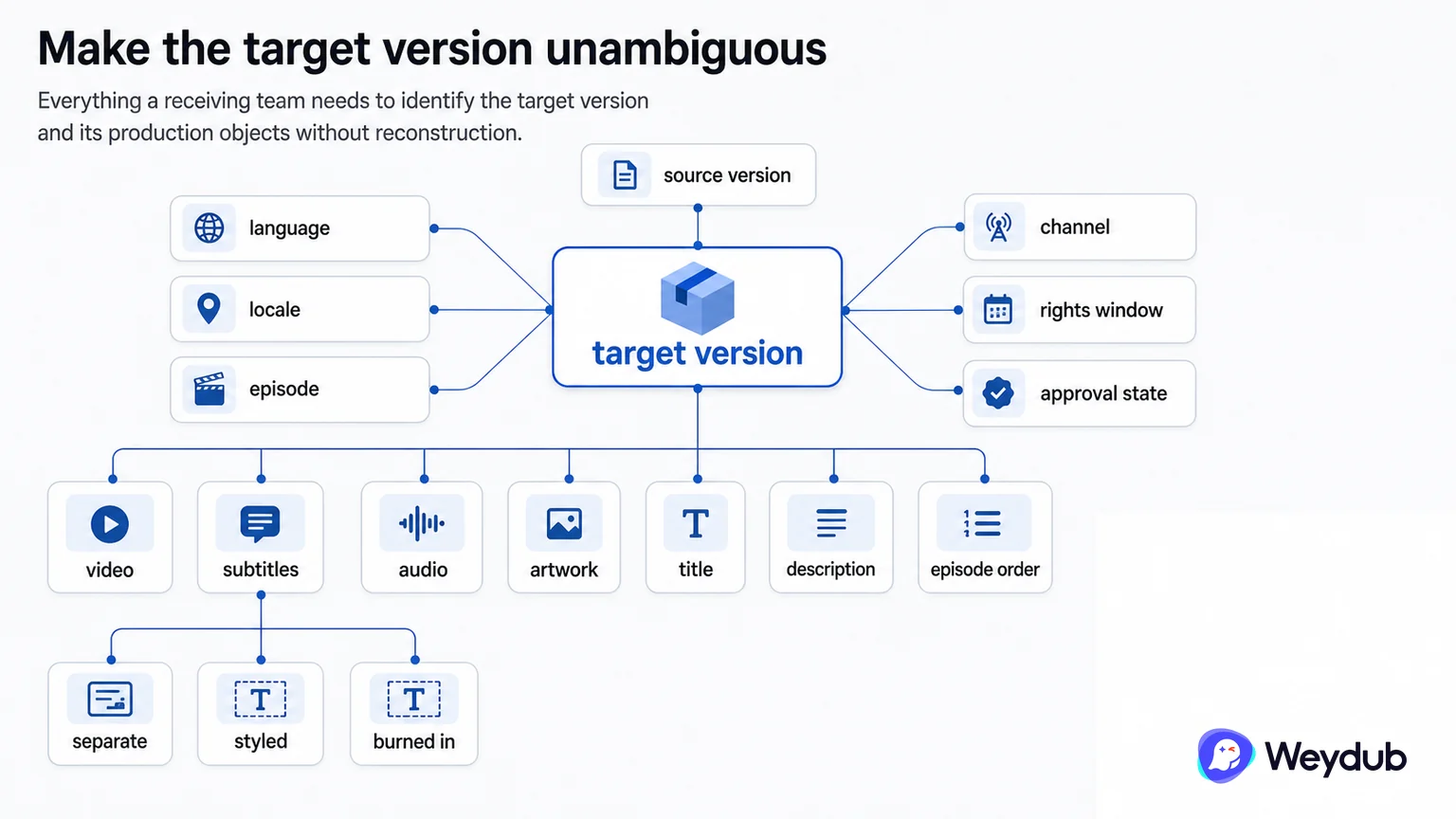
A receiving team should identify the language, locale, episode, source version, channel, rights window, and approval state without reconstructing the project from filenames or chat history.
- Align video, subtitles, audio, artwork, title, description, and episode order.
- Record whether subtitles are separate, styled, or burned in.
- Keep the source and replacement relationship visible.
Build the package around the destination
Requirements vary by channel and contract. One destination may need a burned-in version, another a separate SRT or VTT, and another a dubbed mix or separate stems. Metadata, chapters, thumbnail, aspect ratio, language settings, and rights scope can block release even when the video plays.
| Package layer | Typical contents | Acceptance check |
|---|---|---|
| Picture | Clean master or channel encode | Playback, resolution, frame, naming |
| Text | SRT, VTT, ASS, captions | Timing, language, reading speed |
| Audio | Dubbed mix, stems, music and effects | Sync, level, language, rights |
| Metadata | Title, description, chapters, language | Matches version and channel |
| Control | Manifest, review state, rights window | Approved owner and handoff |
Treat delivery as an acceptance gate
The package is ready when the receiving party can use it, not merely when a file has been exported. Check the first and last episode, representative subtitle and audio moments, episode order, metadata, and the destination constraints before handoff.
- Freeze source, language, channel, and rights scope.
- Assemble files and manifest.
- Run playback, subtitle, audio, metadata, and naming checks.
- Record exceptions and approval.
- Deliver the accepted version and keep its lineage.
Frequently asked questions
Is the final video enough for delivery?
Usually not. Editable subtitles, audio tracks, artwork, metadata, manifests, and rights or review records may be needed for the next channel or language.
Should every channel receive the same package?
No. Keep a shared approved source, then create channel-specific packages with their own technical and rights checks.
Related theme: Distribution and delivery
Weydub workflow
Take the next production step
Prepare a localized version with subtitles, voice, timing, and a delivery path that matches the destination.