
Character context
How to label short-drama characters with names, aliases, and dialogue
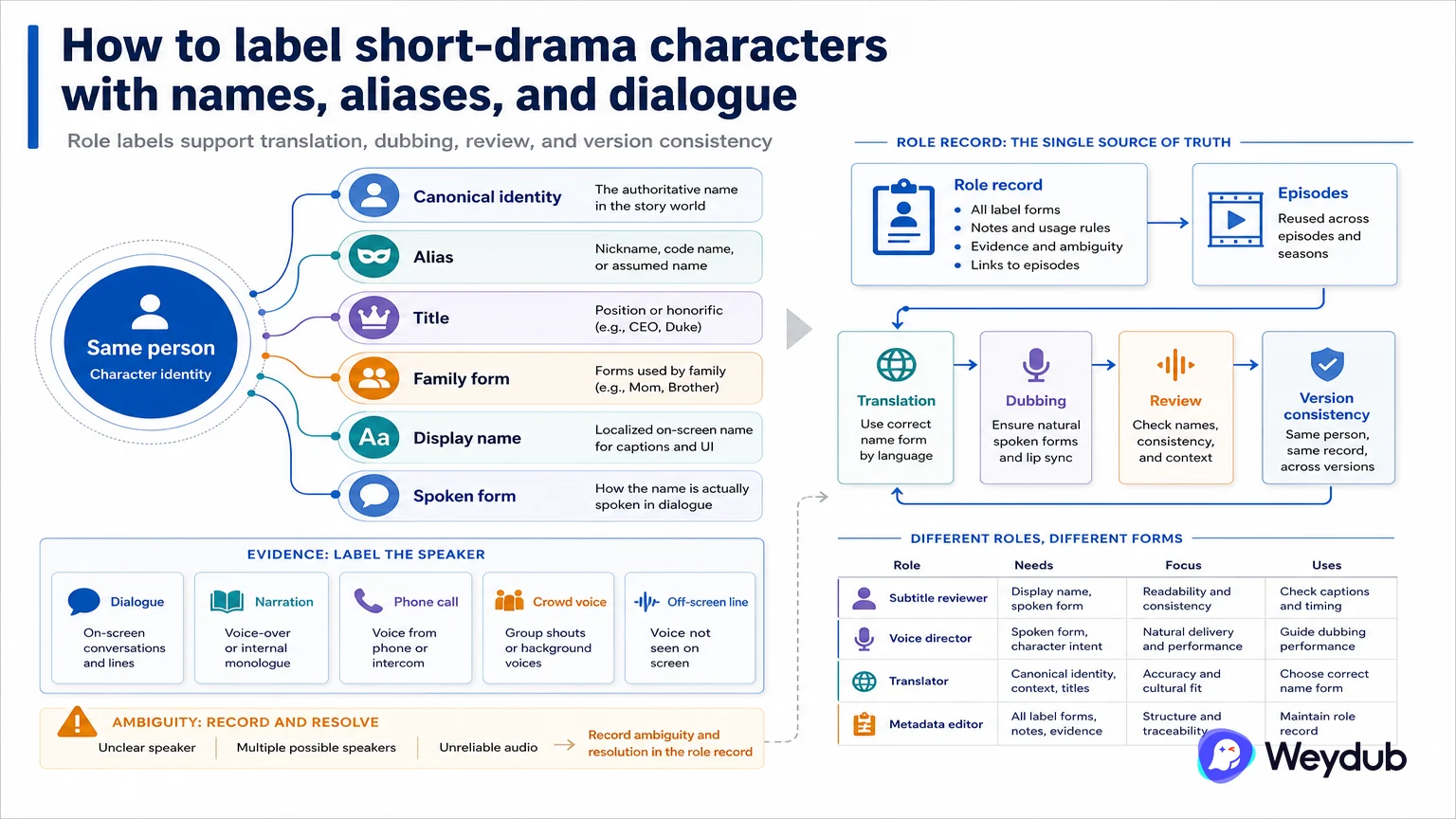
Role labels support translation, dubbing, review, and version consistency when the same person appears under different names or forms of address.
Key conclusions
- Separate canonical identity, alias, title, and spoken form.
- Mark dialogue, narration, and off-screen speakers explicitly.
- Reuse approved role context across episodes and language versions.
A character may have a legal name, a nickname, a title, a family form of address, and a translated display name. Those are not interchangeable fields. A subtitle reviewer may need one form while a voice director needs another to understand the relationship and performance.
Label the speaker and the evidence for the label. Dialogue, narration, phone calls, crowd voices, and off-screen lines can create different confidence levels. Record ambiguity instead of silently assigning the line to the nearest visible person.
A shared role record helps the team review a series consistently. When a name or relationship changes, the system can show which subtitles, translations, voices, metadata, and episodes depend on it.
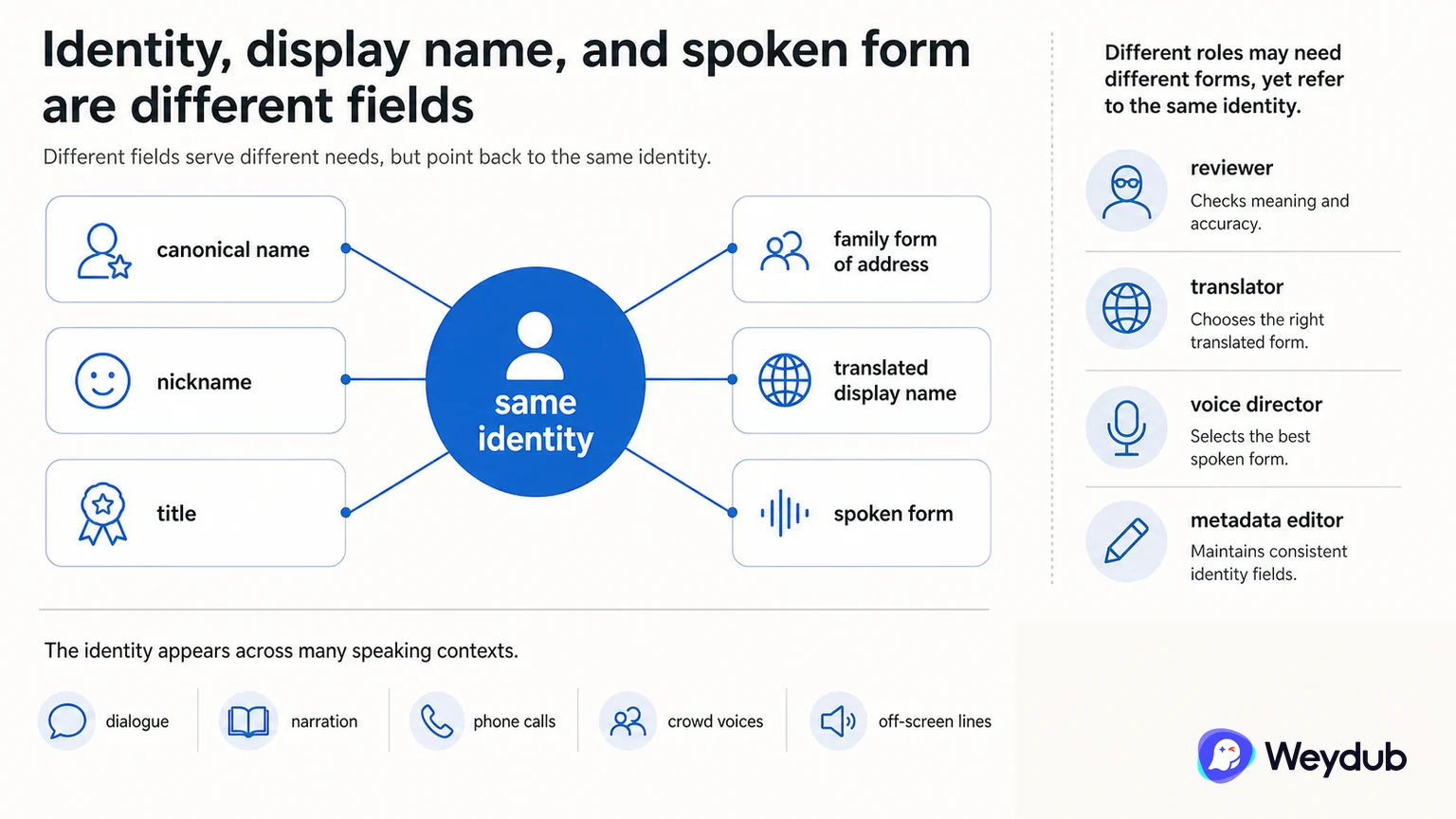
Identity, display name, and spoken form are different fields
One character may have a canonical name, nickname, title, family form of address, and translated display name. A reviewer, translator, voice director, and metadata editor may need different forms while still referring to the same identity.
- Separate canonical identity, alias, title, and spoken form.
- Mark dialogue, narration, phone calls, crowd voices, and off-screen lines.
- Record uncertainty instead of assigning a speaker from proximity alone.
Use a role record across the series
A role record should connect identity to relationships, terminology, voice intent, and language-specific display choices. When a relationship or name changes, the record should show which outputs depend on it.
| Field | Example | Downstream use |
|---|---|---|
| Identity | Canonical character ID | Cross-episode continuity |
| Alias | Nickname or title | Dialogue and subtitle form |
| Evidence | Visible, spoken, inferred | Review confidence |
| Language | Locale-specific expression | Translation and dubbing |
Resolve ambiguity before it propagates
A wrong role label can affect translation, pronouns, voice assignment, and delivery metadata. Resolve the source decision, update the shared record, and recheck only the dependent cues and versions.
- List visible and spoken identities.
- Confirm relationship and role context.
- Assign canonical and local forms.
- Review affected subtitles and voice lines.
- Preserve the decision for later episodes.
Frequently asked questions
Can a face-recognition result decide the speaker?
It can provide a candidate, but story context, dialogue evidence, and review may be stronger signals, especially for off-screen or visually ambiguous lines.
Should aliases create separate characters?
Usually no. Keep aliases under the canonical identity unless the story establishes a genuinely different role.
Related theme: Localization capabilities
Weydub workflow
Take the next production step
Start with the source condition and choose a focused workflow for subtitle extraction, picture cleanup, or language production.