
Change propagation
If one character name changes, what else must be rechecked?
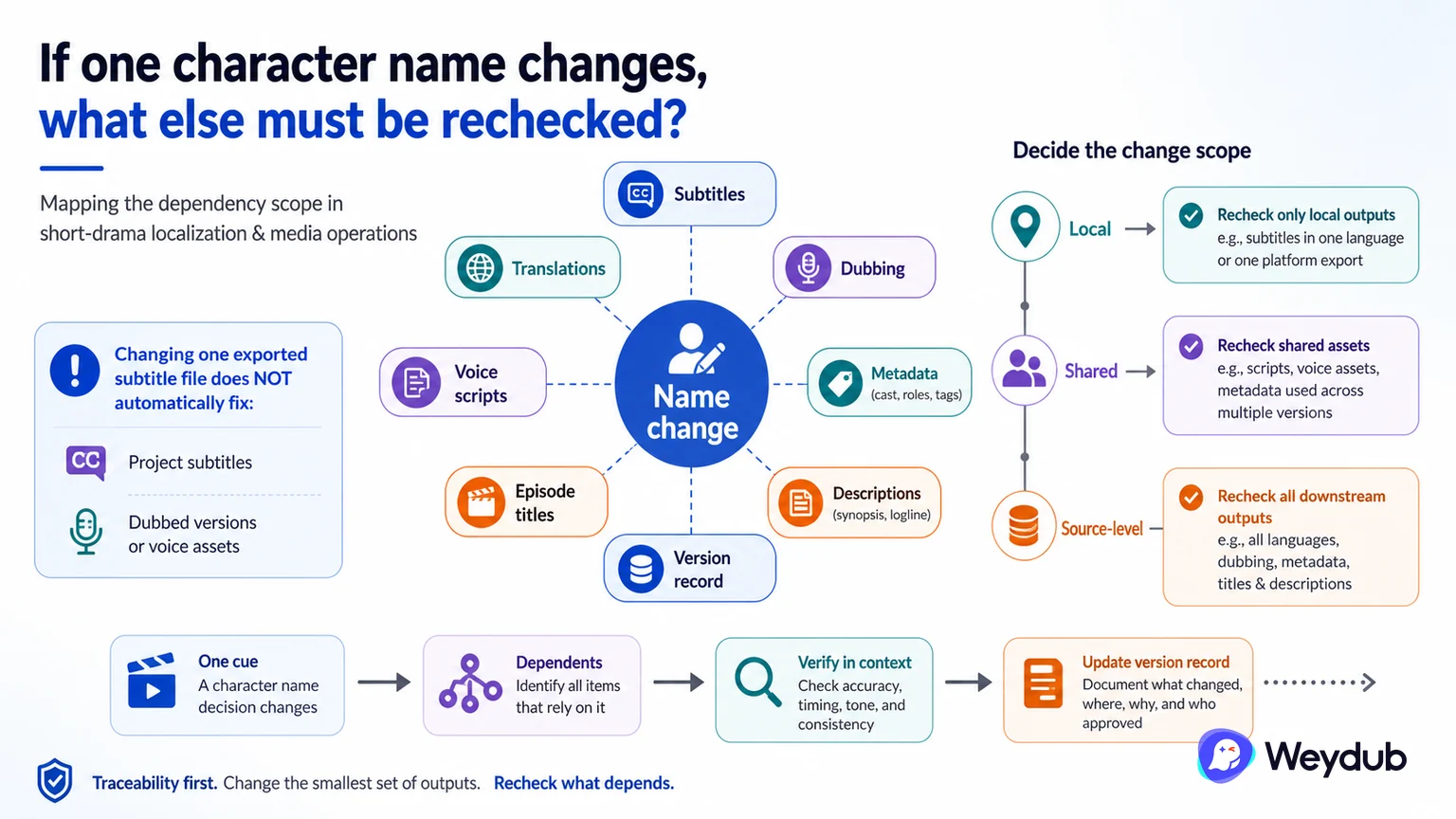
A shared identity or terminology decision can affect subtitles, scripts, voice direction, metadata, and downstream language versions.
Key conclusions
- Classify the changed item as local, shared, or source-level.
- Trace dependent subtitles, translations, dubbing, and package metadata.
- Recheck the smallest affected outputs while preserving unrelated approvals.
A name may appear in dialogue, captions, episode titles, descriptions, character records, and voice direction. Changing it in one exported subtitle file does not necessarily correct the project or the dubbed versions that used the old value.
The first question is scope. If the name was wrong in one cue, a local repair may be enough. If the character record or source script was wrong, every dependent language and output should be checked. The system should show that relationship instead of relying on memory.
After the correction, verify the changed items in context and update the version record. A small, traceable rework is safer than regenerating an entire series without knowing which dependency required it.
A name is shared source context
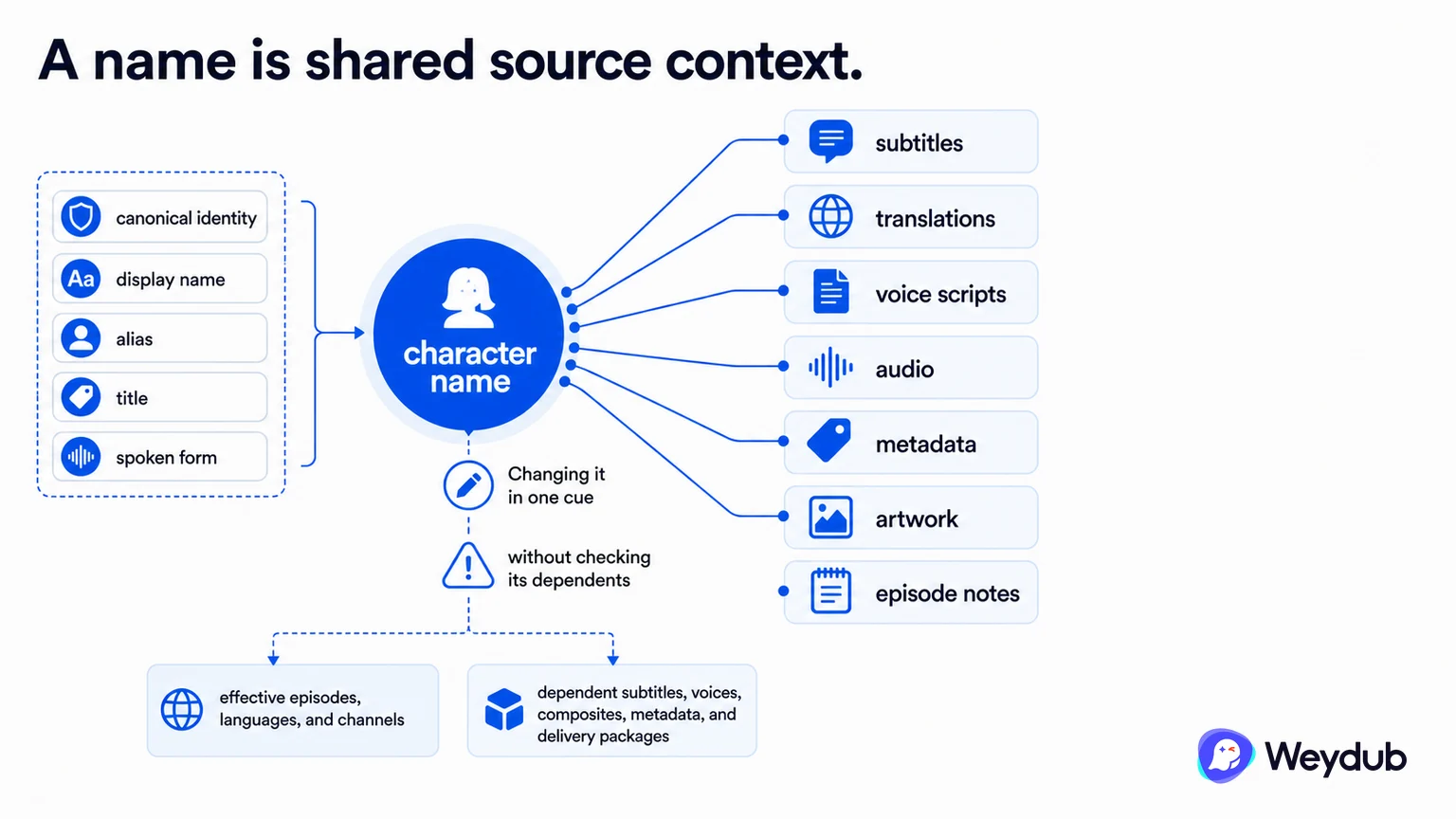
A character name can appear in subtitles, translations, voice scripts, audio, metadata, artwork, and episode notes. Changing it in one cue without checking its dependents can leave the series internally inconsistent.
- Distinguish canonical identity, display name, alias, title, and spoken form.
- Record the effective episodes, languages, and channels.
- Find dependent subtitles, voices, composites, metadata, and delivery packages.
Trace the change before reworking
First confirm the approved source fact and scope. Then identify which target-language decisions use the old form. Some languages may need a new naturalized form, while others only need a source record update.
| Dependency | Possible effect | Review |
|---|---|---|
| Source subtitle | Cue wording or speaker label | Episode and neighboring cues |
| Translation | Name, title, relationship | Language-specific terminology |
| Dubbing | Script, pronunciation, voice | Line and performance |
| Delivery | Metadata, artwork, package | Channel version and replacement |
Rework locally, then update lineage
Do not regenerate every language by reflex, but do not edit only the visible cue either. Rework the smallest dependent units, check continuity, and mark the new output as replacing the old version.
- Approve the source name and scope.
- Locate dependent language and media outputs.
- Update glossary and role records.
- Rework affected cues, voices, and packages.
- Run cross-episode and delivery checks.
Frequently asked questions
Does a name change always require redubbing the series?
No. Identify the affected episodes, cues, language forms, and voice outputs first. Only dependent lines and packages need rework.
Can the English name be copied to every language?
Identity can be shared, but names, titles, and forms of address may need language-specific decisions.
Related theme: Quality and review
Weydub workflow
Take the next production step
Organize source, language, picture, audio, and delivery checks around the version that is actually going to ship.