
Dubbing review
After dubbing, is the problem audio sync or lip sync?
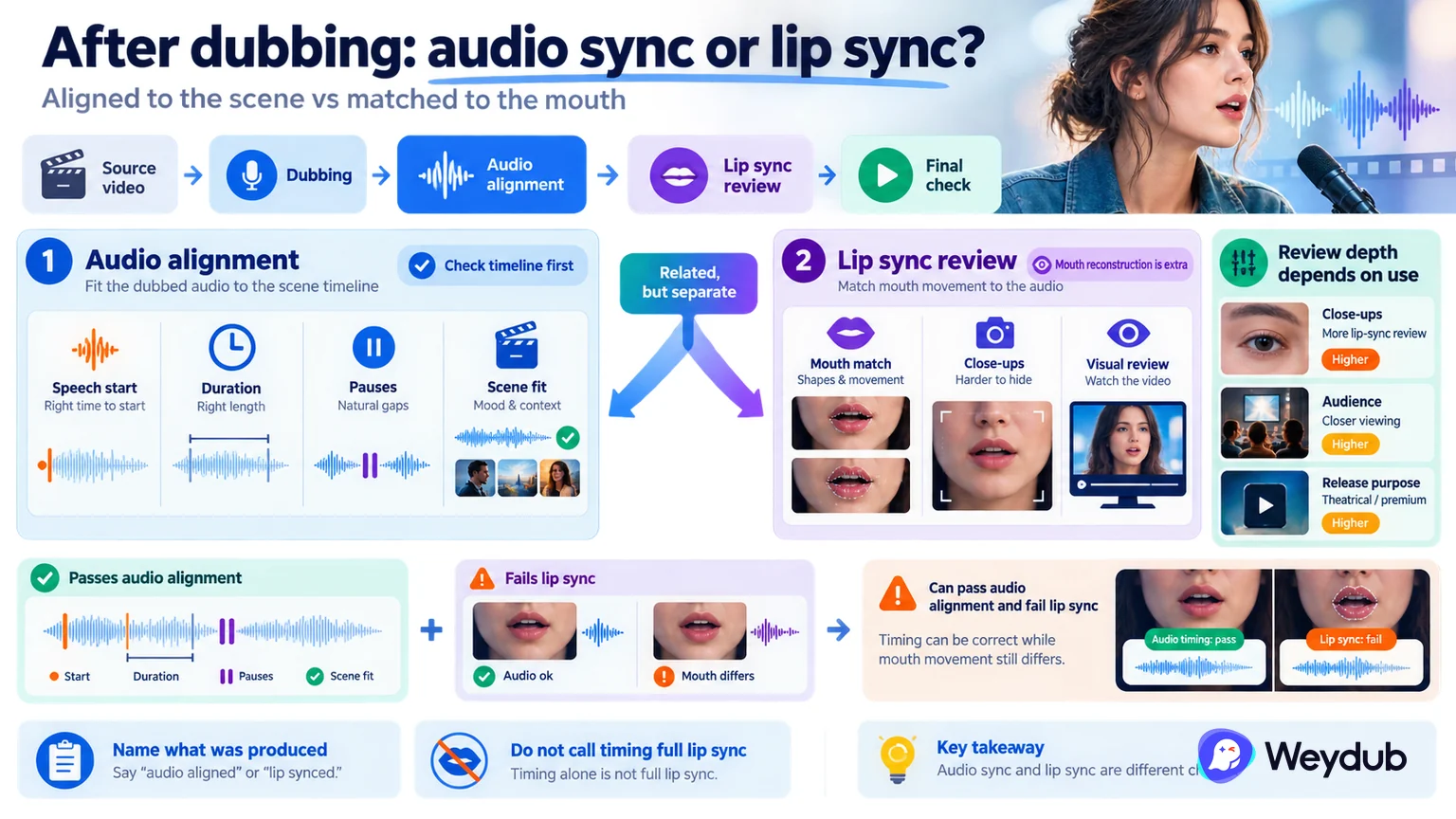
A voice can be aligned to the scene while the mouth movement remains different; these are related but separate acceptance requirements.
Key conclusions
- Check speech start, duration, pauses, and scene alignment first.
- Treat mouth reconstruction as an additional visual requirement.
- Choose the review depth based on close-ups, audience, and release purpose.
Audio alignment asks whether the dialogue begins and ends at the right points, fits the scene, and works with music and effects. Lip sync asks whether visible mouth movement matches the target speech. A project can pass one and fail the other.
Start by reviewing the audio and picture timeline. Then inspect close-ups and high-visibility dialogue where mouth movement is part of the audience expectation. Do not describe ordinary timing alignment as full lip sync.
The package and public claim should name which behavior was produced and reviewed. This keeps a useful distinction between a dubbed track and a more extensive audiovisual reconstruction.
Separate scene timing from mouth matching
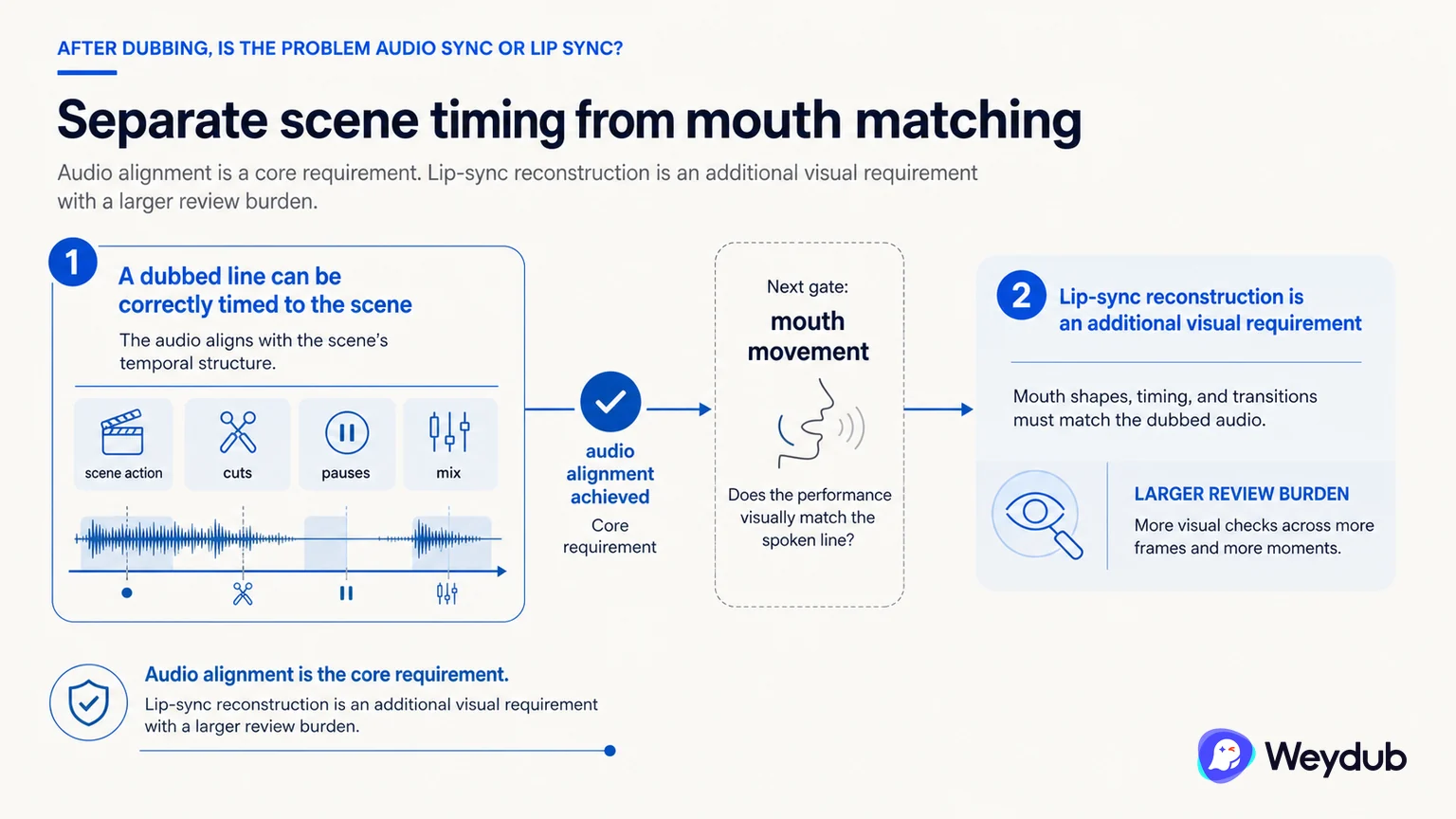
A dubbed line can be correctly timed to the scene without matching every mouth movement. Audio alignment is a core requirement; lip-sync reconstruction is an additional visual requirement with a larger review burden.
- Check speech against scene action, cuts, pauses, and mix.
- Treat mouth movement as a separate visual acceptance gate.
- Choose the extra reconstruction depth by audience and release risk.
Review the two acceptance bars
First verify that the voice begins, ends, and pauses naturally in the scene and that music and effects remain balanced. Then, only when required, inspect mouth shape, face continuity, close-ups, and visual artifacts introduced by lip-sync processing.
| Requirement | Evidence | Typical scope |
|---|---|---|
| Audio alignment | Voice, scene, subtitles, mix | Core dubbed release |
| Lip sync | Mouth and target speech | Close-up or premium release |
| Continuity | Face, shot, and motion | All visual reconstruction |
| Rights | Voice and picture use | Territory and channel |
Do not promise one from the other
A strong voice clip does not prove scene timing, and good timing does not prove mouth matching. Name the requirement in the delivery brief and test the actual output that viewers will receive.
- Define audio and visual acceptance separately.
- Review voice, timing, and mix.
- Add lip-sync checks where justified.
- Inspect close-ups and scene transitions.
- Approve the exact package and scope.
Frequently asked questions
Does every dubbed video need lip sync?
No. Many releases need natural audio-to-scene alignment without mouth reconstruction. The channel and audience determine whether the extra step is justified.
Can lip sync fix a poorly timed translation?
No. Translation length, segmentation, and audio timing should be corrected first.
Related theme: Distribution and delivery
Weydub workflow
Take the next production step
Prepare a localized version with subtitles, voice, timing, and a delivery path that matches the destination.