
Version management
Where do multilingual short-drama versions become difficult to manage?
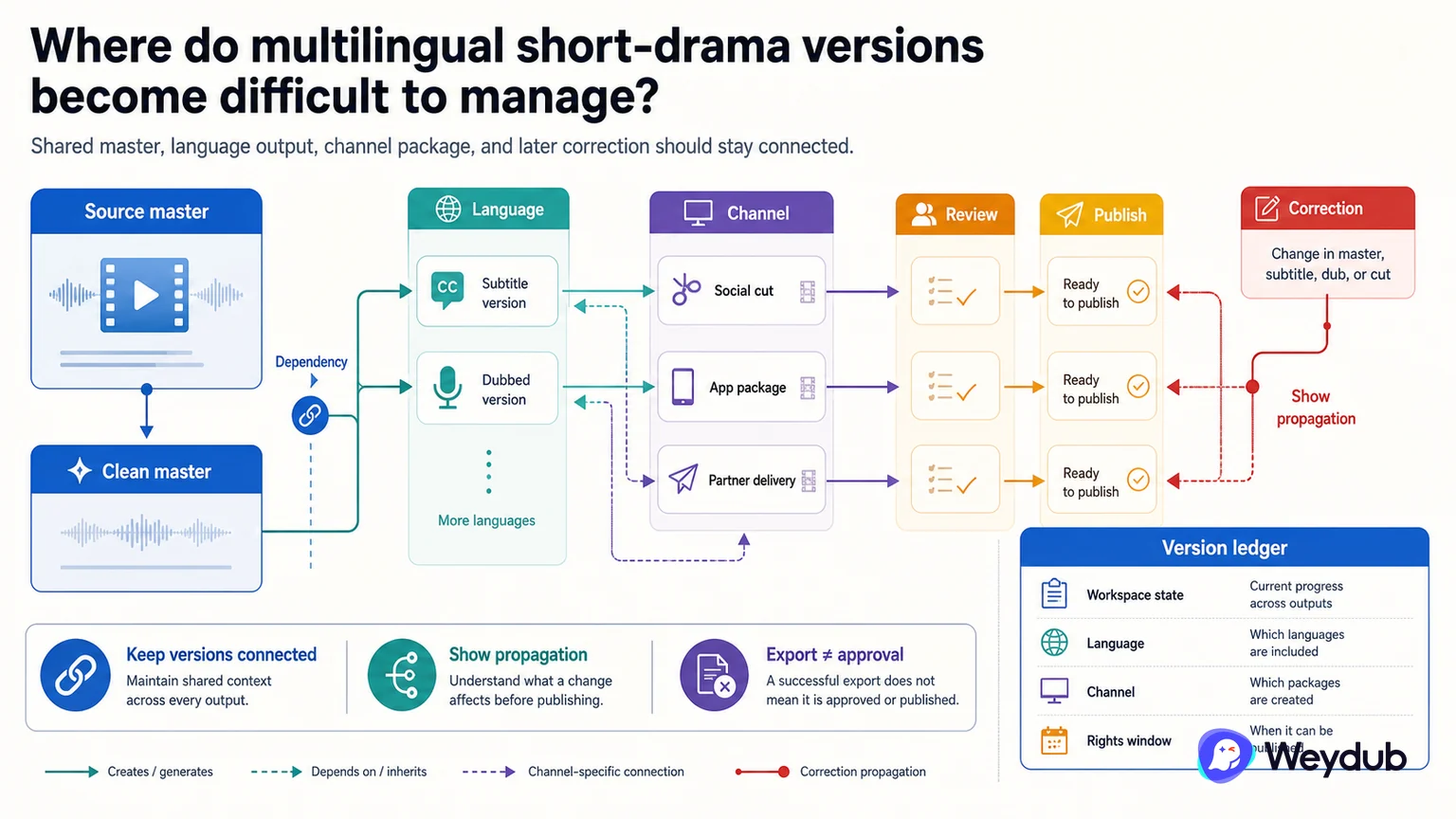
The first problems usually appear when a shared master, language output, channel package, and later correction are recorded as unrelated files.
Key conclusions
- Keep master, language, channel, and release versions connected.
- Record how a correction propagates across dependent outputs.
- Do not let a successful export stand in for approval or publishing state.
A series can have several legitimate versions: source master, clean master, subtitle version, dubbed version, social cut, app package, and partner delivery. Trouble starts when the file name is the only relationship between them and a new correction is applied to one output without checking the rest.
Shared context should be reused where appropriate, but outputs can still have independent review. A terminology decision may affect every language; a platform thumbnail change may affect only one channel. The system should make that difference visible.
A version ledger or workspace state should answer which source was used, which language and channel were intended, who reviewed it, and whether it is ready to publish. This is more durable than a folder labelled final.
Version complexity comes from relationships
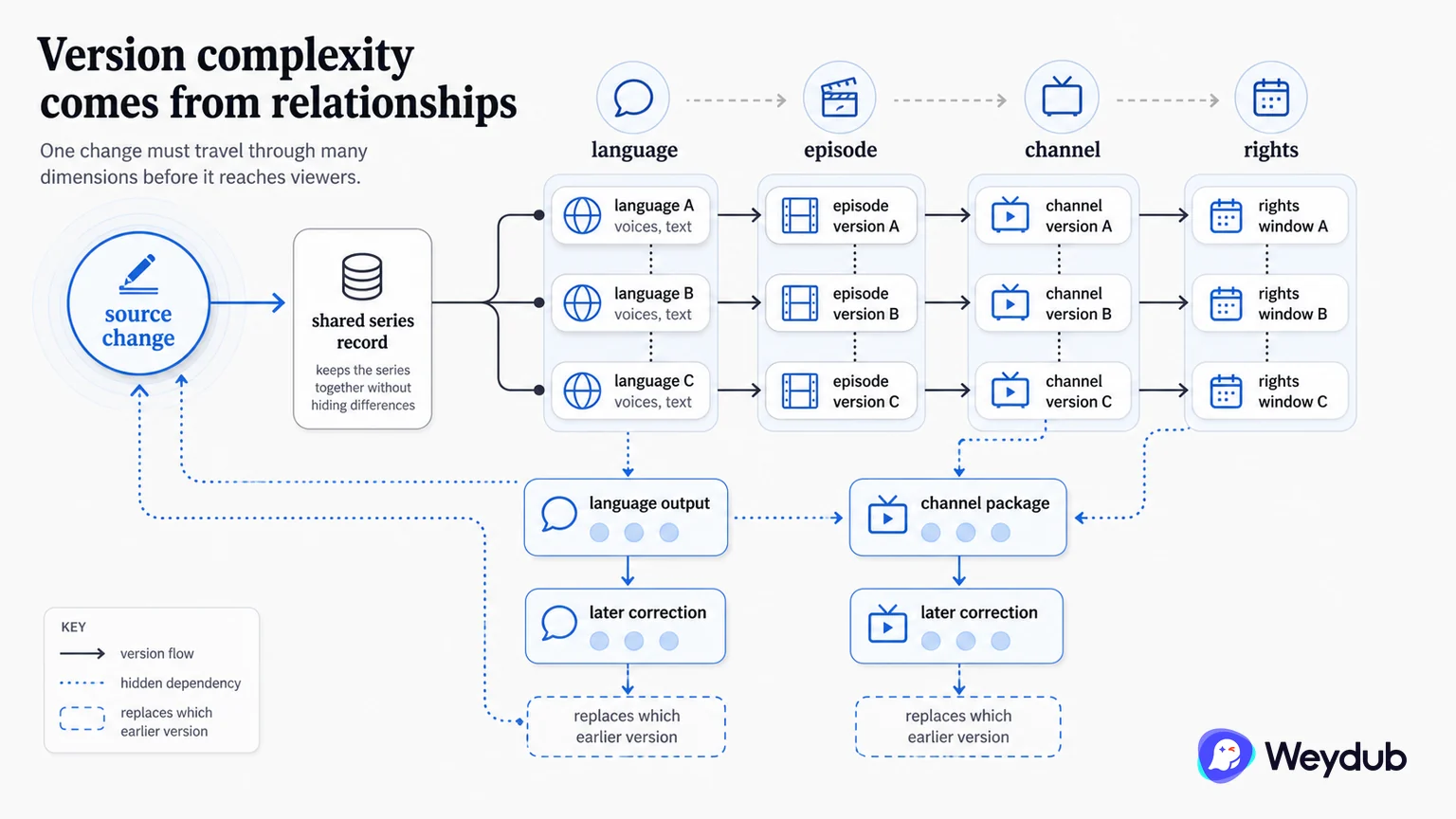
A series becomes difficult to operate when one source change must travel through several languages, voices, picture versions, channels, and rights windows. The problem is not simply too many files; it is that the dependency relationships are hidden.
- Keep source, language, episode, channel, and rights dimensions separate.
- Mark which output replaces which earlier version.
- Use a shared series record without collapsing language-specific decisions.
Find the common failure points
Names drift, one episode is missing, a YouTube version uses an old subtitle, a dubbed mix has the wrong timing, or an artwork file promises a different language. Each can look local while affecting a larger release package.
| Failure | Hidden dependency | Control |
|---|---|---|
| Name drift | Character and glossary record | Propagate approved source decision |
| Missing episode | Series and batch count | Manifest reconciliation |
| Wrong version | Replacement relationship | Version state and lineage |
| Wrong package | Channel and rights scope | Destination acceptance gate |
Use a dependency-first correction loop
When a source or shared decision changes, identify affected languages and outputs before editing. Rework only the dependent units, then update the series state and delivery manifest so the next team sees the new boundary.
- Identify the changed source or decision.
- Find dependent languages, episodes, and packages.
- Rework the smallest valid units.
- Run regression checks around the change.
- Update version and delivery state.
Frequently asked questions
Does every source correction require every language to be regenerated?
No. First identify the affected cues, roles, outputs, and packages. Only dependencies that actually changed need rework.
Is a folder hierarchy enough to manage many languages?
It helps store files, but a production system or manifest must also express state, lineage, review, and rights scope.
Related theme: Quality and review
Weydub workflow
Take the next production step
Organize source, language, picture, audio, and delivery checks around the version that is actually going to ship.