
AI character review
How to label AI-comic characters across faces, costumes, and scene drift
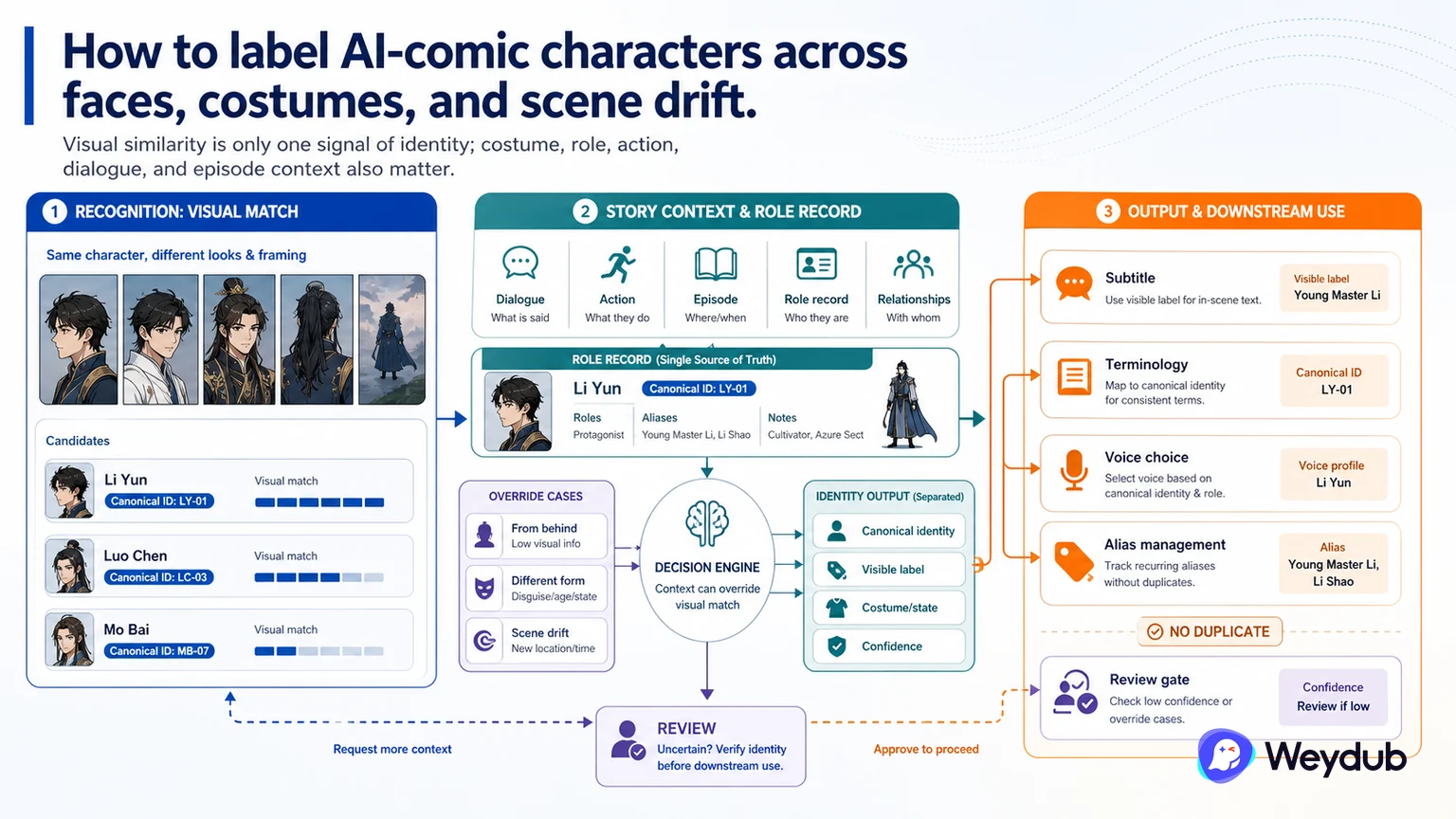
Visual similarity is only one signal of identity; costume, role, action, dialogue, and episode context also matter.
Key conclusions
- Use a role record alongside visual recognition.
- Mark costume changes and recurring aliases without creating duplicate characters.
- Review uncertain identity before translation or voice assignment propagates it.
AI comics can change face, hair, clothing, framing, or illustration style between panels. A recognition system can provide candidates, but story context may be the stronger signal when the character is shown from behind or in a different form.
Keep canonical identity, visible label, costume or state, and confidence separate. This prevents a new outfit from becoming a new character and prevents a similar face from being assigned the wrong line.
Character labeling is production context. It should feed subtitle attribution, terminology, voice choice, and review, while preserving an explicit manual correction when the visual evidence is uncertain.
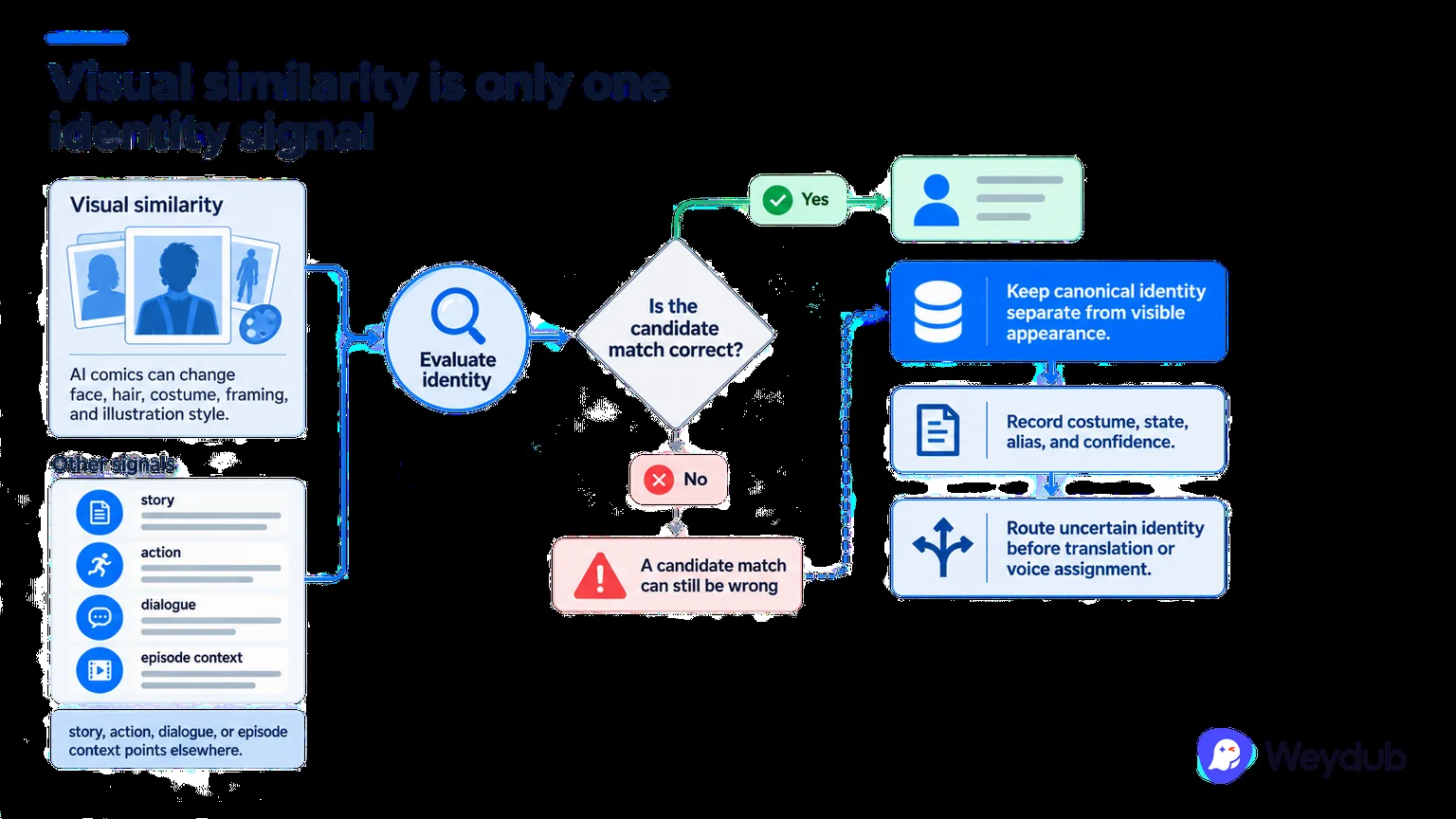
Visual similarity is only one identity signal
AI comics can change face, hair, costume, framing, and illustration style. A candidate match can still be wrong when the story, action, dialogue, or episode context points elsewhere.
- Keep canonical identity separate from visible appearance.
- Record costume, state, alias, and confidence.
- Route uncertain identity before translation or voice assignment.
Prevent costume drift from becoming identity drift
A new outfit should not create a new character, and a similar face should not automatically inherit the wrong line. Combine visual candidates with role records, dialogue, relationships, and episode continuity.
| Signal | What it contributes | Limit |
|---|---|---|
| Face or image | Visual candidate | Costume and style drift |
| Costume/state | Scene continuity | Shared outfits or disguises |
| Dialogue | Role and relationship | Off-screen or ambiguous speaker |
| Series record | Canonical identity | Needs maintenance and review |
Keep the human correction explicit
When evidence conflicts, record the correction and its scope. The role decision should feed subtitle attribution, terminology, voice choice, and later episode review without pretending a single recognition score settled the story.
- Create canonical character records.
- Collect visual and story signals.
- Mark candidates and confidence.
- Resolve exceptions with review.
- Propagate approved roles to dependent work.
Frequently asked questions
Can costume change alone create a new character?
No. Treat it as a state or appearance field unless the story establishes a separate identity.
Should every uncertain panel be manually labeled?
High-risk or dependency-heavy cases should be reviewed; stable low-risk cases can use a documented sampling policy.
Related theme: AI media workflows
Weydub workflow
Take the next production step
Keep automation, review, and delivery connected when AI-generated media needs to become a usable release.