
Hybrid dubbing
How can human dubbing fit into an AI localization workflow?
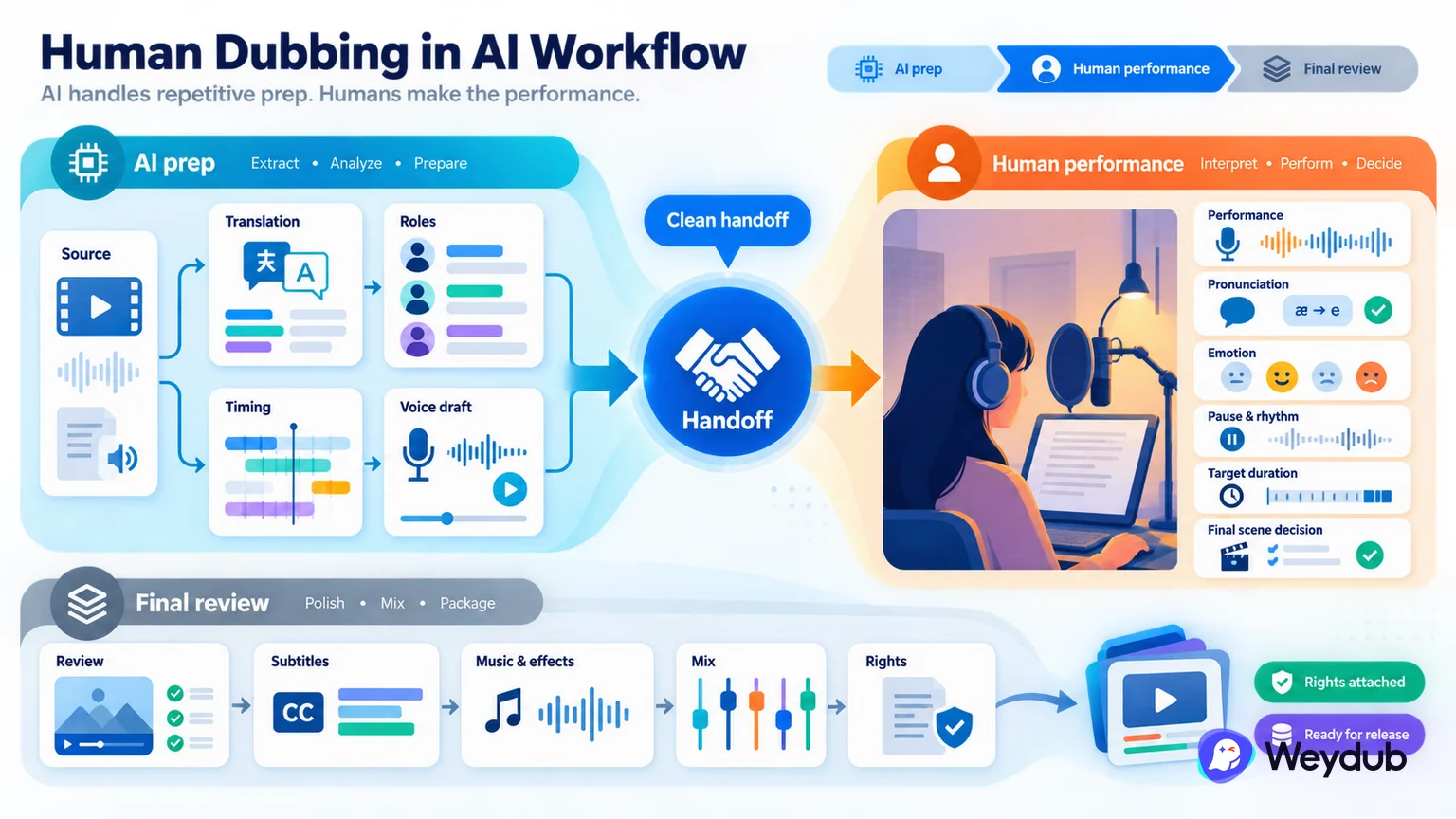
AI can prepare source, translation, timing, and candidate voice work while human performers and directors handle the parts that need interpretation and performance.
Key conclusions
- Use AI to reduce repetitive preparation without hiding performance decisions.
- Give human talent clean scripts, role context, timing, and pronunciation guidance.
- Record the final voice, mix, rights, and review state as part of the language version.
A hybrid workflow can start with source extraction, translation suggestions, role mapping, and a timing plan. Human actors or directors then interpret the scene, correct the line where needed, and create a performance that suits the audience and release purpose.
The handoff must be specific. A performer needs the character relationship, pronunciation, emotion, pause, and target duration, not just a string of translated words. The production team also needs to know which source and version the script represents.
After recording, review speech against the picture, subtitles, music, effects, and mix. Store rights and consent with the output so a useful performance does not become an ambiguous asset later.
Keep AI preparation and human performance connected
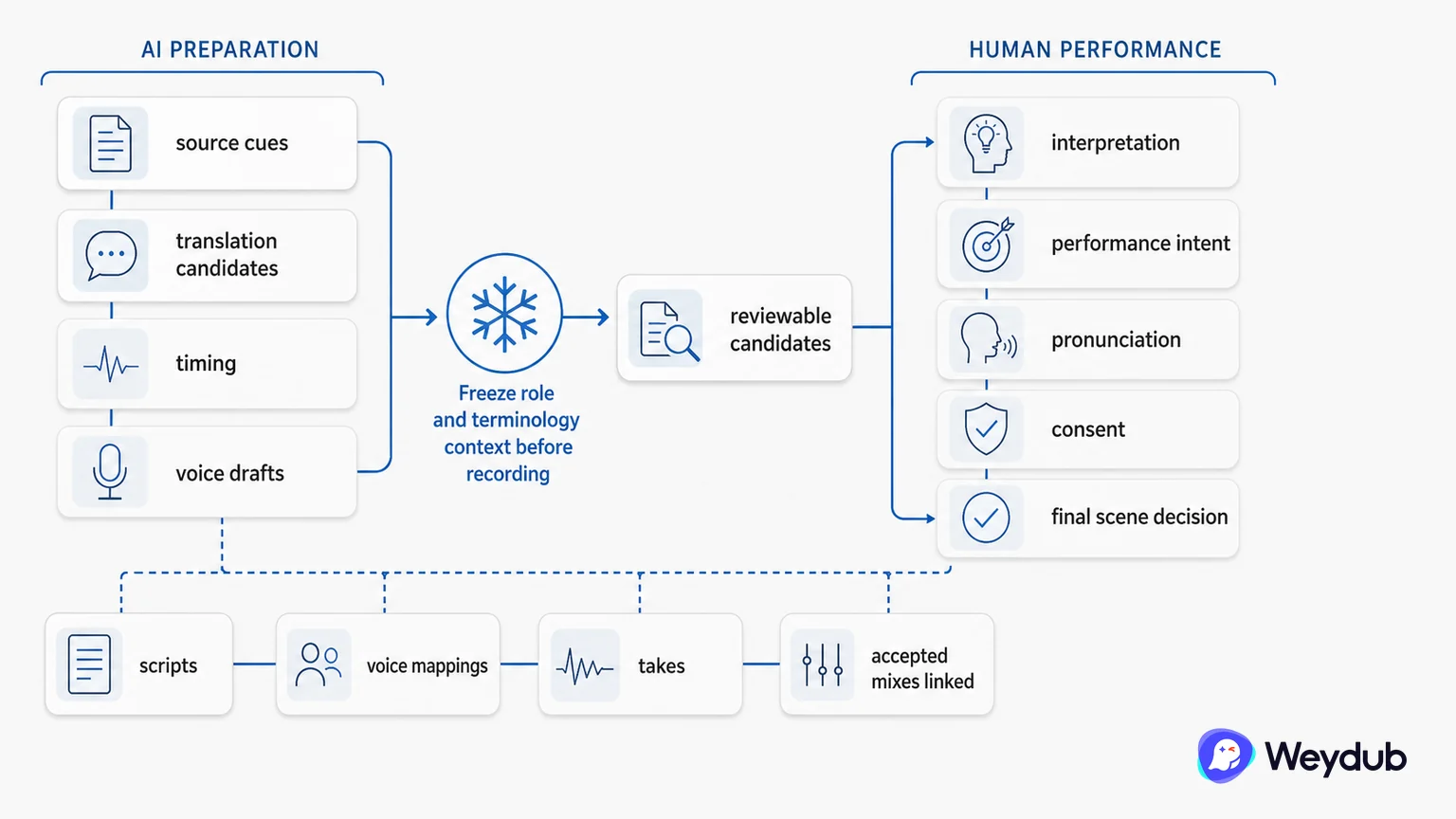
AI can prepare source cues, translation candidates, timing, and voice drafts. Human performers, directors, and reviewers handle interpretation, performance intent, pronunciation, consent, and the final scene decision.
- Freeze role and terminology context before recording.
- Use AI drafts as reviewable candidates, not final performance proof.
- Keep scripts, voice mappings, takes, and accepted mixes linked.
Define the handoff by responsibility
The handoff should identify who resolves source ambiguity, who approves translation, who directs performance, who checks timing and mix, and who accepts the final package. A file transfer alone loses the reason behind a performance choice.
| Work area | AI can assist with | Human gate |
|---|---|---|
| Script | Draft and timing candidate | Meaning, role, register |
| Voice | Candidate rendering | Consent, fit, performance |
| Direction | Variant generation | Emotion, intent, continuity |
| Mix | Track preparation | Sync, levels, music, effects |
Preserve reusable performance context
Approved character voice, pronunciation, emotional direction, and timing decisions can guide later episodes. They should remain editable and scoped, because a new scene, language, or channel may require a different choice.
- Confirm source, roles, and target-language script.
- Prepare AI and human performance candidates.
- Direct and review the difficult scenes.
- Mix and check against picture.
- Approve the track and record its scope.
Frequently asked questions
Can AI dubbing replace a human director?
It can automate candidate generation, but performance intent, role continuity, consent, and acceptance still need accountable judgment.
Should human-dubbed output use the same timing as AI output?
The scene and language constraints remain, but performance may require revised segmentation, pauses, and mix decisions.
Related theme: Distribution and delivery
Weydub workflow
Take the next production step
Prepare a localized version with subtitles, voice, timing, and a delivery path that matches the destination.