
Production planning
How much time and budget does a live-action short drama need?
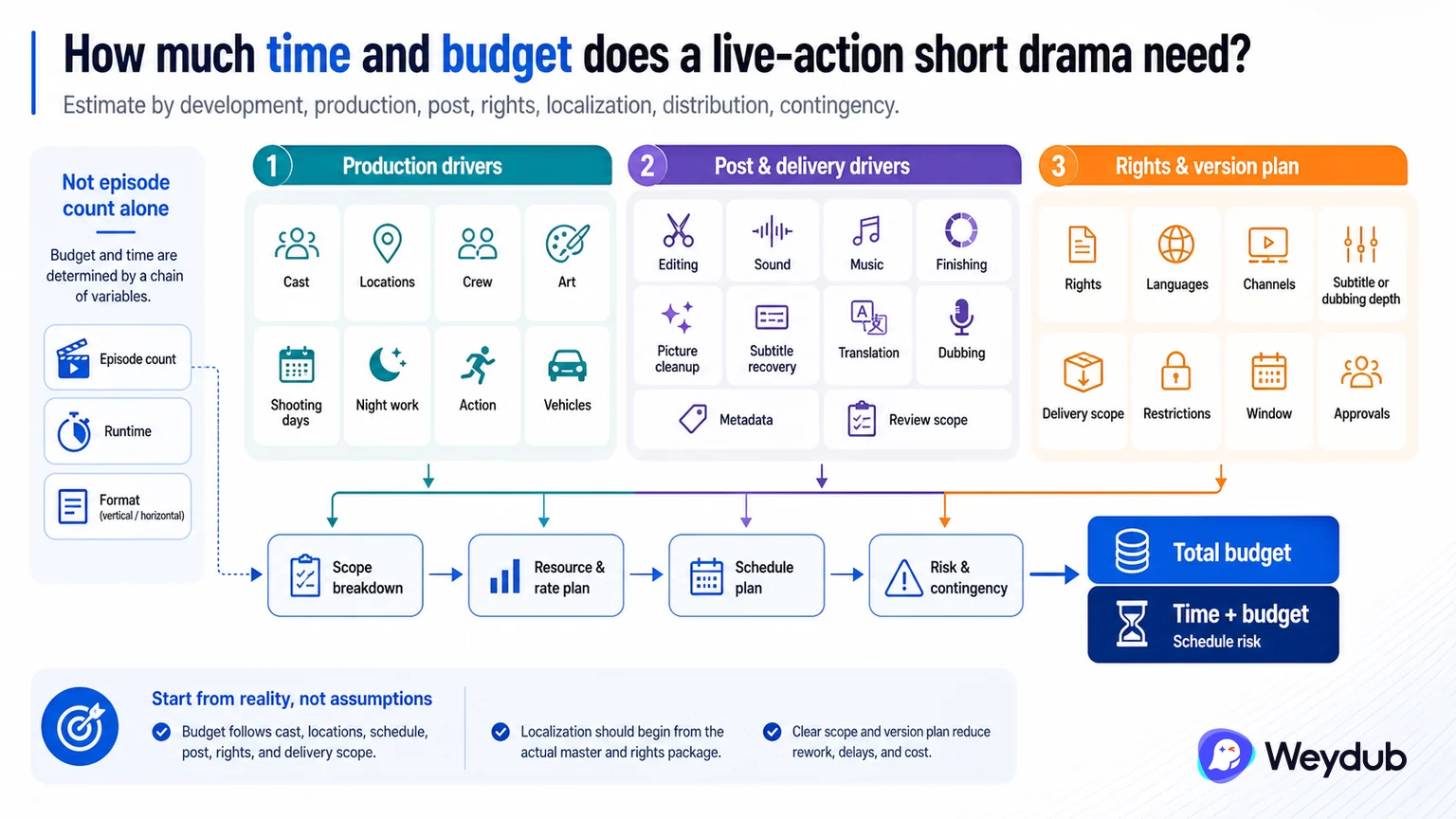
A useful estimate separates development, production, post, rights, localization, distribution, and contingency instead of using one per-episode number.
Key conclusions
- Budget follows cast, locations, schedule, post, rights, and delivery scope.
- Episode count alone does not explain production cost.
- A localization plan should begin from the actual master and rights package.
The cost of a live-action series depends on what the project must create and how reliably it must create it. Cast, locations, crew, art, shooting days, editing, music, finishing, and delivery can vary widely even when two projects have a similar episode count.
Schedule pressure changes cost as well. A compressed shoot may reduce calendar time while increasing crew or post-production risk. A rushed source master can also move cost downstream into subtitle recovery, picture cleanup, translation, dubbing, and rework.
For overseas release, add the rights and version plan early. The estimate should say which languages, channels, subtitle or dubbing depth, metadata, and review scope are included, rather than treating localization as an afterthought.
There is no single short-drama production price
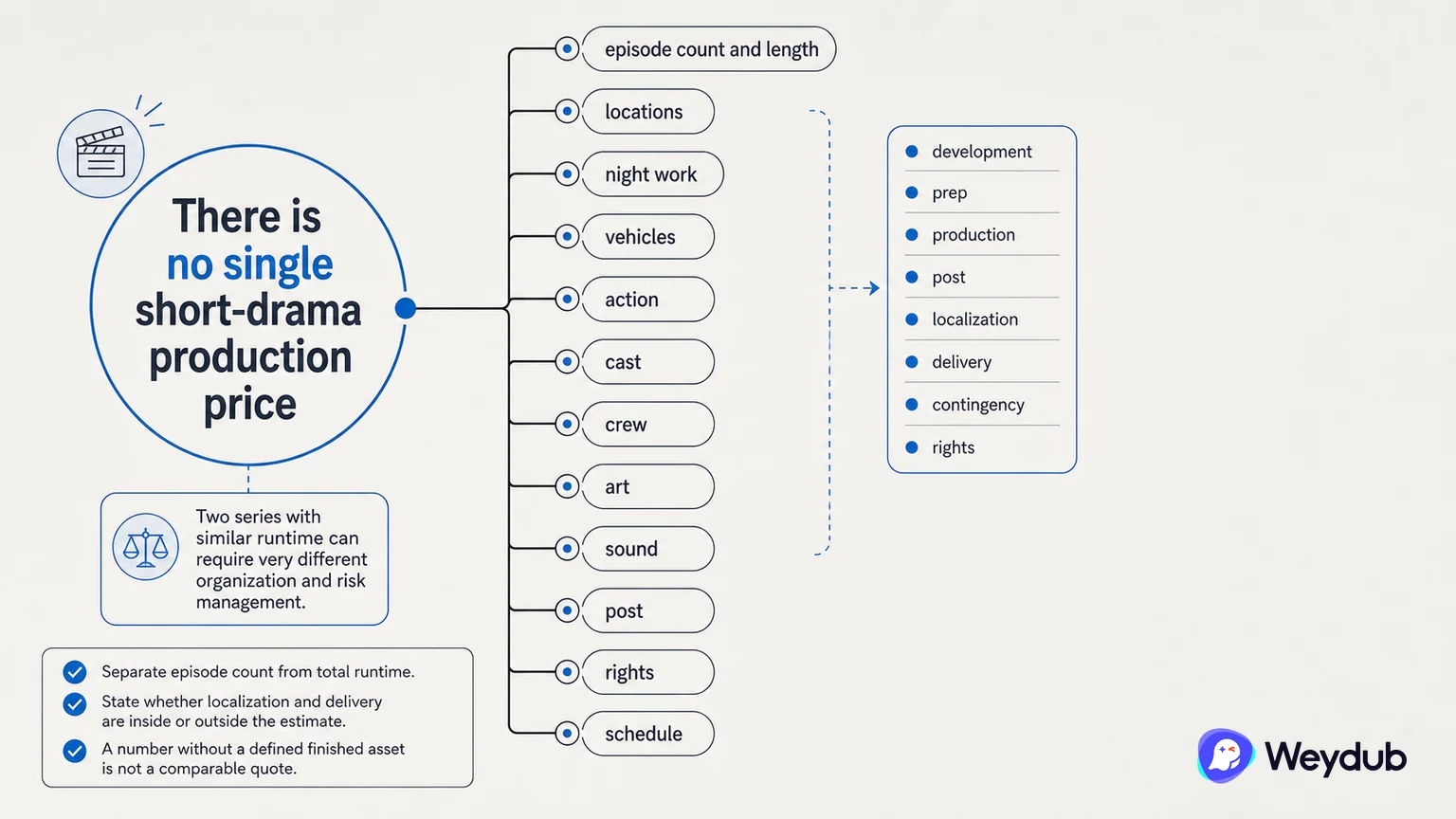
A total budget depends on episode count and length, locations, night work, vehicles, action, cast, crew, art, sound, post, rights, and schedule. Two series with similar runtime can require very different organization and risk management.
A useful estimate states what is included: development, prep, production, post, localization, delivery, contingency, and rights. A number without a defined finished asset is not a comparable quote.
- Separate episode count from total runtime.
- List locations, night work, action, cast, and post requirements.
- State whether localization and delivery are inside or outside the estimate.
Schedule is a dependency map
Shooting days are only one part of the schedule. Script readiness, casting, location availability, continuity, picture lock, subtitle and audio work, review, and channel delivery can create dependencies that appear late if they are not planned together.
The localization team benefits from a clean master, episode order, source audio, approved text, and rights information. Missing any of these can turn a post-production estimate into a rework schedule.
| Cost or schedule layer | Question | Evidence needed |
|---|---|---|
| Production | What must be shot and where? | Script, breakdown, locations, cast, crew |
| Post | What must be finished before language work? | Picture lock, audio, text, episode order |
| Localization | Which version depth is required? | Locale, subtitles, dubbing, picture, review |
| Delivery | What must each channel receive? | Rights, specs, metadata, package checklist |
Estimate with a representative episode
Use one ordinary episode and one difficult episode to test the assumptions. The sample should expose dialogue density, text in picture, action, music, emotional performance, and the amount of review needed. Then scale from measured work rather than a generic industry average.
- Define the finished deliverable and release scope.
- Break down ordinary and high-risk episodes.
- Estimate production, post, localization, review, and delivery separately.
- Add contingency for known dependencies and rights uncertainty.
- Reconcile the estimate against actual sample work.
Frequently asked questions
Can episode count alone estimate a short-drama budget?
No. Runtime, scene complexity, locations, cast, production conditions, post, rights, localization, and delivery all affect cost.
Should localization be planned after picture lock?
It can start after a stable master, but language, source text, audio, rights, and channel requirements should be considered earlier so the master is usable.
Related theme: Short-drama globalization
Weydub workflow
Take the next production step
Move from a market and source decision to a reviewable multi-episode localization workflow.