
ASR workflow
How to use ASR to rebuild subtitles from a clean master
Speech recognition can restore a timed source track when the picture is clean but the original subtitle or script is missing.
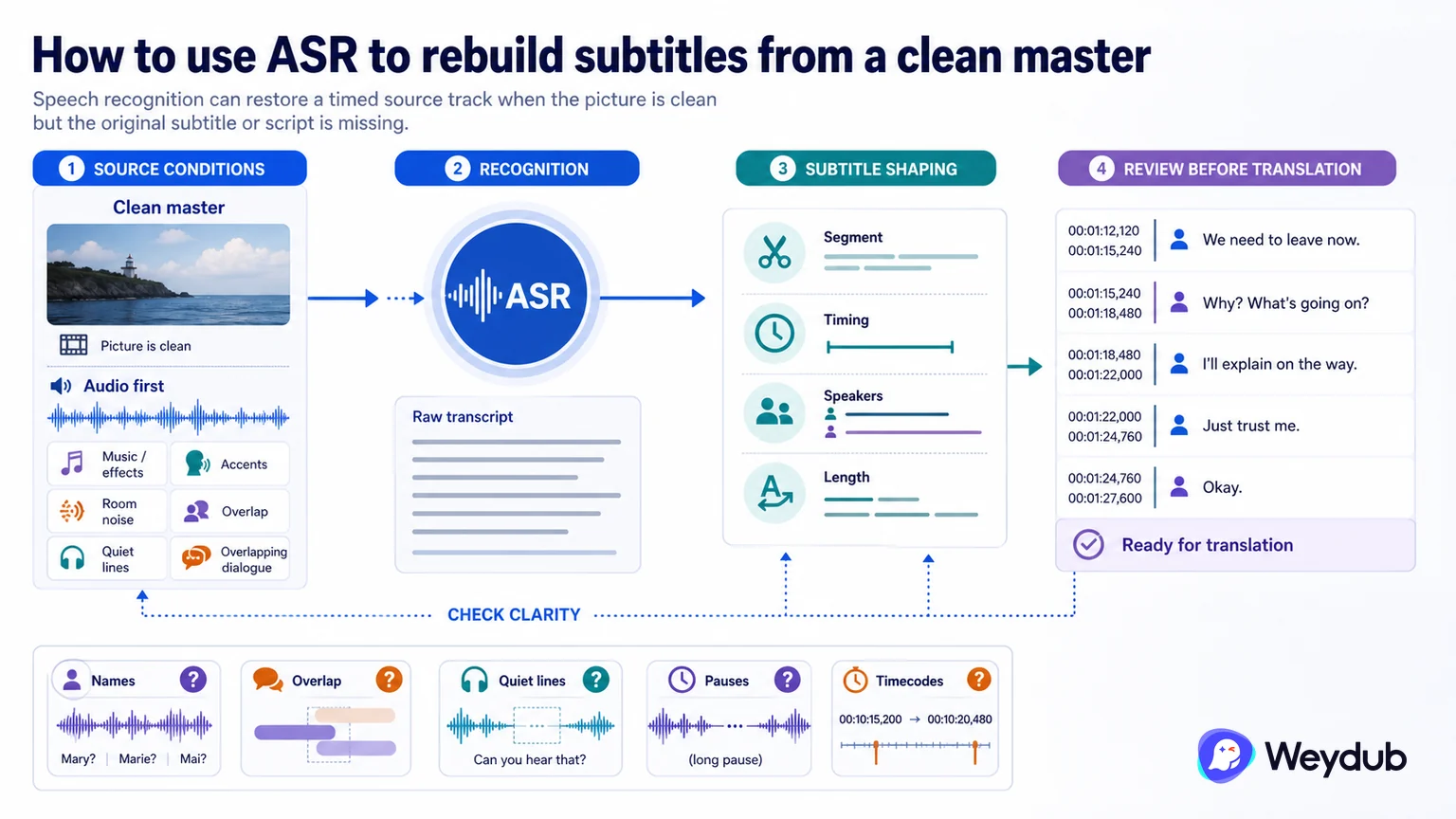
Key conclusions
- Inspect audio clarity, speakers, music, and language before recognition.
- Separate recognition from semantic segmentation and subtitle-length control.
- Review names, overlap, quiet lines, pauses, and timecodes before translation.
ASR starts from the audio track, not visible text. A clean master may still contain music, effects, room noise, accents, or overlapping dialogue that change recognition quality. Record the source conditions before treating the transcript as a reliable script.
The workflow should recognize speech, segment it into subtitle-ready units, assign timing and speakers where possible, and enforce readable length. A line that is technically recognized can still be badly timed or too dense for viewers.
Review the difficult parts deliberately: names, low-volume dialogue, simultaneous speech, song or effects overlap, and scene transitions. Preserve the source track and the corrected version as separate states before translation or dubbing.
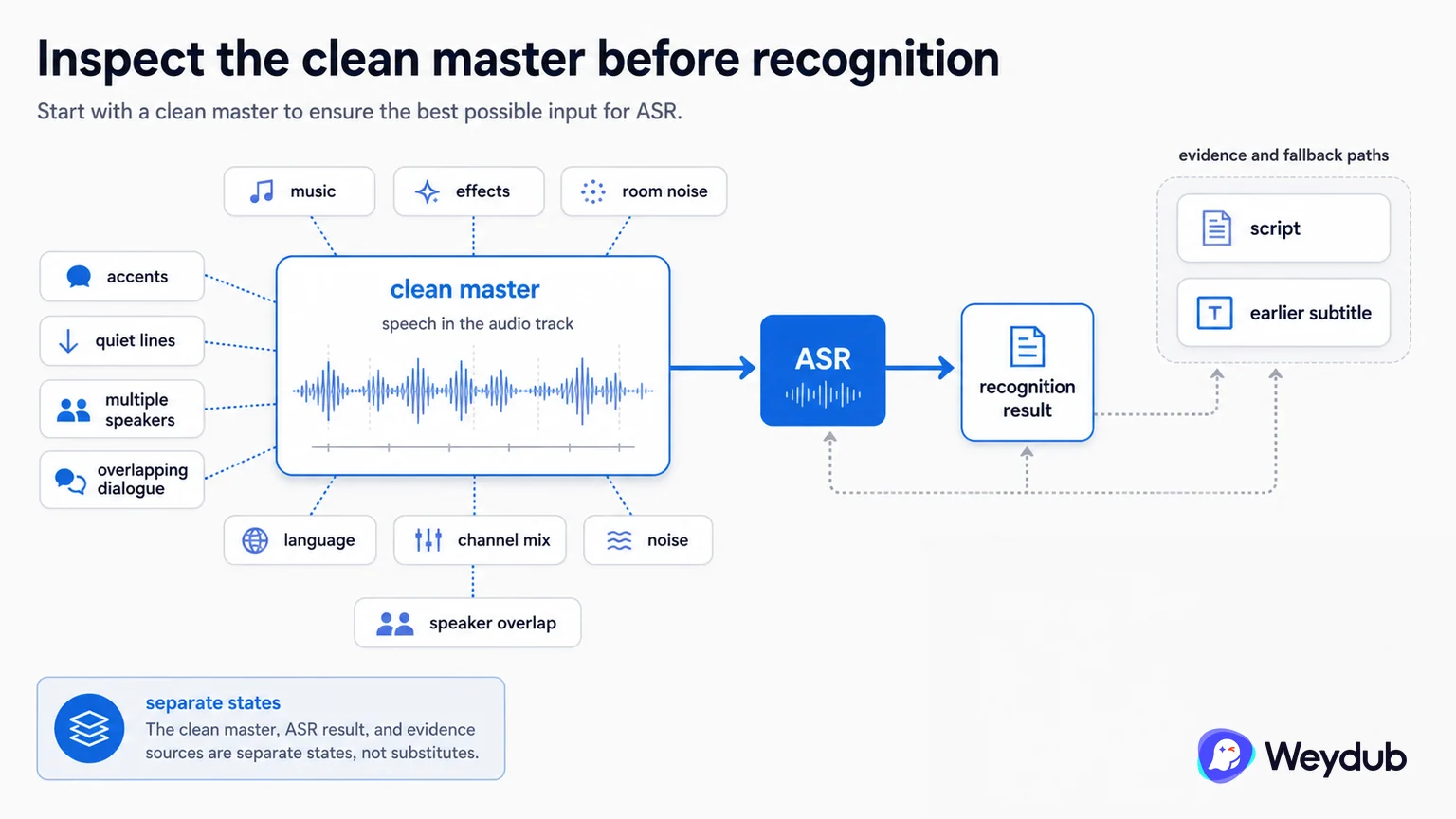
Inspect the clean master before recognition
ASR starts from speech in the audio track rather than text visible in the picture. A clean master may still include music, effects, room noise, accents, quiet lines, multiple speakers, or overlapping dialogue. These source conditions should be recorded before treating the transcript as a reliable subtitle source.
Keep the original audio and any supplied script separate from the recognition result. They are evidence and fallback paths, not interchangeable versions.
- Check language, channel mix, noise, music, and speaker overlap.
- Record whether a script or earlier subtitle exists for comparison.
- Preserve source audio and recognition output as separate states.
Separate recognition from subtitle construction
A transcript is not yet a subtitle track. The workflow must segment speech into meaningful, readable units, assign timing, handle speakers where possible, and control target-language density after translation. A fluent sentence can still be late, too long, or broken at the wrong phrase boundary.
Timing should be checked against speech, picture action, scene transitions, and neighboring cues. Preserve a correction path back to the recognized text rather than editing only the final burn-in.
| Stage | Question | Typical review focus |
|---|---|---|
| Recognition | What words are supported by the audio? | Names, quiet speech, overlap, noise |
| Segmentation | Where should a viewer read each cue? | Meaning, shot changes, pauses |
| Timing | When should the cue enter and leave? | Speech onset, duration, adjacent cues |
| Translation | Does the target line remain usable? | Terminology, density, locale, performance |
Review difficult cues before translation or dubbing
Names, low-volume dialogue, simultaneous speakers, songs, effects overlap, and scene changes are more likely to expose a weak source subtitle. Sample these deliberately instead of relying only on an average recognition score.
Once the source subtitle is corrected and approved, use it as the stable input for translation or dubbing. If uncertainty remains, record it and route the cue to a script, OCR, or human recovery path rather than hiding it in a downstream language file.
- Run recognition and preserve the raw result.
- Segment and time the source-language cues.
- Review high-risk audio and timing cases.
- Approve the source subtitle or mark a fallback.
- Pass the approved source into translation and dubbing.
Frequently asked questions
Can ASR replace a missing subtitle file automatically?
It can create a useful draft, but recognition, segmentation, timing, speaker attribution, and review are separate steps. The source conditions determine how much correction is needed.
Should ASR and OCR be fused into one hidden score?
Keep the evidence paths explicit. Audio and visible text solve different source problems and should be compared or combined only under a defined review policy.
Related theme: Localization capabilities
Weydub workflow
Take the next production step
Start with the source condition and choose a focused workflow for subtitle extraction, picture cleanup, or language production.