
Cost migration
When AI models get cheaper, does localization become cheaper or better?
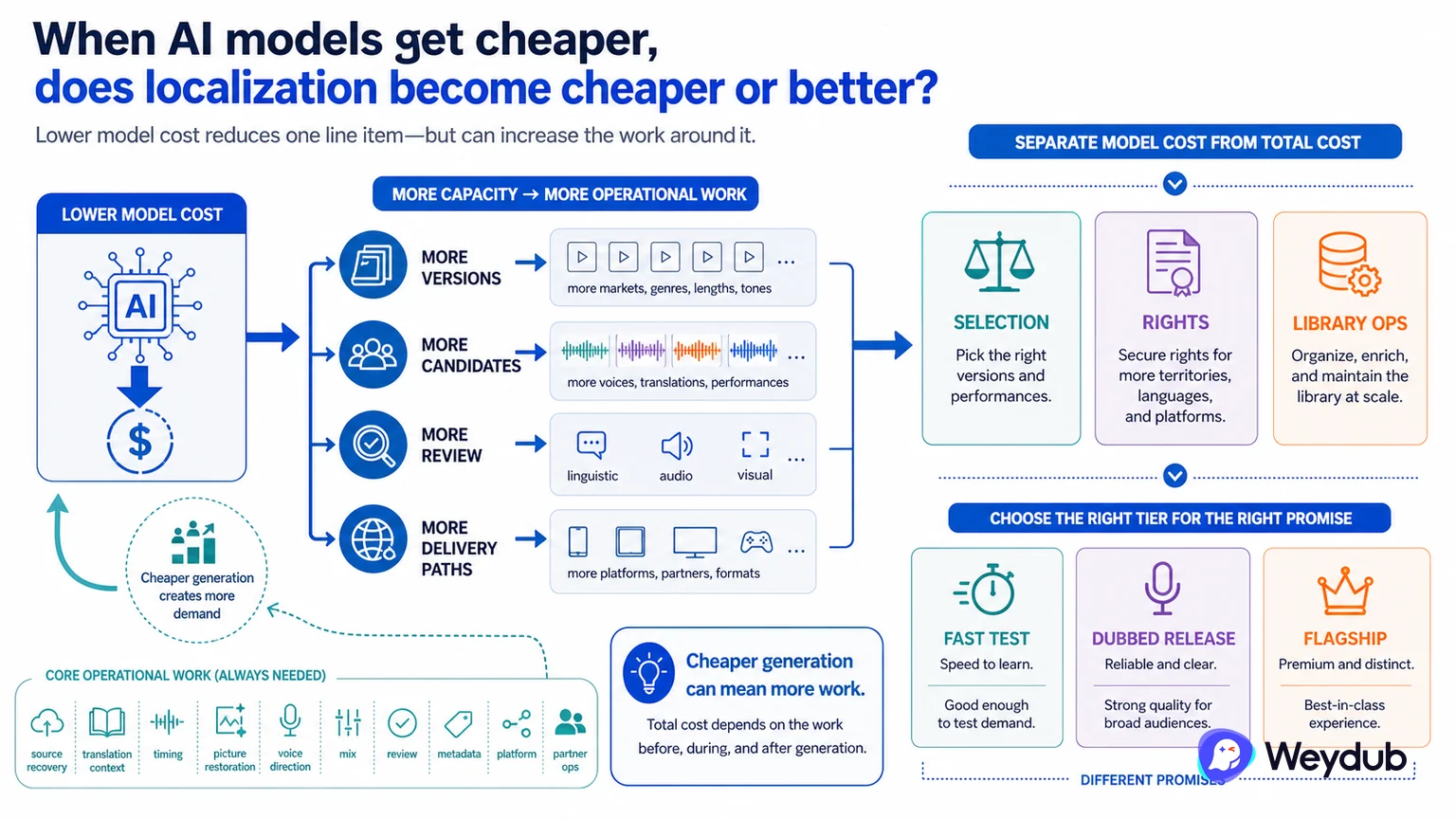
Lower model cost can reduce one line item while increasing the number of versions, candidates, reviews, and delivery paths a team must manage.
Key conclusions
- Separate model cost from total production and release cost.
- Expect savings to move toward selection, review, rights, and library operations.
- Use quality tiers and evidence rather than promising that cheaper always means better.
The model call is only one part of a localization project. Source recovery, translation context, timing, picture restoration, voice direction, mix, review, metadata, platform, and partner operations can remain significant even when generation becomes inexpensive.
Cheaper generation may also create more demand. A team can produce more language candidates and more channel versions, which increases the value of clear assets, failure isolation, sampling, and version lineage.
The right question is where the budget creates audience or operational value. A fast subtitle test, a focused dubbed release, and a flagship high-review version can coexist when their promises and acceptance criteria are explicit.
Lower model cost moves the budget
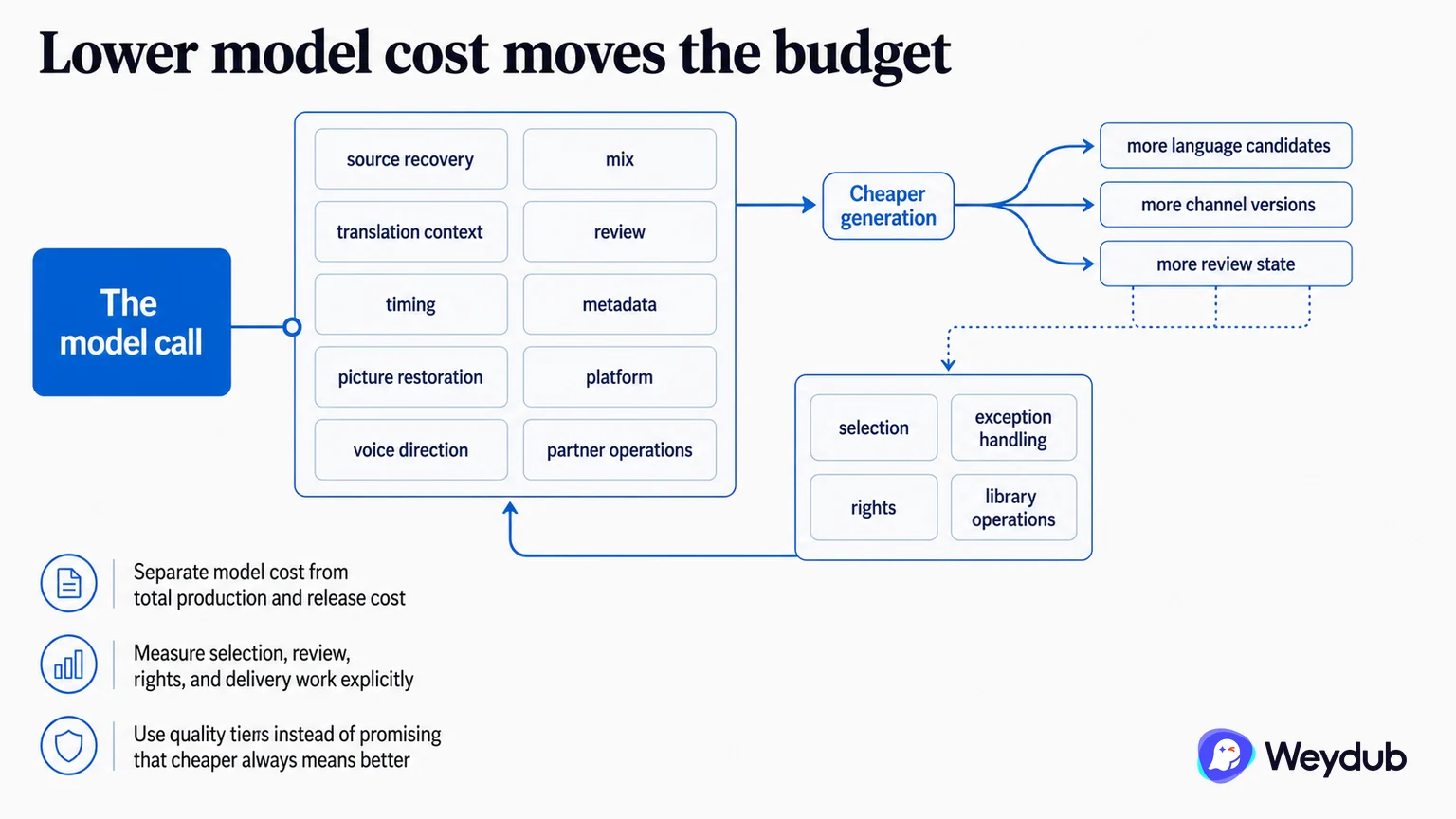
The model call is only one part of localization. Source recovery, translation context, timing, picture restoration, voice direction, mix, review, metadata, platform, and partner operations can remain significant even when generation becomes inexpensive.
Cheaper generation can also create more demand: more language candidates, more channel versions, and more review state. Savings may move toward selection, exception handling, rights, and library operations.
- Separate model cost from total production and release cost.
- Measure selection, review, rights, and delivery work explicitly.
- Use quality tiers instead of promising that cheaper always means better.
A lower unit price can increase total scope
A team may choose to create more versions because each draft is cheaper. That can be valuable when the audience or channel requires it, but it also increases naming, status, review, storage, rights, and package obligations. The total cost should include those effects.
| Cost movement | What may fall | What may rise |
|---|---|---|
| Generation | Model or task price | Number of candidates |
| Language | Draft creation | Review and exception handling |
| Delivery | Per-output transformation | Metadata, packages, and channel variants |
| Operations | Manual repetition | Lineage, rights, and library management |
Choose the quality tier that matches the release
A fast subtitle test, a focused dubbed release, and a flagship high-review version can coexist when their promises and acceptance criteria are explicit. The useful question is where the budget creates audience or operational value, not whether one model is universally cheaper.
- Define audience, channel, and quality promise.
- Measure the complete workflow cost.
- Set review and rights requirements for the tier.
- Compare accepted output rather than raw generation count.
- Reinvest savings where they improve release value.
Frequently asked questions
Does a cheaper model make the whole project cheaper?
Not necessarily. Review, rights, picture, sound, delivery, and version operations may remain or grow.
How should teams compare cost savings?
Compare accepted, delivered output and total operating cost, not only the price of one model call.
Related theme: Industry observations
Weydub workflow
Take the next production step
Apply the decision framework to a repeatable localization workflow with visible assets, tasks, and handoffs.